Chapter 1. Ecosystems, biomes and matter cycles
An environmental explanation needs both a mechanism and a boundary. Name the organisms, substances or reservoirs involved, then explain what moves or changes. Distinguish a stock, such as kilograms of carbon in soil, from a flow, such as kilograms of carbon entering the soil each year. A large stock need not have the largest annual flow.
1.1 Introduction to ecosystems
An ecosystem includes organisms and the physical conditions with which they interact. Light, temperature, water and soil chemistry are abiotic factors; food organisms, competitors, parasites and predators are biotic factors. A limiting resource can reduce survival or reproduction even when other resources are abundant. Competition occurs within a species as well as between species. Two bird species can reduce competition by feeding at different heights or times; this resource partitioning does not manufacture additional food.
Predation benefits the consumer while harming the prey. In parasitism, one partner obtains resources at the host's expense, often without immediately killing it. Mutualism benefits both partners. Commensalism describes a benefit to one with no substantial measured effect on the other. Classify the particular interaction supported by evidence rather than treating every interaction between the same two species as identical. A plant-pollinator relationship is mutualistic when nectar acquisition and increased plant reproduction are both demonstrated.
1.2 Terrestrial biomes
Temperature and the amount and seasonal timing of precipitation help explain broad vegetation patterns. Latitude, elevation, topography and ocean circulation modify those patterns. A climograph combines monthly precipitation with temperature; check both axes and the seasonal pattern before assigning a biome.
| Biome | Useful distinguishing conditions and vegetation |
|---|---|
| Tropical rainforest | Warm conditions and abundant rain through much of the year; layered broadleaf forest; rapid nutrient cycling. |
| Savanna | Warm grassland with scattered trees and pronounced wet and dry seasons; fire and herbivory matter. |
| Desert | Low precipitation relative to water loss; sparse drought-adapted vegetation; deserts can be hot or cold. |
| Temperate grassland | Seasonal temperatures and rainfall insufficient for widespread closed forest; grasses and often fertile organic-rich soils. |
| Temperate seasonal forest | Substantial seasonal temperature variation with enough moisture for broadleaf deciduous forest. |
| Temperate rainforest | Mild coastal conditions and very high precipitation; large evergreen trees are common. |
| Shrubland | Typically dry summers and wetter mild winters; drought- and fire-adapted shrubs. |
| Taiga or boreal forest | Long cold winters, shorter growing seasons and predominantly coniferous forest. |
| Tundra | Very short growing season, low-growing vegetation and, in much Arctic tundra, permafrost. |
These are broad patterns, not sharp borders. Soil, disturbance and local exposure can produce different communities under similar regional climate. Climate change can shift suitable conditions faster than some species can disperse.
1.3 Aquatic biomes
Distinguish freshwater systems from saline marine systems, then consider depth, flow, light, temperature, oxygen and nutrient availability. Streams and rivers transport materials downstream; lakes and ponds include shallow illuminated margins and deeper water where light may limit photosynthesis. Turbidity reduces light penetration even when the water is shallow. Seasonal mixing can redistribute oxygen and nutrients in lakes.
Estuaries mix river water with seawater and can provide productive nursery habitat. Salt marshes and mangrove wetlands slow water, trap some sediments and shelter organisms. Coral reefs support diverse communities but depend on particular light, temperature and water-quality conditions. Much of the open ocean has low productivity per square meter because nutrients are scarce, yet its enormous area makes its total production important. Upwelling can bring nutrient-rich deeper water to the illuminated surface. Do not infer productivity from depth or salinity alone; identify the limiting resource in the stated setting.
Marine phytoplankton, algae and photosynthetic microbes take up carbon dioxide while building organic matter and releasing oxygen through oxygenic photosynthesis. This makes marine production important to both carbon and oxygen cycling. Much of the organic matter is later respired or decomposed, consuming oxygen and returning carbon; gross production is not the same as permanent atmospheric oxygen accumulation or long-term carbon burial. Freshwater rivers, lakes and connected groundwater also support drinking-water supplies. Habitat condition can therefore affect both aquatic organisms and the quality and reliability of water used by people.
1.4 The carbon cycle
Photosynthesis incorporates inorganic carbon into organic molecules. Respiration by plants, animals and microbes returns much of that carbon as carbon dioxide. Decomposition moves carbon through food webs and can release carbon dioxide or, in some oxygen-poor environments, methane. Carbon also moves between the atmosphere and ocean through gas exchange. Sediments, carbonate rocks and fossil fuels can store carbon for far longer than an individual leaf or an atmospheric exchange event.
Combustion transfers carbon from fuel to the atmosphere rapidly. Deforestation can both release stored carbon and reduce subsequent uptake; the magnitude depends on what happens to the biomass and land. A forest can have a large carbon stock without being a strong net sink in every year. For a defined boundary and period, net stock change equals carbon entering minus carbon leaving. Draw arrows with processes on them, rather than drawing an unlabeled circle that implies every reservoir exchanges carbon equally quickly.
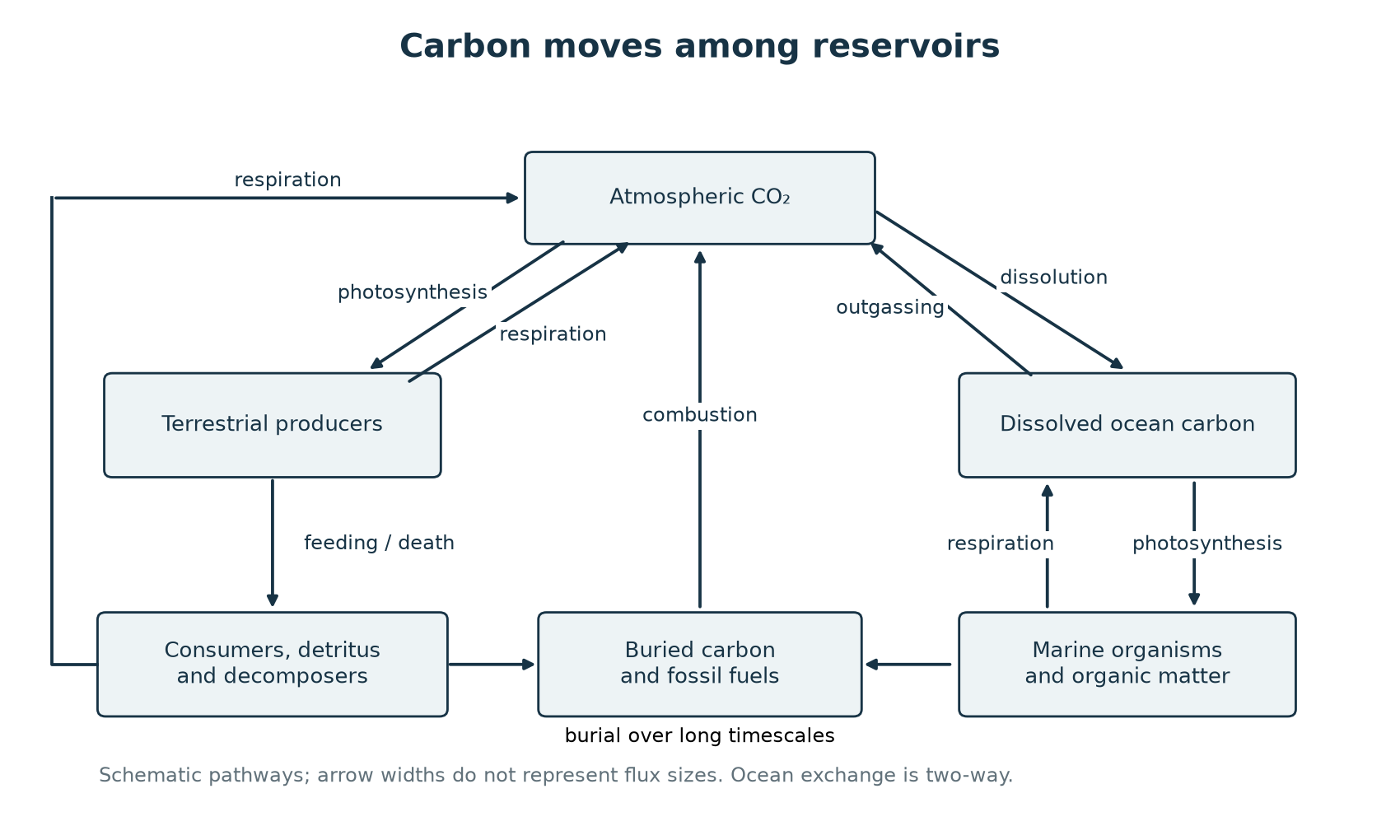
Carbon changes reservoirs through distinct processes. Gross photosynthesis is not permanent sequestration.
1.5 The nitrogen cycle
Atmospheric nitrogen gas is abundant, but most plants cannot use N2 directly. Nitrogen fixation converts it into biologically available compounds; certain microbes produce ammonia, which commonly forms ammonium in soil water. Plants assimilate ammonium or nitrate into organic molecules, and consumers acquire nitrogen through food. Ammonification releases ammonium from organic nitrogen during decomposition and waste processing.
Under suitable oxygenated conditions, nitrification oxidizes ammonium to nitrite and then nitrate. Denitrification follows a different pathway: in oxygen-poor environments, microbes can reduce nitrate to gaseous nitrogen products that leave the water or soil. These are branching transformations, not a mandatory conveyor belt that every nitrogen atom follows in order. Negatively charged clay and humus tend to retain ammonium ions more readily than nitrate ions, so nitrate can leach with drainage water. Fertilizer increases available nitrogen, but crop uptake, runoff, leaching and gaseous losses determine where it ultimately goes. Keep a budget in elemental nitrogen units when the question asks for kg N.
The atmosphere is the largest readily identified reservoir in the biological nitrogen-cycle model, mostly as N2. Its abundance does not prevent nitrogen limitation: most producers cannot directly use that gas, so the supply of available ammonium or nitrate can limit growth. Specify the nitrogen form and conversion process instead of equating abundant atmospheric nitrogen with abundant usable fertilizer.
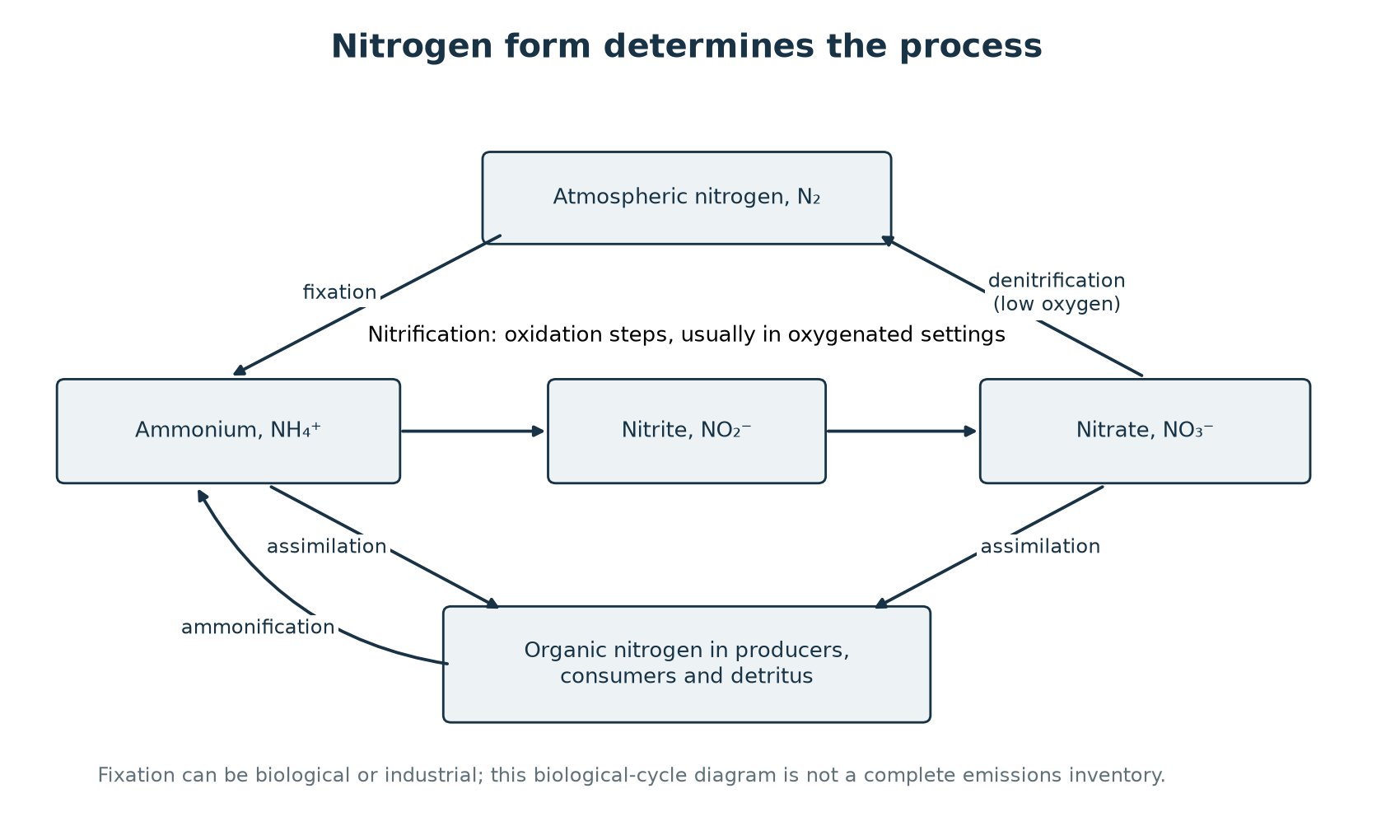
Fixation, nitrification, assimilation, ammonification and denitrification connect different nitrogen forms.
1.6 The phosphorus cycle
Weathering releases phosphorus from minerals. Producers take up phosphate, consumers obtain phosphorus in food, and decomposition returns it to soil or water. Erosion and runoff can transport phosphorus to lakes and oceans, where sedimentation and burial may store it for long periods. Unlike the nitrogen cycle, this ordinary cycle has no major atmospheric reservoir or large gaseous return pathway. That qualification does not mean that a phosphorus-containing gas can never exist.
Slow weathering can limit the supply available to organisms. Additional phosphorus can stimulate production where it is the limiting nutrient, especially in many freshwater systems. A wetland can retain particle-bound phosphorus through sediment trapping and can retain some dissolved phosphorus through sorption or uptake. Retention is not limitless or necessarily permanent: saturation, erosion, decomposition or changed chemistry can release stored phosphorus. Explain both the mechanism and the conditions under which a proposed nutrient-removal strategy works.
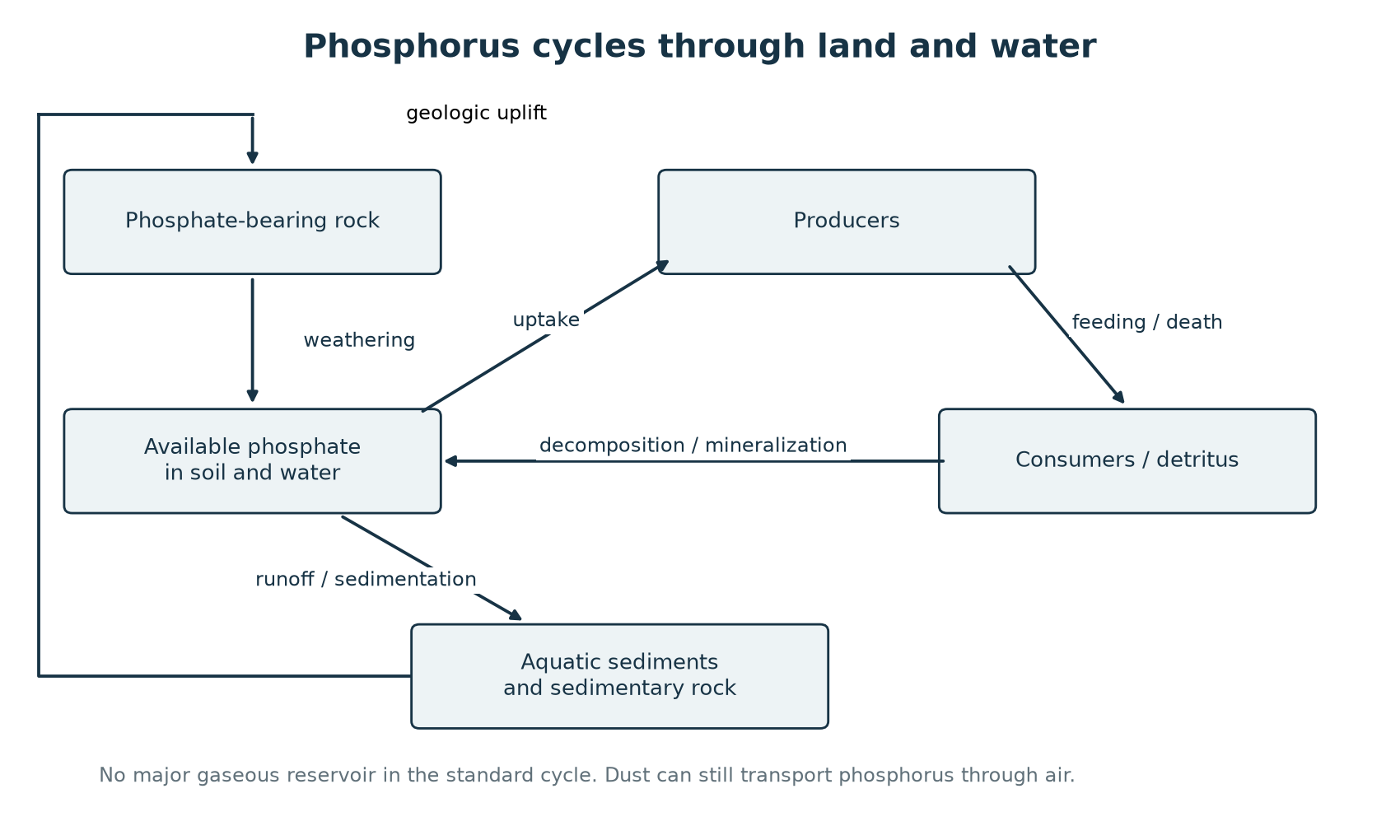
Phosphate uptake and recycling operate faster than much of the rock-forming and uplift cycle.
1.7 The hydrologic cycle
Solar energy drives evaporation and contributes to transpiration from vegetation; gravity drives precipitation, runoff and movement through the ground. Condensation forms droplets or ice crystals in clouds. Infiltration moves water into soil, while percolation can carry it deeper toward an aquifer. Groundwater may later discharge to a stream or spring. Most surface water is in the oceans, while a much smaller freshwater share is stored in ice, groundwater and surface waters.
The route matters. Paving can reduce infiltration and increase rapid runoff, even when the total rainfall is unchanged. Removing vegetation can change both interception and transpiration. For a bounded watershed over a stated period, precipitation and other inputs equal outflow plus evapotranspiration plus the change in storage. A calculation that omits storage must either justify that omission or state it as a simplifying assumption. A depth of water becomes a volume only after multiplication by area.
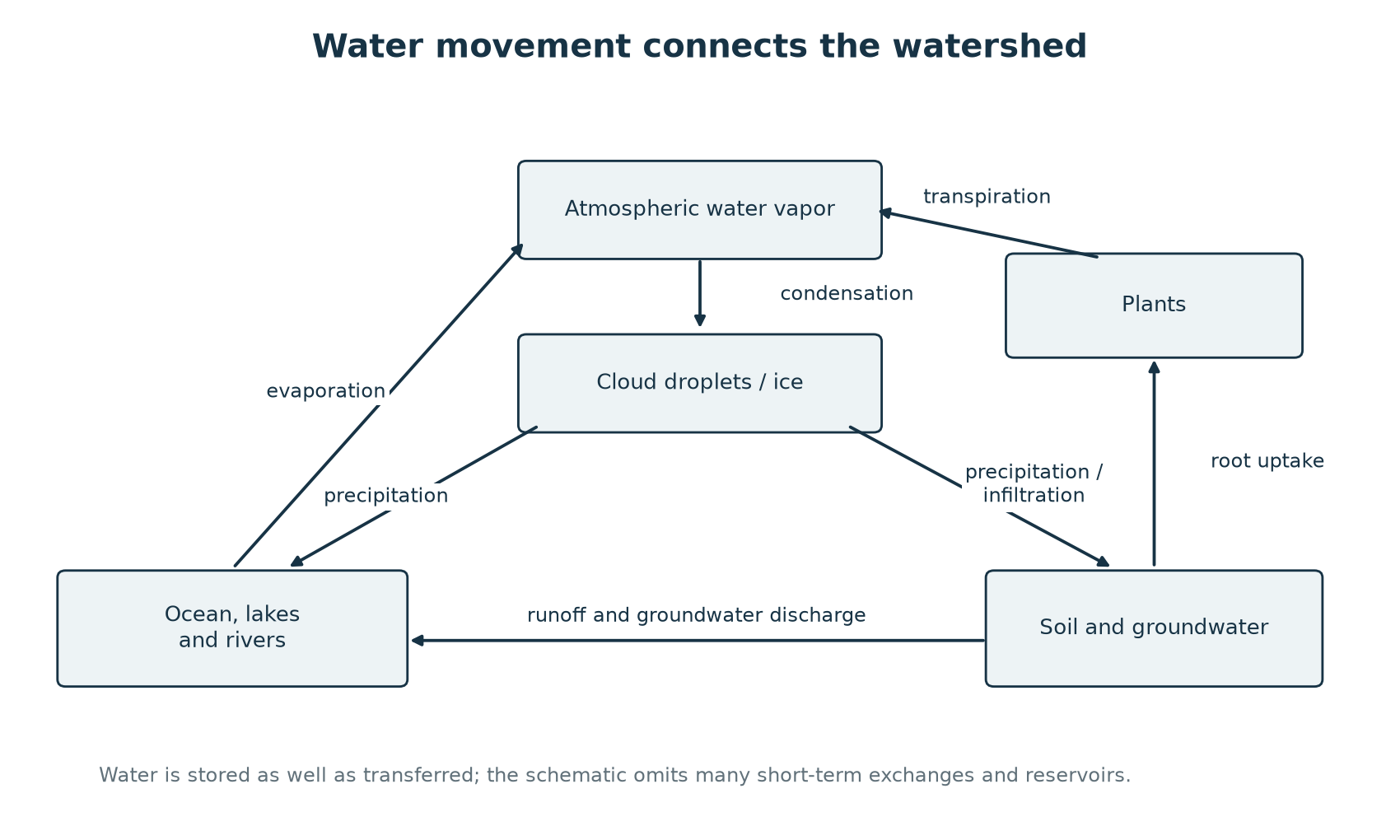
Evaporation and transpiration return water to air; precipitation, infiltration and flow connect storage compartments.
Worked example: a nutrient budget
A hypothetical 30-ha field receives 80 kg N per hectare in one season. Plants incorporate 55% of the applied nitrogen, 25% remains in specified soil storage, and the rest leaves in drainage. The input is 30 × 80 = 2,400 kg N. Plant uptake is 1,320 kg N and soil storage is 600 kg N. The remaining fraction is 20%, giving 480 kg N in drainage. The check is 1,320 + 600 + 480 = 2,400. If a treatment removes 40% of that drainage nitrogen, removal is 192 kg N and discharge is 288 kg N. The 40% applies to the drainage load, not to the original field input.
Worked example: water depth to volume
A 0.5-ha paved area receives 20 mm of rain. Under a simplified assumption of no infiltration, evaporation or storage, runoff volume is 5,000 m² × 0.020 m = 100 m³. Reporting 100 mm would confuse a volume with a depth. In a real drainage design, runoff losses and storage would need measurement or justified estimates.
When revisiting a missed question, sketch the relevant reservoirs, label each arrow and write the units before calculating. Use the printed chapter practice; the companion page identifies whichever online resources are currently available.