Chapter 14. Toxicity, waste and environmental health
Hazard describes a capacity to cause harm; exposure describes contact with the hazard. Risk depends on both, along with dose, route, timing and susceptibility. A study can measure mortality, reproduction, development or another endpoint, and those outcomes should not be silently substituted for one another.
8.3 Endocrine disruptors
Endocrine-disrupting chemicals interfere with hormone signaling, for example by mimicking a signal, blocking a receptor or altering hormone production or transport. Effects can involve development, growth or reproduction. Timing matters because exposure during a sensitive developmental stage can differ from the same nominal exposure later in life.
A study showing fewer viable eggs in exposed fish can support a reproductive-effect claim even if no fish die. It does not, by itself, establish the exact molecular mechanism or predict every human effect. Use appropriate controls, replicated exposure groups and measured endpoints. Do not assume that an acute mortality test is sufficient to detect all endocrine effects or that absence of death means absence of harm.
Possible endocrine-related endpoints include altered reproductive development, changed sex ratios or developmental malformations in susceptible organisms. The substance, dose, exposure timing, species and measured endpoint must be specified; one response in one test does not establish every effect in every population. An absence of mortality is therefore not evidence that reproductive or developmental function is unchanged.
8.7 Persistent organic pollutants
Some organic pollutants resist environmental breakdown and remain long enough to travel widely. Many important examples, including certain PCBs and DDT-related compounds, are fat-soluble and can be stored in tissues. Persistence depends on molecular properties and conditions; being synthetic or carbon-based alone does not make every compound persistent.
Transport by air, water and organisms can move pollutants far from their original release. Reducing new emissions may not immediately eliminate stored contamination in soil, sediment or organisms. A management plan may need source control and careful treatment of reservoirs. Compare persistence, mobility and toxicity separately: a substance can be highly toxic without lasting long, or persistent without having the same toxicity as another persistent substance.
8.8 Bioaccumulation and biomagnification
Bioaccumulation is buildup within an organism when uptake exceeds elimination over time. Uptake may occur from food, water or other contact. Biomagnification is an increase in tissue concentration across successive trophic levels. It is favored for substances that are sufficiently persistent and retained; it is not a universal property of every pollutant.
Use comparable tissue and concentration units when evaluating a food-chain table. A higher total contaminant mass in a large animal is not automatically a higher concentration. There is no fixed rule requiring a tenfold concentration increase at each level; the ecological 10% energy approximation is a different idea. Effects can include reproductive and developmental harm in predators, but the endpoint depends on the substance and exposure.
Specific substances produce specific effects. DDE, a persistent breakdown product of the insecticide DDT, can accumulate through food webs and interfere with eggshell formation in susceptible birds, contributing to thinner shells and reduced reproductive success. This history is especially associated with exposed predatory birds; it does not mean that every pesticide has the same persistence or eggshell effect.
Methylmercury is an organic mercury form that can accumulate in aquatic food webs, creating exposure through contaminated fish and shellfish. It can harm the nervous system, and exposure during development is especially concerning. That route differs from inhaling elemental mercury vapor; the name mercury alone does not specify the form, pathway or endpoint. Tissue basis, diet, exposure duration and elimination help explain concentrations, so no fixed multiplication factor applies at every trophic transfer.
8.9 Solid waste disposal
Engineered landfills use liners, leachate collection, covers and gas management to reduce releases. Leachate is liquid that has passed through waste and can carry contaminants. Oxygen-poor decomposition can produce methane, which may be captured and used or flared. Controls reduce risk but require maintenance and monitoring; they do not make all waste disappear or eliminate every possible leak.
Incineration reduces waste volume and can recover energy, but produces ash and requires air-pollution controls. Electronic waste can contain valuable materials and hazardous substances, making appropriate collection and processing important. Discarded tires can hold water and create vector habitat. Ocean debris can entangle or be ingested by wildlife; accumulation zones are not necessarily solid islands that can simply be lifted away. Follow the material's fate rather than equating disposal with destruction of matter.
An engineered sanitary-landfill cell separates several flows. A low-permeability bottom-and-side liner can combine compacted clay with a synthetic membrane. Above it, drainage material and collection pipes collect leachate—water that has contacted waste and mobilized contaminants—for removal and appropriate treatment. A cover or cap reduces infiltration and limits access, while surface stormwater drains aim to route relatively clean runoff around or off the waste area without mixing it with leachate. Water quality still needs checking; a stormwater label is not proof that every runoff sample is uncontaminated.
Separate gas wells and pipes collect landfill gas formed during decomposition, commonly containing methane and carbon dioxide, for treatment, controlled flaring or suitable energy use. Gas collection does not replace leachate collection. Monitoring wells and continued inspection can detect failures or migration; liners, caps and gas systems reduce particular risks but are not a guarantee of zero leakage. The instructional cross-section shows the physical arrangement and the different destinations of runoff, leachate and gas.
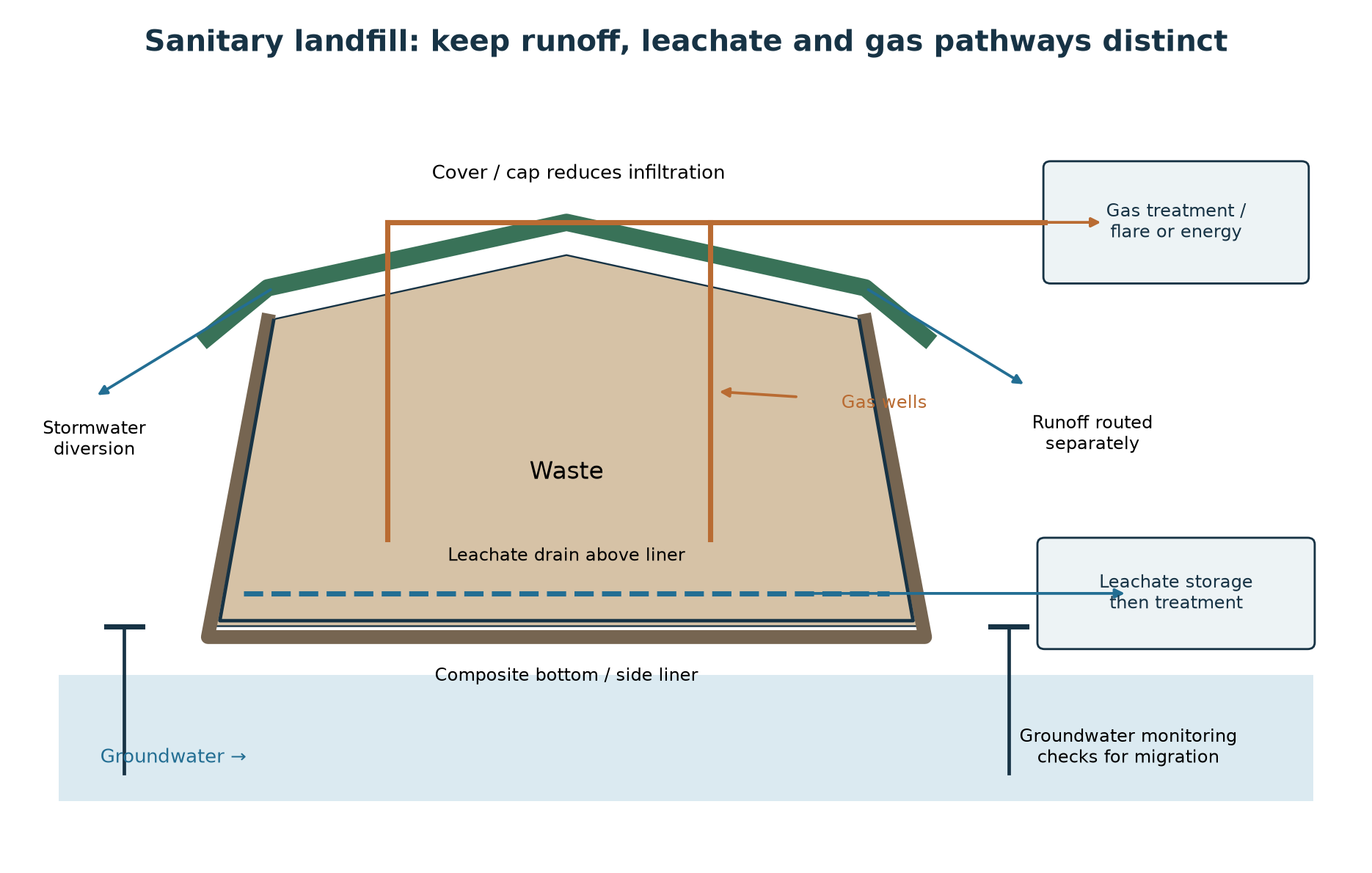
Schematic arrangement separates surface runoff, liquid that contacted waste, and decomposition gas. Liners and controls reduce risk; monitoring and maintenance remain necessary.
8.10 Waste reduction methods
Source reduction avoids creating waste, reuse extends an item's service, and recycling processes material into new products. They address different stages. Recycling can reduce virgin extraction, but contamination, collection, processing energy and usable yield determine the result. Collecting a tonne for recycling does not guarantee a tonne of finished material.
Composting manages biological decomposition of suitable organic material, ideally with adequate air and moisture. It can return organic matter to soil, but poor management can create odors, pests or oxygen-poor conditions. Repair and reuse of electronics can extend product life, followed by appropriate recovery of materials. Capturing landfill gas can reduce methane release and supply energy; it is not equivalent to preventing the waste or proving that all landfill contents are rapidly shrinking.
Some closed landfill sites can support carefully planned habitat or recreation after capping, but reuse must preserve the engineered cover and accommodate settlement, gas collection, leachate control and monitoring. Closure changes land use; it does not end decomposition or automatically remove every exposure pathway.
8.12 Lethal dose 50%
LD50 is the dose associated with death in 50% of a specified test population under specified conditions. It is commonly expressed relative to body mass, such as mg of substance per kg of organism. To translate a stipulated dose to an amount, multiply by body mass in matching units. The result is not a prediction that a particular individual must die.
Comparing lower and higher LD50 values is informative only when relevant test conditions, species, route and duration are comparable. Acute lethality does not measure every chronic, developmental or ecological effect. If a graph reports concentration in water rather than dose per body mass, it is a different quantity and cannot be converted to an ingested dose without exposure information.
8.13 Dose-response curves
A dose-response curve plots an endpoint against exposure or dose. Check whether the vertical axis is mortality percent, growth, reproduction or another measure, and whether the horizontal scale is linear or logarithmic. A threshold-like pattern suggests little measured effect below a range under that test, but limited sampling and measurement sensitivity constrain the conclusion.
Interpolate only when the data and requested precision justify it. Do not extend a line far beyond tested doses as though its behavior were known. Responses can depend on age, exposure duration and mixtures. To compare treatments, use the same endpoint and conditions, and include a control. Zero observed mortality at one dose cannot establish that all possible effects are absent there.
8.14 Pollution and human health
Link exposure to a plausible pathway and a measured outcome. Inhaled asbestos fibers are associated with mesothelioma and other disease; elevated ground-level ozone can impair respiratory function. Pathogens in sewage-contaminated water can cause gastrointestinal illness, including some forms of dysentery. These examples involve different agents and routes, so a particle filter, water treatment and emission reduction do not solve the same problem.
Establishing causation in human populations can be difficult because exposures, behavior and living conditions overlap, and effects may appear after long delays. Well-designed observational studies can provide valuable evidence, but a raw correlation is not enough to identify one cause uniquely. Ethical research does not require deliberately assigning harmful exposures. Evaluate controls, comparison groups, dose measures and alternative explanations before extending a finding beyond the study.
8.15 Pathogens and infectious diseases
A pathogen causes disease; a vector carries a pathogen between hosts. Climate can change where some vectors survive, but transmission also depends on hosts, habitat, infrastructure, behavior and public-health capacity. A warmer season does not guarantee an outbreak. Clear-looking water or a clean-looking building does not prove the absence of pathogens.
| Example | Agent and environmental transmission connection |
|---|---|
| Cholera | A bacterial disease often transmitted through contaminated water or food; safe water and sanitation interrupt the pathway. |
| Tuberculosis | A bacterial infection spread through airborne particles from a person with infectious disease; it is not a mosquito-borne illness. |
| Malaria | A parasitic disease usually transmitted through infected Anopheles mosquitoes. |
| West Nile disease | A viral infection commonly transmitted to people by infected mosquitoes. |
| Zika | A viral infection transmitted by certain mosquitoes and also through sexual transmission and other documented routes. |
| Plague | A bacterial disease associated with infected animals and fleas; transmission pathways vary with the form of disease. |
| SARS | A viral respiratory disease; close-contact respiratory transmission was important in its outbreaks. |
| MERS | A viral respiratory disease with animal-to-human and person-to-person transmission in particular settings. |
The table identifies mechanisms for environmental comparisons, not a complete clinical description. Inadequate water, sanitation, housing and access to care can increase exposure and impede response; those structural conditions should not be confused with a claim that a disease belongs to a particular group of people.
WHO identifies the African Region, especially sub-Saharan Africa, as carrying the greatest malaria burden. Malaria is caused by Plasmodium parasites and transmitted mainly through infected Anopheles mosquitoes; it is not confined to Africa, and changes in climate alone do not determine local transmission without vectors, parasites, hosts and suitable exposure conditions.
Plague is a bacterial disease whose routes differ by form and exposure: infected flea bites and contact with infected animal tissues can transmit infection, while pneumonic plague can spread through infectious respiratory droplets in close contact. MERS is a coronavirus disease linked to dromedary camels, with person-to-person transmission possible in close-contact settings. Distinguish reservoir, vector, pathogen and route rather than calling every disease waterborne or assuming all forms share one transmission pathway.
Worked example: a stipulated dose
A laboratory problem gives an LD50 of 18 mg/kg for a specified test and an organism mass of 0.25 kg. The corresponding amount is 18 × 0.25 = 4.5 mg. Dividing by 0.25 would produce units inconsistent with the requested amount. The calculation does not establish a safe dose, an individual outcome or a value for another species.
Worked example: actual recovered material
A program collects 80 tonnes of discarded material. If 15% is rejected as contamination and processing recovers 90% of the accepted mass, usable output is 80 × 0.85 × 0.90 = 61.2 tonnes. The 80-tonne collection figure is not the final recycled yield. A full comparison would also consider transport, processing and displaced virgin material.
For a missed toxicity item, underline the endpoint, organism, route, dose unit and time. These details define what the evidence can support.