What to practice
- Split a velocity into components and treat horizontal and vertical motion separately, linked only by time.
- Find the time of flight, range and landing speed of a projectile launched from level ground or from a height.
- Add velocities as vectors to compare motion seen from different reference frames.
Framework
Horizontal: x(t) = (v_0 cos θ)·t, v_x = v_0 cos θ (a_x = 0) | Vertical: y(t) = y_0 + (v_0 sin θ)·t - (1/2)g·t², v_y = v_0 sin θ - g·t
Two-dimensional motion is two one-dimensional problems that share a clock. Split every velocity into components first. For a projectile the horizontal velocity stays constant, the vertical motion has acceleration g downward, and the time in the air comes from the vertical motion alone. Motion also depends on the observer, so velocities measured in different reference frames add as vectors.
A useful setup is a two-column table, with one column for horizontal quantities and one for vertical quantities. The only thing the columns share is the time. Find the time from the vertical column, then carry it across to the horizontal column. A ball dropped and a ball launched sideways from the same height land together because their vertical motion is identical.
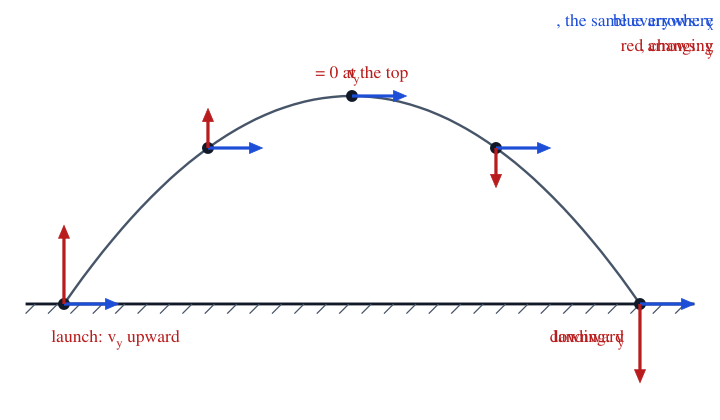
For a launch at angle θ above the horizontal, v_x = v_0 cos θ and the starting vertical velocity is v_0 sin θ. At the top of the path the vertical velocity is zero, but the speed is not. The object keeps its horizontal velocity, and its acceleration is still g downward. From level ground, the time up equals the time down, and launch angles that add to 90° give the same range.
For relative motion, add velocities as vectors. If a boat points straight across a river, the current carries it downstream without changing how long the crossing takes, because the two perpendicular motions do not affect each other.
On the exam: never put a horizontal speed into a vertical equation, and be ready to explain why the time of flight depends only on the vertical motion.
Worked AP Physics 1: Algebra-Based Problem: 2D Kinematics: Vector Components, Projectile Motion, and Relative Velocity
A projectile is launched horizontally at v_0x = 15.0 m/s from the edge of a cliff of height H = 45.0 m above level ground (take g = 10.0 m/s²). Find (a) the time of flight, (b) the horizontal range R, and (c) the impact speed.
Step 1 (Vertical Free-Fall Time): Since v_0y = 0, H = (1/2)g·t² → 45.0 = 0.5(10.0)·t² = 5.0t² → t² = 9.0 → t = 3.0 s.
Step 2 (Horizontal Range): Because a_x = 0, R = v_0x·t = (15.0 m/s)(3.0 s) = 45.0 m.
Step 3 (Vertical Velocity at Impact): v_y = -g·t = -(10.0 m/s²)(3.0 s) = -30.0 m/s.
Step 4 (Total Impact Speed via Pythagoras): v = √(v_x² + v_y²) = √(15.0² + (-30.0)²) = √(225 + 900) = √(1125) = 33.5 m/s.
Horizontal and vertical motions of a projectile are independent, linked ONLY by the shared time of flight t.
Practice procedure
Build a two-column table [Horizontal (a_x = 0) | Vertical (a_y = -g)] and never mix horizontal speeds into vertical equations.
Common mistakes
Saying the total velocity at the apex of an angled trajectory is zero (only v_y = 0; v_x = v_0 cos θ remains nonzero).
Thinking a faster horizontal launch stays in the air longer. Horizontal speed changes where the object lands, not when it lands.
Thinking the acceleration is zero at the top of the path. It is g downward at every point.
Key terms
Term: Projectile Motion
Definition: Two-dimensional motion with constant horizontal velocity (a_x = 0) and constant vertical downward acceleration (a_y = -g).
Term: Trajectory Apex
Definition: Highest point of a projectile's path where vertical velocity v_y = 0 and speed equals v_0 cos(θ).