What to practice
- Interpret the diagnostic by error and choose a prerequisite repair
What thirty-six questions can tell you
The diagnostic samples all eight units. Each unit's share of the 36 questions, and each mathematical practice's share, falls inside the official multiple-choice ranges (unit and practice weightings). Every question has one primary practice: carry out a process (P1), connect representations (P2) or justify a conclusion (P3). These are the three practices that multiple-choice questions assess; the fourth, communicating with correct notation (P4), is assessed only in free response, and written-task rubrics mark its points.
Its one job is choosing where to start. It cannot certify mastery or predict an AP score, so no score conversion is given. It also tests calculus you may not have studied yet, which is expected: an unstudied topic is a scheduling fact, not a weakness.
Take it under honest conditions
- Part A, Questions 1–24: no calculator. Allow about 51 minutes, the exam's Part A pace.
- Part B, Questions 25–36: graphing calculator required. Allow about 35 minutes. Set radian mode first and keep unrounded values until the final answer (Chapter 23). Most decimal choices are rounded to the nearest thousandth; Question 34 asks for the nearest whole number.
- Use the printed 36-row answer sheet that opens the practice: rows numbered 1–36, each with circles A–D, three rows to a line. Fill one circle per row.
- Mark “not yet learned” instead of guessing. If you have not studied a question's topic, write N on its row and move on. A lucky guess hides a gap; an N simply waits for its chapter.
- Beside every answer, write C (confident), U (unsure) or G (guess).
- Use no notes, and score nothing until all 36 rows are filled.
Questions 12–13 share Figure D4, and 17–18 share Figure D5. Question numbers match item IDs: Question 7 is APCAL-D-M07.
Score by unit and by practice
Mark each row correct, miss or N. A miss means you attempted the question and chose wrongly.
| Unit | Questions | Misses | N |
|---|---|---|---|
| 1 Limits and continuity | 1–3, 25 | ||
| 2 Derivatives | 4–6, 26 | ||
| 3 Composite and implicit | 7, 8, 27 | ||
| 4 Contextual rates | 9, 10, 28, 29 | ||
| 5 Analyzing functions | 11–15, 30, 31 | ||
| 6 Integrals | 16–19, 32, 33 | ||
| 7 Differential equations | 20, 21, 34 | ||
| 8 Applications of integrals | 22–24, 35, 36 |
Practice counts are 22 P1, 8 P2 and 6 P3; the map below lists each question's practice. Read the explanation for every miss and every U or G answer, then give each miss one of Chapter 1's error codes.
Separate “not yet” from “learned wrong”
Apply these rules in order.
- Confident misses come first. A wrong answer marked C is a rule you believe and will repeat.
- Prerequisite errors come next. An ALGEBRA or DOMAIN code, or a degree-mode answer, travels into every unit. Work the matching repair below before new chapters.
- A practice pattern points to Chapter 22. P3 misses in two or more units usually mean your reasons skip a condition; study justification early.
- Two misses in one unit point to its chapters. Study them fully before their practice.
N rows need no repair: follow your calendar.
Worked example: from tally to next lesson
A hypothetical student has studied Units 1–5. She writes N on Questions 16–24 and 32–36, misses 1 and 7 marked C, and misses 26 and 31 marked U. Her choices: 0 on Question 1, on 7, 3.995 on 26 and 87.304 on 31.
Questions 26 and 31 share one cause: degree mode. Question 1 read as 0, and Question 7 dropped the inner derivative. Her plan: the radian repair below and Chapter 23's setup first, then the algebra repair, then Chapter 4, topic 1.6 and Chapter 7, topic 3.1. Units 6–8 simply stay on the calendar.
Try it 2.1
Another student misses Questions 3, 14 and 36, all marked C, choosing B, C and C. Everything else is correct. What comes next?
Check your reasoning. These are three of the six P3 questions, in Units 1, 5 and 8. Choice 3B treats an existing limit as continuity; 14C assumes differentiability. Both are CONDITION errors. Choice 36C ignores outflow, an OBJECT error. Start Chapter 22 now, then reread Chapter 4, topic 1.11; Chapter 11, topic 5.2; and Chapter 19, topic 8.3.
Map each question to its repair chapter
Each explanation's Repair and retry line names the chapter, topic and next attempt.
| Q | Topic and focus | Practice | Repair chapter |
|---|---|---|---|
| 1 | 1.6 limit by factoring | P1 | 4 |
| 2 | 1.3 limit from a graph | P2 | 3 |
| 3 | 1.11 continuity conditions | P3 | 4 |
| 4 | 2.3 derivative from a table | P1 | 5 |
| 5 | 2.4 continuity versus differentiability | P2 | 5 |
| 6 | 2.8 product rule | P1 | 6 |
| 7 | 3.1 chain rule | P1 | 7 |
| 8 | 3.3 inverse derivative | P3 | 7 |
| 9 | 4.7 L'Hospital's Rule | P1 | 10 |
| 10 | 4.2 speeding up | P2 | 9 |
| 11 | 5.7 Second Derivative Test | P1 | 12 |
| 12 | 5.4 extrema from a derivative graph | P2 | 11 |
| 13 | 5.6 concavity from a derivative graph | P2 | 12 |
| 14 | 5.2 Extreme Value Theorem | P3 | 11 |
| 15 | 5.11 closest point | P1 | 13 |
| 16 | 6.2 Riemann sum | P1 | 14 |
| 17 | 6.4 accumulation derivative | P1 | 14 |
| 18 | 6.6 signed area | P2 | 15 |
| 19 | 6.9 substitution | P1 | 16 |
| 20 | 7.3 slope field | P2 | 17 |
| 21 | 7.7 separable equation | P1 | 18 |
| 22 | 8.1 average value | P1 | 19 |
| 23 | 8.4 area between curves | P2 | 20 |
| 24 | 8.9 disk volume | P1 | 21 |
| 25 | 1.4 limit from a table | P1 | 3, with 23 |
| 26 | 2.8 product rule in radians | P1 | 6, with 23 |
| 27 | 3.2 implicit slope | P1 | 7 |
| 28 | 4.1 derivative in context | P3 | 9 |
| 29 | 4.5 related rates | P1 | 10 |
| 30 | 5.5 Candidates Test | P1 | 11 |
| 31 | 5.1 Mean Value Theorem | P1 | 11, with 23 |
| 32 | 6.5 accumulation extremum | P3 | 14 |
| 33 | 6.7 value from a rate | P1 | 15 |
| 34 | 7.8 exponential growth | P1 | 18 |
| 35 | 8.2 total distance | P1 | 19 |
| 36 | 8.3 net rate | P3 | 19 |
Chapter 8, on choosing derivative methods and higher derivatives, has no diagnostic question; study it in sequence.
Repair the prerequisites calculus assumes
Algebra: cancel factors and keep the domain
Worked example. Simplify . Factor: for and . The two forms agree except at , which is why the limit as exists, , although the original is undefined there.
Rewrite roots and reciprocals as powers before differentiating: , , . The power rule then lowers each exponent by 1: the derivative of is , not .
Common error. Canceling terms instead of factors: is not .
Try it. (a) Simplify and state the excluded inputs. (b) Write as a power.
Answers. (a) , with and . (b) .
Functions: notation, composition and inverses
Worked example. For , replace every by : , not . In , evaluate the inner function first; naming the inner function is the first step of the chain rule.
An inverse swaps inputs and outputs: if , then , so search a table's output column. is not .
Check domains before computing: needs , needs , a denominator cannot be 0, and a time model may start at .
Try it. (a) For , simplify . (b) If , find .
Answers. (a) , for . (b) 3, because .
Radians: measure angles by arc length
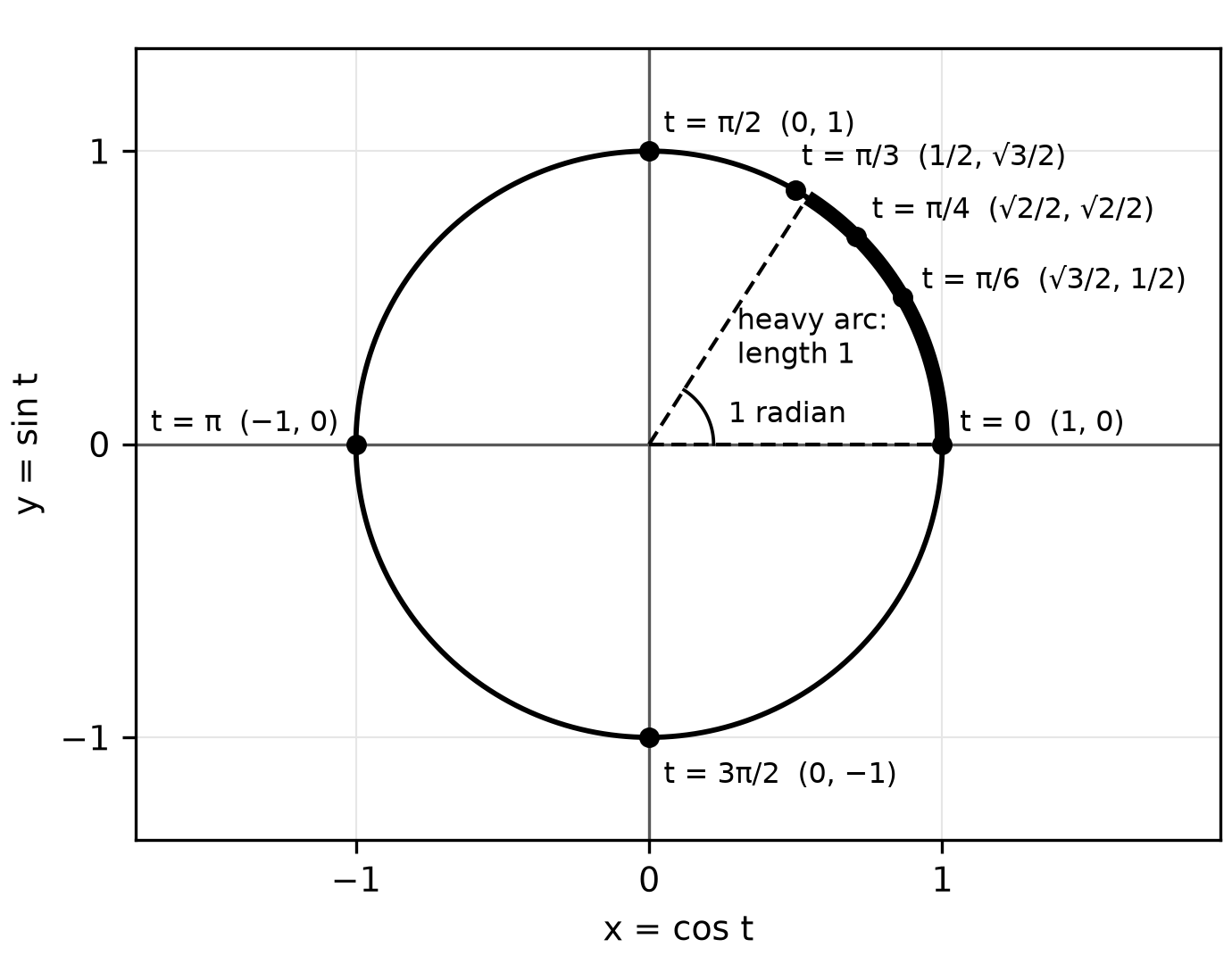
Figure 2.1. Radian measure on the unit circle.
An angle of 1 radian cuts off an arc equal to the radius, so a full turn is radians and radians equal 180 degrees. Calculus facts such as “the derivative of is ” hold only in radians.
Common error. A degree-mode answer looks plausible. Test the mode: should return 1, not about 0.0274.
Try it. (a) Convert 135 degrees to radians. (b) Evaluate exactly. (c) A calculator reports . What went wrong?
Answers. (a) . (b) . (c) Degree mode; in radians, .
Plan the next lesson
Write the next chapter and a date into your calendar now. Before that session, write one corrected sentence for each miss you are repairing, then complete the chapter's practice; its fresh questions show whether the repair worked.
Do not retake this diagnostic to measure progress. You know its keys, so a higher score would measure memory. Mock A in Chapter 25 is the next fresh measurement.
Practice
The diagnostic is items APCAL-D-M01 to APCAL-D-M36, printed after this chapter's companion panel as Questions 1–36 with the 36-row answer sheet. Answers, full reasoning, the error behind each wrong choice and a Repair and retry line are in Answers, explanations and written responses at the back of the book, under Chapter 2: answers and explanations.