What to practice
- Build a targeted retest from already attempted items and record the repair
A correction is not yet a repair
Reading an explanation and fixing the wrong line gives you a correction. A repair shows later, when you make the same decision correctly without help, and then again in a new setting. This chapter turns your error log into a short targeted retest. It adds no new questions: every item in a retest is one you have already attempted, labeled as a revisit. A revisit counts once in any tally of questions practiced, and success on a known item shows retention, not independent mastery.
When to revisit
| When | What to do |
|---|---|
| Same day | Rework the miss from a blank page after reading its explanation |
| About 2 days later | Retrieve the decision; pair the item with one that looks similar but needs a different move |
| About 1 week later | A mixed set from several chapters, without chapter labels |
| About 3 weeks later | The decision in a new context; rewrite one weak written response |
| When your Chapter 1 route schedules it | This chapter's targeted retest |
Find items by ID
Every bank item has a fixed ID. APCAL-C11-M04 is Chapter 11's fourth multiple-choice question; APCAL-C11-F02 is its second written task; APCAL-D-M07 is diagnostic question 7. The book prints running numbers, so use this map. In the table, each ID omits the prefix APCAL-, and IDs follow printed order within a chapter.
| Ch. | Multiple-choice IDs | Questions | Written-task IDs | Written tasks |
|---|---|---|---|---|
| 2 | D-M01 to M36 | 1–36 | none | none |
| 3 | C03-M01 to M14 | 37–50 | C03-F01 | 1 |
| 4 | C04-M01 to M15 | 51–65 | C04-F01 to F02 | 2–3 |
| 5 | C05-M01 to M13 | 66–78 | C05-F01 | 4 |
| 6 | C06-M01 to M15 | 79–93 | C06-F01 to F02 | 5–6 |
| 7 | C07-M01 to M10 | 94–103 | C07-F01 to F02 | 7–8 |
| 8 | C08-M01 to M06 | 104–109 | C08-F01 | 9 |
| 9 | C09-M01 to M12 | 110–121 | C09-F01 to F02 | 10–11 |
| 10 | C10-M01 to M17 | 122–138 | C10-F01 to F02 | 12–13 |
| 11 | C11-M01 to M15 | 139–153 | C11-F01 to F02 | 14–15 |
| 12 | C12-M01 to M15 | 154–168 | C12-F01 to F02 | 16–17 |
| 13 | C13-M01 to M13 | 169–181 | C13-F01 | 18 |
| 14 | C14-M01 to M16 | 182–197 | C14-F01 to F02 | 19–20 |
| 15 | C15-M01 to M14 | 198–211 | C15-F01 to F02 | 21–22 |
| 16 | C16-M01 to M14 | 212–225 | C16-F01 | 23 |
| 17 | C17-M01 to M07 | 226–232 | C17-F01 | 24 |
| 18 | C18-M01 to M09 | 233–241 | C18-F01 to F02 | 25–26 |
| 19 | C19-M01 to M11 | 242–252 | C19-F01 | 27 |
| 20 | C20-M01 to M12 | 253–264 | C20-F01 | 28 |
| 21 | C21-M01 to M12 | 265–276 | C21-F01 to F02 | 29–30 |
So APCAL-C11-M04 is Question 142. The mocks number separately: Mock A's Questions 1–42 are APCAL-MA-M01 to M42, and its Written tasks 1–6 are APCAL-MA-F01 to F06. Mock B uses APCAL-MB- the same way.
Build a targeted retest
- Select 8 to 12 logged items whose evidence-of-improvement entry is still empty. Include every error code you have logged at least twice, and a written task for each setup or justification error.
- Mix the order so that no two neighbors come from the same chapter. A mixed order makes you recognize the decision instead of following the chapter's pattern.
- Label each item in your log as "Revisit" with the date.
- Protect the mocks. Include a mock item only after you have taken that mock, timed.
- Time it at about 3 minutes per question and 15 per written task, without notes.
- Score each item as correct unaided, correct after rereading, or incorrect.
- Transfer. For each decision you got right, change one feature of the item (its numbers, representation or context), solve the variant unaided and check it by a second method, such as a graph or a calculator. The next mock then supplies fresh items on the same decisions.
A worked retest plan
Suppose your log after Chapter 21 shows nine unrepaired entries: CONDITION on APCAL-C11-M04, APCAL-C15-M07 and APCAL-C18-F01; SIGN on APCAL-C12-M09 and APCAL-C14-M03; UNITS on APCAL-C19-M02; PRECISION on APCAL-C20-M05 and APCAL-C21-F02; GEOMETRY on APCAL-C21-M06.
A mixed order using the map: Question 142, Question 184, Question 243, Question 204, Question 257, Question 162, Question 270, then Written tasks 25 and 30. Seven questions at about 3 minutes and two written tasks at about 15 take roughly 51 minutes, one study block.
| Result | Next step |
|---|---|
| Correct unaided | Date the evidence-of-improvement entry, do the transfer variant, revisit in about 3 weeks |
| Correct after rereading | Reread the named repair heading; retry in about 2 days |
| Incorrect | Rework the repair section's worked examples, then retry from a blank page and log a new entry |
Here CONDITION repeats in three chapters, and SIGN and PRECISION in two each. A code that repeats across chapters points to a habit, so add a routine check:
- CONDITION: write the hypotheses before the conclusion.
- SIGN: state what a positive value means before computing.
- UNITS: write units on every line of a setup.
- PRECISION: store values and round once, at the end.
- GEOMETRY: sketch one slice and label its length.
Read across representations
Many REPRESENTATION errors draw a conclusion from evidence that cannot support it. When you revisit such an item, name the representation the stem gives, say what it can establish alone and write the translation the question needs.
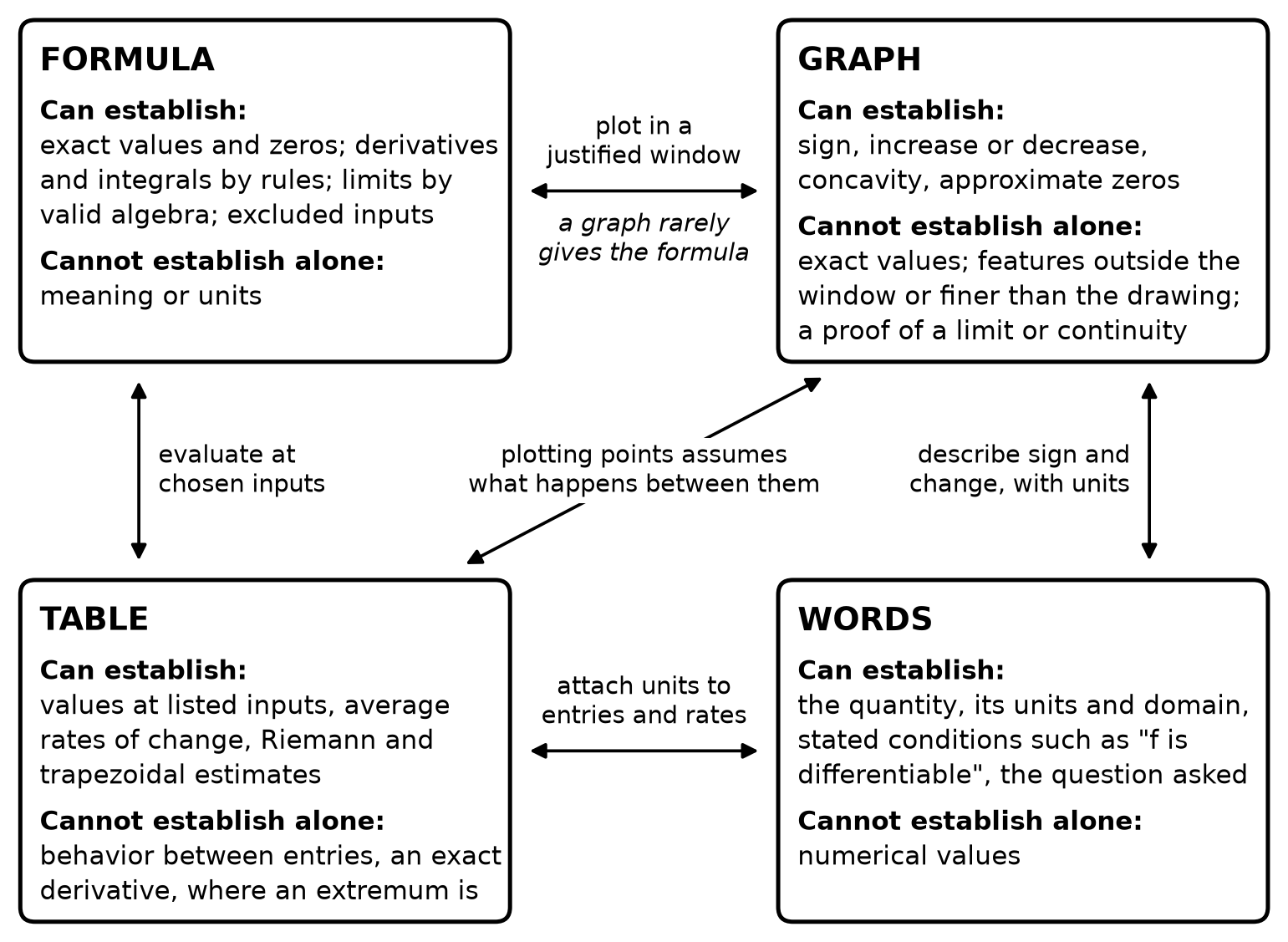
Figure 24.1. What each representation can establish alone, and the translations that connect them.
Try it
Try it 24.1. A log shows these unrepaired entries: APCAL-C06-M05 (ALGEBRA), APCAL-C10-M12 (OBJECT), APCAL-C10-F02 (OBJECT), APCAL-C16-M03 (DOMAIN), APCAL-C17-M02 (REPRESENTATION) and APCAL-C19-M10 (OBJECT). (a) Give each entry's printed label, in the log's order. (b) Order them so that no two neighbors share a chapter, and estimate the time. (c) Which code calls for a habit check, and what check?
Check your plan. (a) Question 83, Question 133, Written task 13, Question 214, Question 227 and Question 251. (b) One order: Question 133, Question 83, Question 251, Question 214, Written task 13, Question 227; about 30 minutes. (c) OBJECT, the only code that repeats across chapters (10 and 19): before computing, write the quantity the question asks for, with its units.
Practice
Chapter 24 adds no numbered questions. Build and take one targeted retest from your own log, label each item as a revisit with the date, score it, and record each result and next step. Then continue your route; in the twelve-week route, Mock A comes next.