What to practice
- Rehearse graph, root, numerical derivative and integral workflows with written setups
Where the calculator belongs
Only Section I, Part B (13 multiple-choice questions, 38 minutes) and Section II, Part A (2 free-response questions, 30 minutes) allow a calculator. Bluebook's built-in Desmos graphing calculator appears only there, and an approved handheld may be used only there (calculator policy).
The course framework expects a graphing calculator to plot a function in a chosen window, solve an equation numerically, compute a numerical derivative and compute a definite integral numerically (course framework, technology section). On a free-response question, write the setup for each such result, such as the equation solved or the integral evaluated, then the result. Results from any other calculator feature need the mathematical steps shown.
Set up before you compute
- Mode. Calculus uses radians. Test it: is about 0.841 in radian mode and about 0.0175 in degree mode.
- Define once. Enter the function once, by name, so every step uses the same expression.
- Keep full precision. Store roots and integral values; never retype a rounded number.
- Write the domain before you graph.
A running example
A tank holds 50 liters at time . For minutes, the amount of water changes at the net rate
liters per minute (constructed practice data). Let be the amount in liters, so .
Workflow 1: graph in an informative window
Choose the window from the problem, not from the default. Figure 23.1A uses a common default, by . It includes negative times that the model excludes, stops two minutes early and misses the third valid zero.
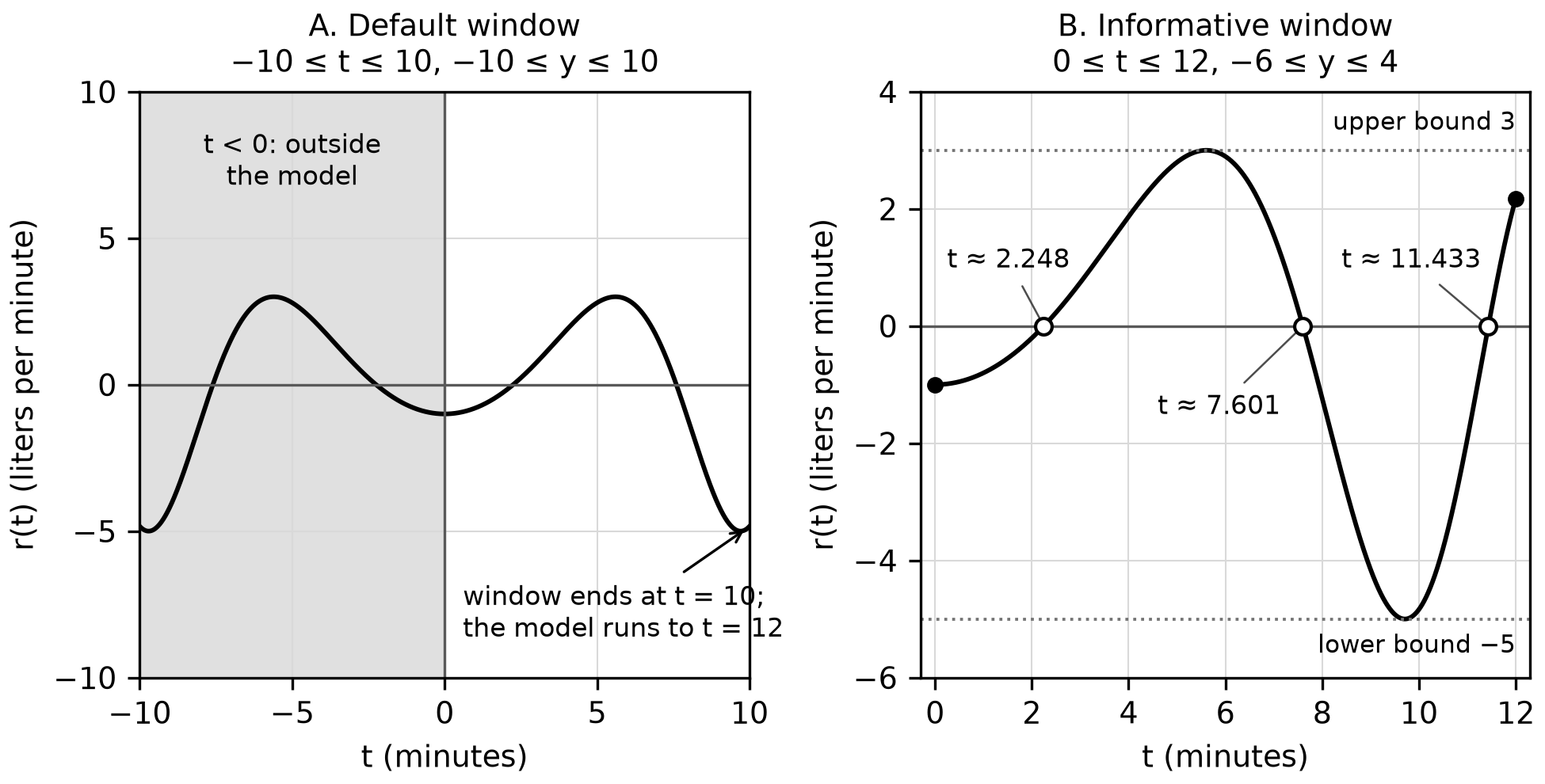
Figure 23.1. The same constructed rate model in a default window (A) and in a window chosen from the domain and the bounds of the sine term (B).
Build the window from what you know. The domain gives . The sine term lies between and , so lies between and , and shows every value. A graph suggests where the sign changes, but it cannot prove how many zeros exist or show detail finer than its pixels.
Workflow 2: find a root on a justified interval
To find when the amount switches between rising and falling, solve . Ask for each root inside a bracket where the sign changes: , and . The roots are , and .
Why exactly three? Let ; as runs from 0 to 12, runs from 0 to 7.2. A root needs , which happens on that interval only at , and ; the next solution, , is too large. Each gives one . The calculator located the roots; the argument counted them.
Workflow 3: a numerical derivative
How fast is the net rate changing at ? Name the derivative, then give its value: liters per minute per minute: the net rate is rising.
A numerical derivative is a difference quotient over a tiny interval, often a symmetric one, so it can display a number where no derivative exists (Try it 23.2). Check differentiability by reasoning.
Workflow 4: a definite integral
The amount after 12 minutes is the starting amount plus the accumulated net change:
liters, because liters per minute times minutes gives liters. The integral is signed: it is the net change. The total rise plus total fall of the amount would be .
Combine the workflows
When is the amount greatest on ? The candidates are the endpoints and the three roots. Evaluate at each, using the stored roots:
| (minutes) | 0 | 2.248 | 7.601 | 11.433 | 12 |
|---|---|---|---|---|---|
| (liters) | 50 | 48.506 | 58.241 | 46.378 | 47.035 |
The greatest amount is about 58.241 liters, at minutes. Comparing every candidate, endpoints included, makes the conclusion absolute rather than local.
Store, then round
Unless a question says otherwise, report decimal answers correct to three decimal places, the standard in recent official scoring guidelines (2026 scoring guidelines). Round only what you report. At the stored root near 7.601, is about ; retyping 7.6 gives , wrong in the third decimal.
Diagnose two flawed solutions
Task: find the least amount of water on and justify it.
Response 1. "r changes from negative to positive at t = 2.248, so the minimum is 48.506 liters."
- That sign change shows only a local minimum. An absolute minimum requires comparing every candidate.
- The value 48.506 appears without its setup, .
- Repair: by the table, the least amount is about 46.378 liters, at .
Response 2. "The graph of r never crosses zero, so the minimum is at an endpoint."
- The calculator was in degree mode. Read in degrees, never exceeds 7.2°, so never rises above about (Figure 23.2). Repair: switch to radians and redo the graph.
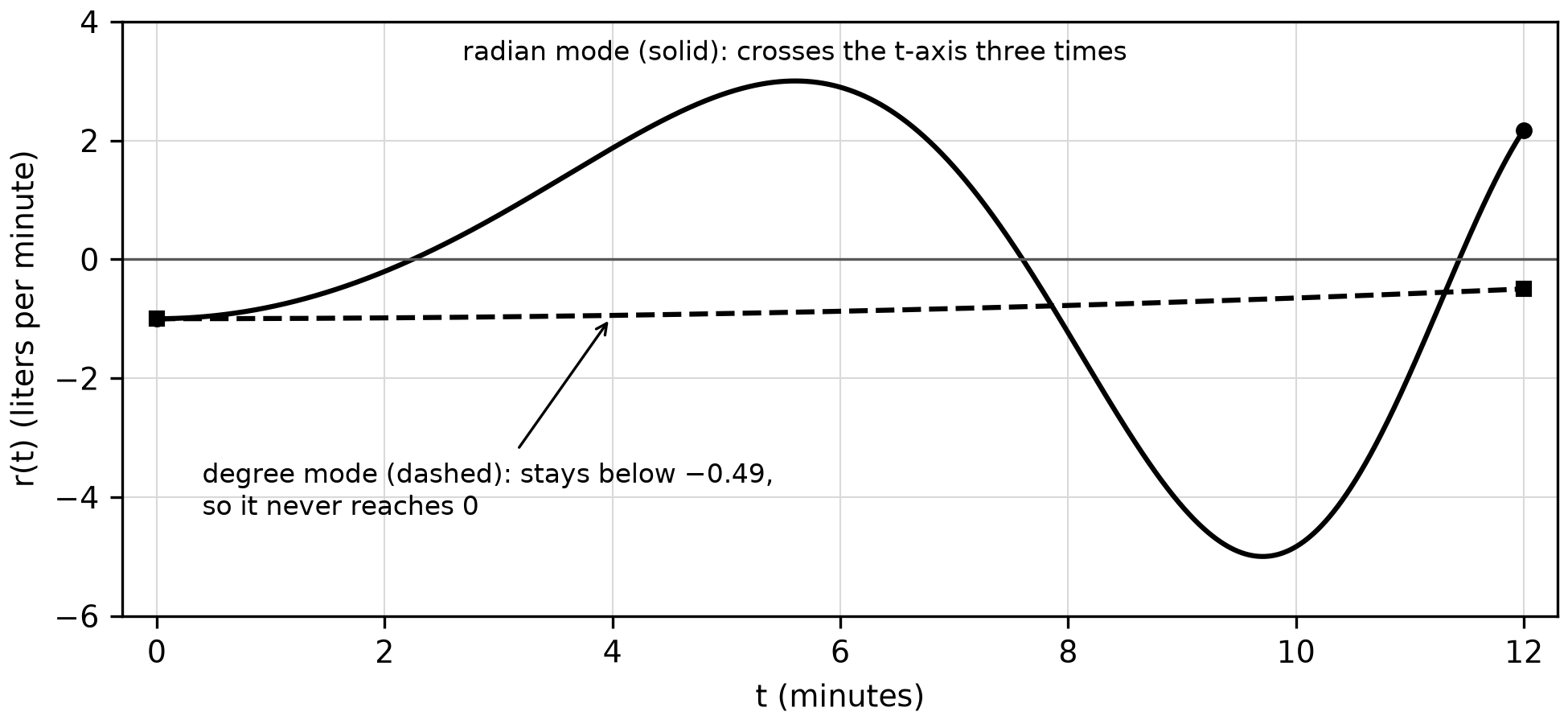
Figure 23.2. One formula, two angle modes. Degree mode silently produces a different function.
What outputs can and cannot establish
| Output | Can support | Cannot establish alone |
|---|---|---|
| Graph | Approximate zeros, sign, shape, a bracket | How many zeros, continuity, exact values, limits |
| Root | A decimal solution inside your bracket | That no others exist, or that it answers the question |
| Numerical derivative | An approximate rate where the function is differentiable | That the derivative exists |
| Definite integral | Signed accumulation of what you entered | Total distance or total change, without an absolute value |
Rehearse the hybrid workflow
On exam day you read free-response prompts on screen and answer on paper. Practice that switch: read a prompt, work in a notebook, and copy each calculator result into a written setup line with units. College Board plans to post full-length sample free-response booklets in early 2027 (hybrid exams).
Bluebook test previews let you try every testing tool; they are short, untimed and unscored, with no feedback. Full-length scored practice tests in Bluebook are for the SAT and PSAT; AP practice is in AP Classroom (Bluebook practice). Use a preview to learn the interface, and this book's mocks for timing.
You may practice on the Desmos website or app during the year, but only Bluebook's built-in version is allowed on exam day. If you bring a handheld, choose a model with an asterisk on the approved list; the asterisk marks graphing calculators with the built-in capabilities AP Calculus expects. Rehearse on that model; menus differ between models, so this book gives no keystrokes.
Try it
Try it 23.1. Let for . (a) How many zeros appear in the window by ? (b) Choose an informative window and find every zero in to three decimal places. (c) Explain why there are no others.
Try it 23.2. Let . Suppose a calculator's numerical derivative at displays 1. Does exist?
Try it 23.3. A particle moves along a line with velocity meters per second for . Write setups for its displacement and its total distance traveled, and evaluate each to three decimal places.
Check your calculator work
23.1. (a) One, near . The graph leaves the bottom of the window near and does not return before . (b) A window such as by shows both zeros: and . (c) is zero only at , so decreases before that point and increases after it. Since , and , each piece has exactly one zero.
23.2. No. For the quotient equals 2; for it equals 0. The one-sided limits differ, so does not exist: the graph has a corner. A symmetric quotient averages the two sides, for every , which is why a calculator can display 1.
23.3. Displacement: meters. Distance: meters. Velocity is negative until and positive afterward, so the two differ. A default window also shows zeros near and , both outside . Adding rounded pieces, , misses the third decimal, so integrate directly or add stored values.
Practice
Chapter 23 has no numbered questions. Work Try it 23.1 to 23.3 on the calculator you will use, writing a setup line before every result. Next, redo the running example from a blank page: window, roots, , and the greatest amount. Finally, open one Bluebook test preview to learn the interface, and use this workflow in Mock A's calculator parts.