What to practice
- Compare a complete argument with a repairable partial response
A justification turns a correct answer into an argument that a reader can check. Free-response scoring often separates the reasoning from the number: published scoring notes award points for a setup, a stated condition or an interpretation, not only for a final value (see the task-specific notes in the 2026 AP Calculus AB scoring guidelines). A correct number with a missing reason can therefore lose points. This chapter adds no new questions. It teaches you to repair responses you have already written, across all eight units.
The four parts of a complete argument
- Claim. State what you conclude, about which function, at which input or on which interval.
- Conditions. If a theorem or test supplies the conclusion, show that its hypotheses hold for this function.
- Evidence. Give the specific values, signs or computations that the reason uses.
- Conclusion in context. Join evidence to claim with "because … therefore", using units and the problem's own words.
The parts need not appear in this order, and a short response can combine them in one sentence. What matters is that none is missing.
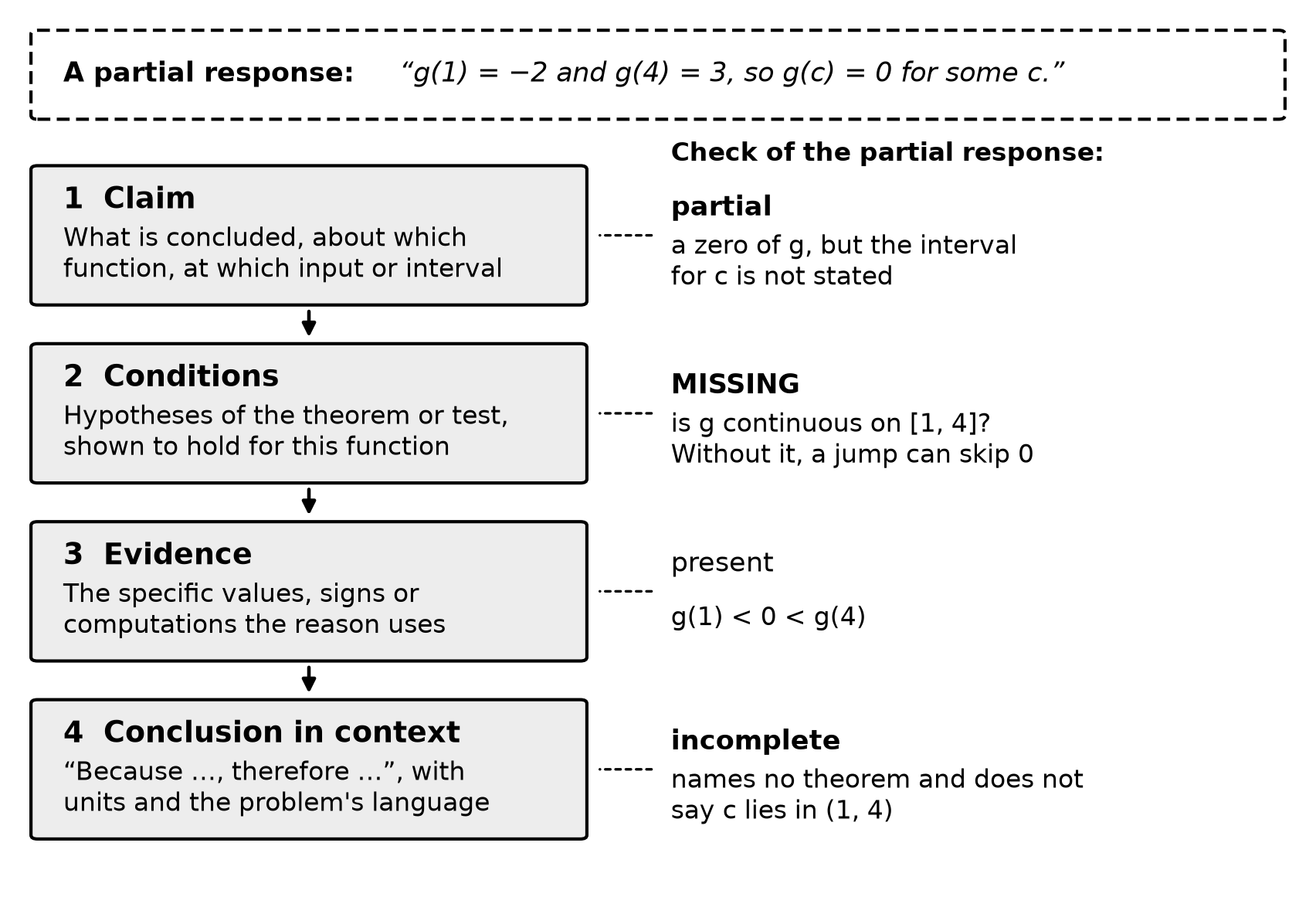
Figure 22.1. A complete argument links claim, conditions, evidence and a conclusion in context. The partial response above the boxes has the evidence but skips a condition.
Check the hypotheses before naming a theorem
A theorem guarantees its conclusion only when its hypotheses hold. If one fails, the theorem is silent: the conclusion might still be true, but you need another reason. Hypotheses are sufficient conditions, not necessary ones.
| Theorem or rule | Hypotheses to state | Guaranteed conclusion |
|---|---|---|
| Intermediate Value Theorem | continuous on ; strictly between and | some in with |
| Mean Value Theorem | continuous on and differentiable on | some in with |
| Extreme Value Theorem | continuous on the closed interval | attains an absolute maximum value and an absolute minimum value on , each at least once |
| Fundamental Theorem, derivative form | continuous on an interval containing and | |
| L'Hospital's rule | the limit has the form or ; and differentiable near with there; exists |
The Extreme Value Theorem row follows the current wording, which guarantees at least one maximum value and at least one minimum value (Fall 2026 course framework corrections); each extreme value is attained, possibly at more than one input. Differentiability implies continuity, but continuity does not imply differentiability. When a problem says is differentiable, say that is therefore continuous.
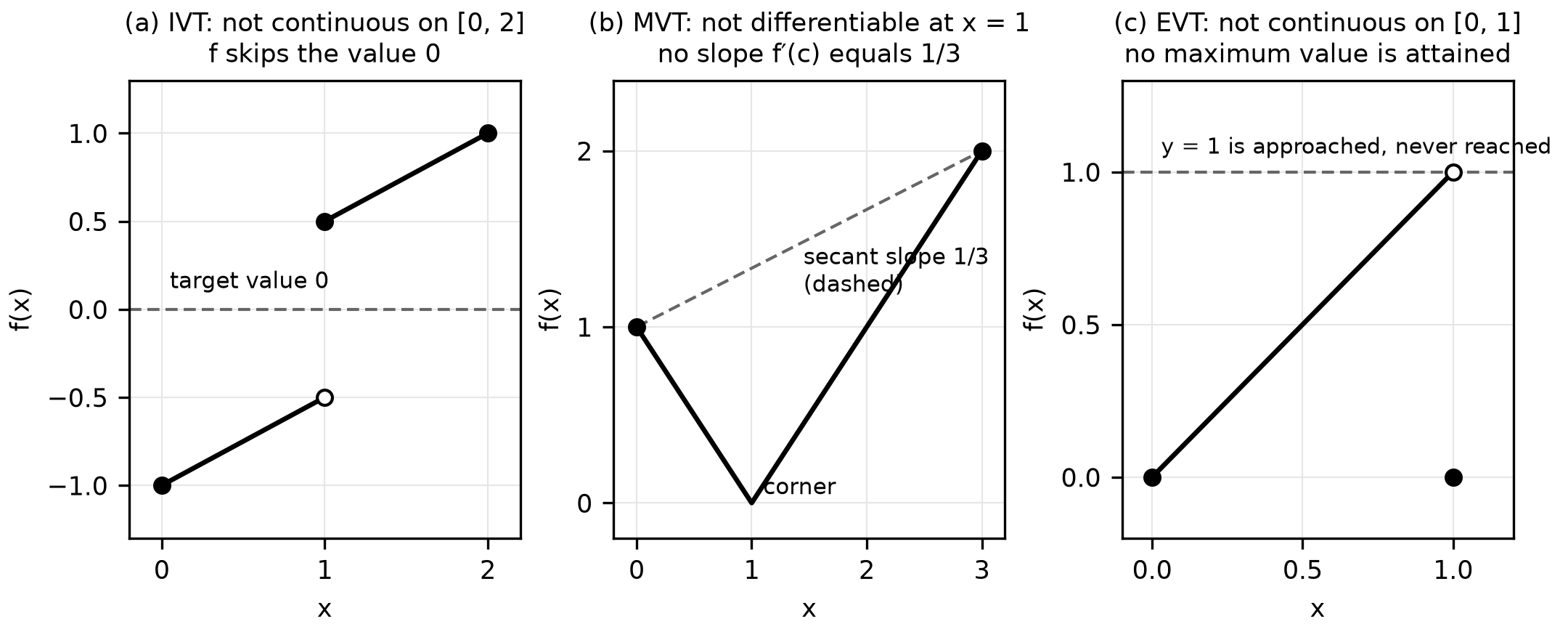
Figure 22.2. Remove one hypothesis and the conclusion can fail. (a) A jump skips the value 0. (b) At a corner, no tangent slope equals the secant slope . (c) A discontinuity at an endpoint leaves no largest value.
Repair six partial responses
Each repair keeps the correct work and adds only what is missing.
Repair 1: a sign change without continuity (Unit 1)
Partial: " and , so for some ." Suppose is differentiable.
Missing: continuity, which a jump would break, as in Figure 22.2(a).
Repaired: "Because is differentiable, it is continuous on . Since , the Intermediate Value Theorem gives a in with ."
Repair 2: a local fact used for a global claim (Unit 5)
Partial: ", so has its absolute maximum on at ."
Missing: a derivative zero only makes 2 a candidate. An absolute extremum needs every candidate and both endpoints.
Repaired, given that is differentiable, 2 is its only critical number, and , , : " is continuous on , so its absolute maximum occurs at a critical number or an endpoint. Of , and , the largest is 7, so the absolute maximum value is 7, at ."
Repair 3: speed judged from one sign (Unit 4)
Partial: ", so the particle is slowing down at ."
Missing: speed depends on velocity and acceleration together. Suppose .
Repaired: "At , and . Velocity and acceleration have the same sign, so the speed is increasing: the particle is speeding up."
Repair 4: a change reported as an amount (Units 6 and 8)
Water enters a tank at liters per hour, and the tank holds 40 liters at .
Partial: "Amount ."
Missing: the integral of a rate is the change in the amount, not the amount; units and the starting value are absent.
Repaired: " liters is the change in the amount of water from to hours. The tank holds liters at ."
Repair 5: dividing away the solution (Unit 7)
Solve with .
Partial: ", so . At this needs , so there is no solution."
Missing: dividing by assumed . Check that case before dividing.
Repaired: "If for all , then and , so the constant function satisfies the equation, and . The particular solution is for all real ." This equation has a whole family of solutions; the initial condition selects one.
Repair 6: a calculator number without its equation (Unit 8)
Partial: "."
Missing: what equation was solved, on what interval, and what the root means.
Repaired: "The region's curves and meet where . On , a calculator gives , which I store at full precision. So the region's right boundary is ."
Units and contextual conclusions
- A derivative's units are output units per input unit. An integral of a rate has the units of the accumulated amount. Areas are square units; volumes are cubic.
- An interpretation names the value, the units, the input and the direction: " means that at minutes the depth is decreasing at 0.4 centimeter per minute."
- Write for a rounded value. Round only the reported answer, to three decimal places unless told otherwise.
Linked parts and carried values
When a later part uses an earlier answer, use your earlier value even if you doubt it, and say so: "Using from part (a), …". A rubric may award a later point for a correct method applied to your earlier value. It cannot do that when the later part is blank or the dependence is hidden. Never round an earlier answer before reusing it.
Try it
Try it 22.1. The depth of water in a channel is meters, hours after noon, and is differentiable. A student writes: "Since and , there is a time with ." Repair the response.
Check your repair. "Because is differentiable, it is continuous on and differentiable on . By the Mean Value Theorem there is a in with . So at some time between noon and 4 p.m., the depth was falling at 1 meter per hour."
Try it 22.2. Given , a student writes: "The graph of is concave down on because is decreasing there." Repair it.
Check your repair. Concavity depends on , not on the sign of . "For , , so is decreasing and the graph of is concave down on ."
Try it 22.3. A particle's velocity is meters per second, and . A student writes: "The particle traveled 12 meters." Repair it.
Check your repair. The integral is displacement, not distance. "At seconds the particle is 12 meters in the negative direction from its position at ." The distance traveled is , at least 12 meters; it equals 12 only if never changes sign.
Practice
Chapter 22 adds no numbered questions. Choose two written tasks that you have already attempted and scored below full credit, ideally from different units; Written tasks 29 and 30 from Chapter 21 qualify if you scored below full credit on them. For each one:
- Underline every claim in your original response.
- Beside each claim, write its conditions, evidence and conclusion in context.
- Rewrite the response on fresh paper, keeping the work that was correct.
- Rescore it with the printed rubric, and log the item as a dated revisit; it counts once, not as a new question.
Reread Figure 22.1 and the hypothesis table before each mock, and repeat this repair on one task in each review week.