What to practice
- Draw a representative slice and translate geometry into a volume integral
A loaf of bread is a stack of thin slices. If you know the area of every slice, you know the volume: add each slice's area times its thickness, then let the thickness shrink. This chapter turns that idea into one routine for every AB volume: squares, triangles and semicircles standing on a base (topics 8.7–8.8), disks (8.9–8.10) and washers (8.11–8.12).
Predict first. A solid has square cross sections. If every square's side doubled, what would happen to the volume? Write your answer; Demonstration 2 checks it.
Slice, measure, integrate
Every volume in this chapter follows three steps.
- Slice. Sketch the region and one representative slice perpendicular to the stated axis. For a solid of revolution, the slice is perpendicular to the axis of rotation. The slice's direction chooses the variable: a vertical slice is thin in , a horizontal slice is thin in .
- Measure. Write the slice's length, or its radii, as a function of that variable. Convert to the cross-sectional area of the stated shape.
- Integrate. Add the areas over every position where slices exist:
Why an integral? Cut the solid into slabs of thickness . The slab at has volume close to , so the volume is close to the Riemann sum from Chapter 14. As shrinks, the slabs fit the solid more closely and the sums approach the integral.
Units confirm the structure. If lengths are in centimeters, is in square centimeters and in centimeters, so each term , and the integral, is in cubic centimeters. An answer in square units means a dimension is missing.
Demonstration 1: squares on a parabolic base (8.7)
The base of a solid is the region between and . Cross sections perpendicular to the -axis are squares.
- Bounds. Solve : or . On , , so the line is on top.
- Measure. A vertical slice at runs from up to , so its length is . That length is the square's side, so .
- Integrate.
Check. The longest slice is , so every square has area at most 1 and the solid fits in a box of volume . The answer, cubic units, is positive and below 2.
Demonstration 2: one slice length, four shapes (8.8)
Keep the base and slice and change only the shape. Derive each area from instead of memorizing a list.
| Shape standing on the slice | Dimension from | Area | Volume |
|---|---|---|---|
| Square | side | ||
| Semicircle, diameter in the base | radius | ||
| Equilateral triangle | height | ||
| Isosceles right triangle, one leg in the base | legs and |
Every area is a constant times , so every volume is that constant times . This answers the prediction: doubling every side multiplies every area, and the volume, by 4.
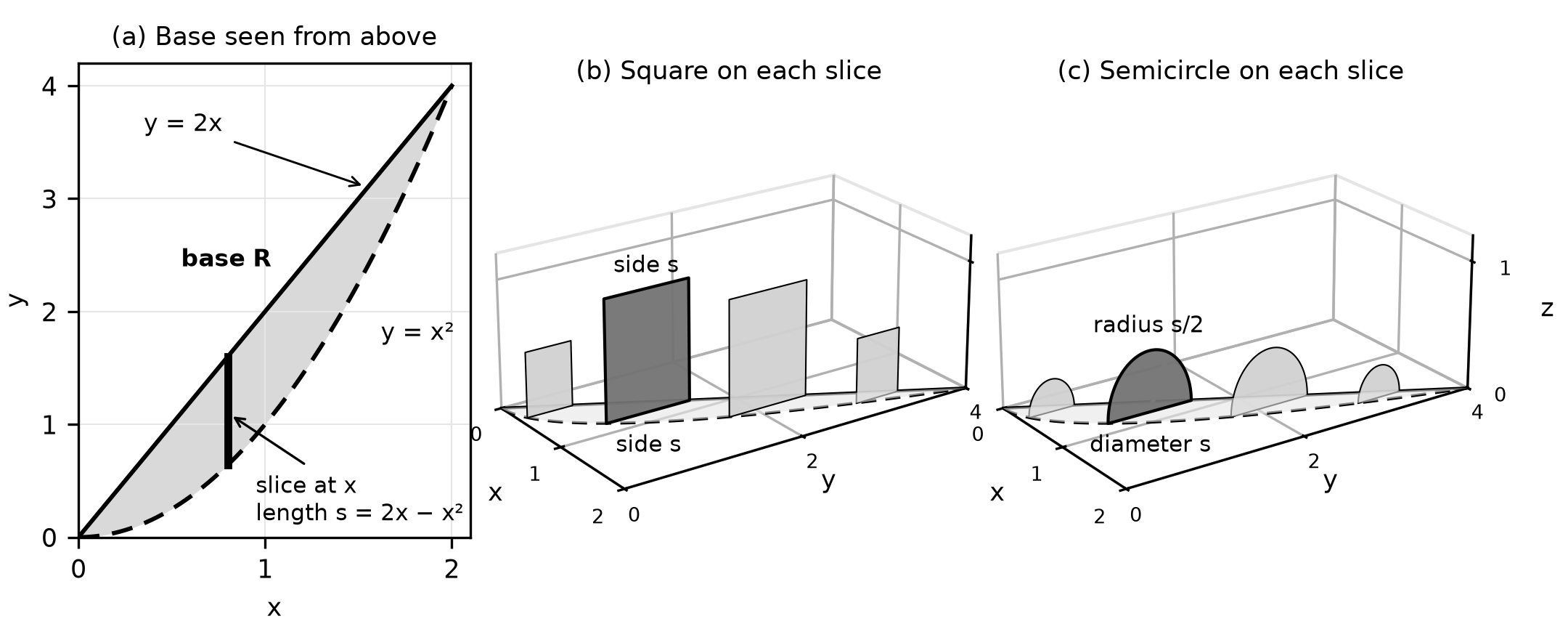
Figure 21.1. One slice of the base supports a square of side or a semicircle of diameter .
Common errors. "Diameter in the base" makes the slice the diameter, so the radius is . Using as the radius gives , four times too large. A triangle needs its actual height: an equilateral triangle's height is , not .
Try it 21.1. The base of a solid is the region bounded by , the -axis and . Cross sections perpendicular to the -axis are semicircles. Find the volume if (a) each diameter lies in the base and (b) each radius lies in the base. Explain the ratio.
Check your work. Here , so . (a) . (b) The radius is , so and . Doubling the radius multiplies each area by 4, so the volume is 4 times as large.
Demonstration 3: from a table of side lengths (representation change)
A concrete footing is 8 meters long. Each cross section perpendicular to its length is a square whose side , in meters, was measured meters from one end (constructed practice data):
| (m) | 0 | 2 | 4 | 6 | 8 |
|---|---|---|---|---|---|
| (m) | 1.0 | 1.2 | 1.5 | 1.4 | 1.0 |
Estimate the volume with a trapezoidal sum.
The table gives lengths, but the integrand must be an area, so square first: 1, 1.44, 2.25, 1.96 and 1 square meters. With widths of 2 meters,
so the footing needs about 13.3 cubic meters of concrete.
Diagnose an incorrect solution. A student applies the trapezoidal sum to itself and reports 10.2 cubic meters. The units expose the error: meters times meters gives square meters. That number estimates the area of the footing's side view, not its volume.
Check. Every side is between 1.0 and 1.5 meters, so the volume lies between and cubic meters. The estimate 13.3 does.
Disks: the region touches the axis (8.9–8.10)
Revolve a region about a line, and each slice perpendicular to that line sweeps out a circle. If the slice reaches the axis, the circle is a solid disk of area , where is the distance from the axis to the far boundary. A radius is always a distance to the axis, never just a -value.
Demonstration 4: choose the slice direction (method choice)
Revolve the first-quadrant region bounded by , and the -axis about the -axis.
Why slice horizontally? The slice must be perpendicular to the axis of rotation. This axis is vertical, so slices are horizontal and the variable is . A vertical slice revolved about the -axis would sweep out a cylindrical shell, a method outside the AP course framework. So solve the boundary for : .
At height , the slice runs from the axis to , so and for :
Check. The solid is a paraboloid inside a cylinder of radius 2 and height 4, which has volume . A paraboloid fills exactly half of that cylinder: .
Demonstration 5: split when the far boundary changes
Revolve the region bounded by , and the -axis about the -axis.
The curves meet where , at , and the line meets the axis at . Every vertical slice reaches the axis, but its top changes at : it is on and on . One formula cannot describe both, so split:
Using all the way to gives , the volume of a different solid.
Check. The second piece is a cone of radius 1 and height 1, with volume . The first is a paraboloid, half of a cylinder of volume .
Demonstration 6: a disk about an offset axis (8.10)
Revolve the region from Demonstration 4 about the line .
The axis is horizontal, so slice vertically. Each slice reaches the axis, so each makes a disk. Its radius is the distance from down to the curve: , not .
Check. Every radius is at most 4, so the solid fits in a cylinder of volume ; is smaller. Moving the axis changed the radius, not the region.
Washers: the slice leaves a hole (8.11–8.12)
If a slice does not reach the axis, it sweeps out a washer: a disk of radius with a disk of radius removed.
Here is the distance from the axis to the farther boundary and the distance to the nearer one. Confirm that across the whole interval.
Demonstration 7: diagnose a squared gap
Revolve region from Demonstration 1, between and , about the -axis.
A student writes .
Diagnosis. The student squared the slice length. But : the hole is a whole disk and must be subtracted as one. Measured from the -axis, and , as Figure 21.2(a) shows:
Check. Revolving the region under gives a cone of radius 4 and height 2, volume . The hole is the solid from , volume . The difference is .
Demonstration 8: move the axis, then rebuild both radii (8.12)
Revolve the same region about two other horizontal lines, redrawing the slice each time.
About , the axis lies below the region, and each distance grows by 1: and .
About , the axis lies above the region, as in Figure 21.2(b). Now the lower curve is farther away: and . Since on , .
"The upper curve gives the outer radius" is true only when the axis is below the region.
Check. For every axis outside the region, , the slice length, because both radii end on the same slice. What changes is , and . That is why the three volumes differ even though the region does not.
Complete the step. For the axis , write and at before reading on. Answer: the axis is above the region, so and ; their difference is again .
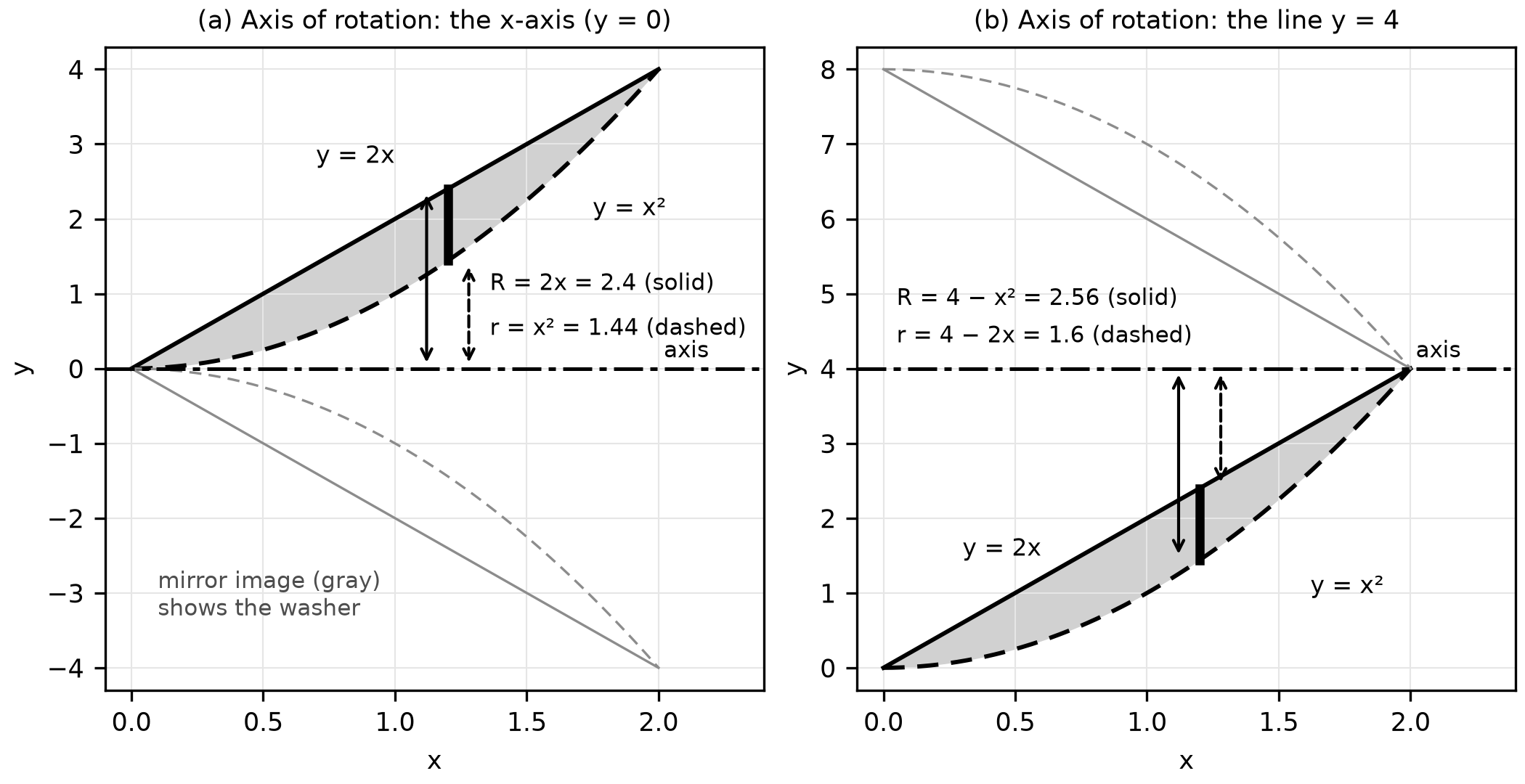
Figure 21.2. The same slice, at , revolved about two axes. Each radius runs from the axis to a boundary.
Demonstration 9: horizontal washers about a vertical axis
Revolve the same region about the line . The axis is vertical, so slice horizontally and solve each boundary for : the line becomes and the parabola , for . Since there, the parabola is farther from : and .
Check. About the -axis instead, the same steps give . Moving the axis one unit away from the region makes the solid larger, as it should.
Try it 21.2. Let be the first-quadrant region between and . Find the volume when is revolved about (a) the -axis, (b) the line and (c) the line . Each time, name the curve that gives the outer radius.
Check your work. The curves meet at and , with between them.
- (a) The line is farther: and , so .
- (b) The lower curve is farther: and , so .
- (c) Solved for , the line is and the curve is , with on . The curve is farther: and , so .
A checklist for every volume
- Sketch the region, the axis and one slice perpendicular to the axis.
- Find every intersection; split wherever a boundary changes.
- Write each length as a distance, in the slice's variable.
- Build the area from the slice: radius for a diameter, a triangle's true height, and for a washer, never .
- Use only where circles appear, and report cubic units.
Retrieve and review
- In about two days, without notes, redo Demonstration 8 about from a blank sketch. Then explain in one sentence why the lower curve gives the outer radius.
- In about a week, mix one cross-section volume with an area question from Chapter 20 and a net-change question from Chapter 19. Before solving, say whether each answer has square or cubic units.
- Log each volume error. Use GEOMETRY when the slice, a radius or a shape's area was wrong, and ALGEBRA only when the setup was right.
Practice
The printed practice after this chapter's companion panel contains Questions 265–276 (items APCAL-C21-M01 to M12) and Written tasks 29–30 (APCAL-C21-F01 and F02). Questions 269, 271, 274 and 276 and Written task 30 require a graphing calculator in radian mode; the others do not. Keep full precision until the end and report decimal answers to three places. Answers, the reasoning behind every choice, rubrics and complete written responses are in Answers, explanations and written responses at the back of the book, under Chapter 21: answers and explanations.