What to practice
- Find friction forces, and tell when static friction is below its maximum value.
- Identify third-law pairs and explain why they never cancel on one free-body diagram.
- Solve circular motion by setting the net inward force from real forces equal to mv²/r.
- Use Newton's law of gravitation and explain apparent weight.
Framework
f_s ≤ μ_s F_N | f_k = μ_k F_N | Hooke's Law: F_s = -k·x | Centripetal Dynamics: ΣF_r = m·v²/r = m·ω²·r | Gravitation: F_g = G·M·m/r²
Forces always come in third-law pairs that act on different objects, so those pairs never cancel on one free-body diagram. Static friction takes whatever value is needed, up to the limit f_s ≤ μ_s F_N, while kinetic friction is f_k = μ_k F_N. Ideal springs obey F = kx. An object moving in a circle needs a net inward force of mv²/r, and that force must come from real forces such as tension, friction, gravity or a normal force.
Static friction is the force students most often get wrong. It is not always μ_s F_N, which is only the largest value it can reach. If you push a crate gently and it stays put, static friction exactly equals your push. Friction points against the slipping that would otherwise happen, and that is not always against the motion. Static friction is what keeps a crate on an accelerating truck.
The two forces in a third-law pair have the same size and act on different objects. In a crash, a truck and a car exert equal forces on each other. The car's speed changes more because it has less mass, not because it feels a larger force.
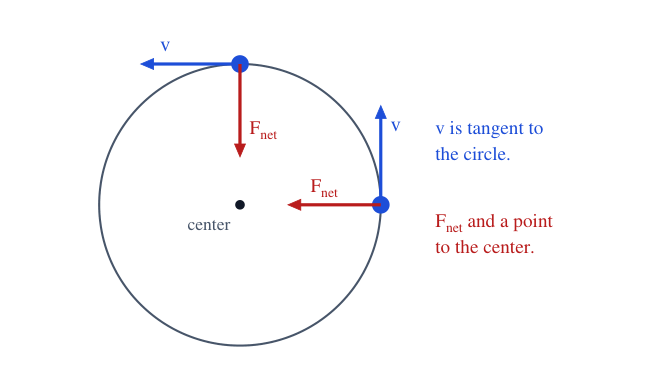
In circular motion, centripetal force is never a separate arrow. It is the name for the net inward force. List the real forces, add them along the radial direction and set the sum equal to mv²/r. At the top of a vertical circle, the minimum speed occurs when the tension or normal force falls to zero, which gives v = √(gr).
Gravity follows F = Gm_1 m_2/r², with r measured between centers, and g = GM/r² is the field strength at that distance. Apparent weight is the normal force, the reading on a scale, and it differs from mg when you accelerate.
On the exam: name the real force that supplies the inward net force, and use the center-to-center distance in gravity problems.
Worked AP Physics 1: Algebra-Based Problem: Newton's Third Law, Static vs. Kinetic Friction, Spring Restoring Forces, and Circular Dynamics
A car of mass m = 1,200 kg rounds a flat, unbanked circular curve of radius r = 50.0 m. If the coefficient of static friction between the tires and dry pavement is μ_s = 0.80 (take g = 10.0 m/s²), derive and calculate the maximum safe speed v_max without skidding.
Step 1 (Vertical Equilibrium): On a flat road, ΣF_y = F_N - mg = 0 → F_N = mg.
Step 2 (Radial Centripetal Force Identification): Static friction points radially inward toward the center of the circle to provide the required centripetal force: f_s = m·v² / r.
Step 3 (Apply Maximum Static Friction Condition): At the verge of skidding, f_s,max = μ_s F_N = μ_s mg = m·v_max² / r.
Step 4 (Cancel Mass and Solve for v_max): Canceling m gives v_max = √(μ_s·g·r) = √(0.80·10.0 m/s²·50.0 m) = √(400) = 20.0 m/s (independent of the car's mass!).
'Centripetal force' is NEVER a separate physical force on a Free-Body Diagram; it is the net radial force ΣF_r = m·v²/r supplied by real forces like tension, gravity, normal force, or static friction.
Practice procedure
For vertical circles (roller coaster loop or ball on a string), minimum speed at the top occurs when F_N → 0 (or T → 0), giving mg = m·v_min²/R → v_min = √(g·R).
Common mistakes
Drawing an outward 'centrifugal force' or labeling a separate 'F_c' arrow on a Free-Body Diagram.
Thinking a heavier truck has a different maximum flat-curve skidding speed than a light sedan with the same tire μ_s.
Thinking the larger object in a collision exerts the larger force. Third-law forces are always equal in size.
Using f = μ_s F_N for a crate that is not about to slip. Static friction is only as large as it needs to be.
Key terms
Term: Centripetal Acceleration (a_c)
Definition: Radially inward acceleration a_c = v² / r required to change the direction of velocity along a circular path.
Term: Gravitational Field Strength (g)
Definition: Force per unit mass g = G·M / r² exerted by a planet of mass M at distance r from its center.