What to practice
- Calculate work from force, displacement and angle, or from the area under a force–position graph.
- Use the work–energy theorem to connect net work to a change in speed.
- Calculate average power and explain how the choice of system changes what counts as work.
Framework
W = F·d·cos(θ), or the signed area under an F-x graph | K = (1/2)m·v² | Work-Energy Theorem: W_net = ΔK = K_f - K_i | Power: P_avg = ΔE/Δt, P = F·v·cos(θ)
Energy reasoning skips the details of motion and compares start and finish. Kinetic energy is K = (1/2)mv². Work is W = Fd cos θ, or the signed area under a force–position graph when the force varies. The work–energy theorem says the net work on an object equals its change in kinetic energy. Power is the rate of energy transfer: P_avg = ΔE/Δt, and for a constant force P = Fv cos θ.
Work can be positive, negative or zero. A force along the motion adds energy, a force against the motion removes it, and a force perpendicular to the motion does no work, because cos 90° = 0. That is why the normal force on a level floor and the tension in a horizontal circle do no work. Always check the angle between the force and the displacement.
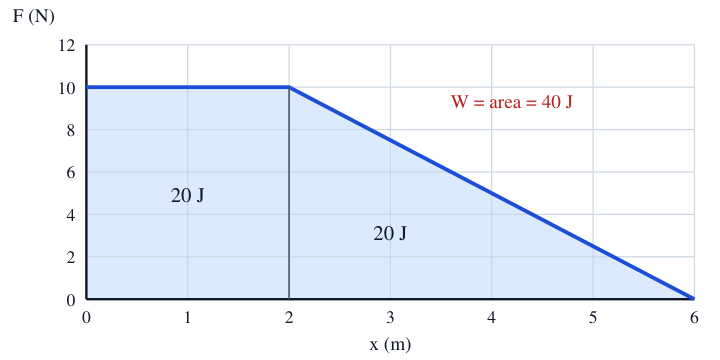
When a force changes with position, W = Fd does not apply, and neither do the constant-acceleration equations. Find the signed area under the force–position graph instead, then set that net work equal to ΔK.
Because kinetic energy depends on v², doubling the speed makes it four times as large. A skidding car at twice the speed needs four times the distance to stop.
What counts as work depends on your system. If the system is the object alone, gravity does external work on it. If the system includes Earth, gravity shows up as a change in potential energy instead. Do not count it both ways.
On the exam: name the system, then say whether each force does positive, negative or zero work.
Worked AP Physics 1: Algebra-Based Problem: Translational Kinetic Energy, Work by Constant & Variable Forces, and the Work-Energy Theorem
A 2.0 kg block initially moving at v_i = 3.0 m/s at x = 0 experiences a net horizontal force F_x(x) that decreases linearly from 12.0 N at x = 0 to 0 N at x = 4.0 m. Find the net work done on the block from x = 0 to x = 4.0 m and its final speed v_f at x = 4.0 m.
Step 1 (Initial Kinetic Energy): K_i = (1/2)m·v_i² = 0.5(2.0 kg)·(3.0 m/s)² = 9.0 J.
Step 2 (Work from Area Under F_x vs. x Graph): The triangle from x = 0 to x = 4.0 m with height 12.0 N has area W_net = (1/2)(base)(height) = 0.5(4.0 m)(12.0 N) = 24.0 J.
Step 3 (Apply the Work-Energy Theorem): K_f = K_i + W_net = 9.0 J + 24.0 J = 33.0 J.
Step 4 (Solve for Final Speed): (1/2)(2.0 kg)v_f² = 33.0 J → v_f² = 33.0 → v_f = √(33.0) = 5.74 m/s.
When force varies with position x, you cannot use W = F·d or constant-acceleration kinematics; always compute the signed area under the F_x vs. x graph and set W_net = ΔK.
Practice procedure
Check the angle θ between force F and displacement d: a force perpendicular to motion (such as normal force or centripetal force) has cos(90°) = 0 and does ZERO work.
Common mistakes
Using W = F·d with the peak force instead of the triangular area when force varies with position.
Forgetting that doubling an object's speed quadruples its kinetic energy K = (1/2)mv² and stopping distance.
Counting gravity twice, once as work and again as potential energy. Choose one view based on your system.
Thinking a force does work just because it acts on a moving object. A force perpendicular to the motion does none.
Key terms
Term: Work-Energy Theorem
Definition: The net work done by all forces acting on a particle equals its change in translational kinetic energy: W_net = ΔK.
Term: Mechanical Power (P)
Definition: Rate of energy transfer or work done per unit time, P = W / Δt = F·v·cos(θ) in watts (J/s).