What to practice
- Choose a system and state which kinds of energy it can store.
- Draw and read energy bar charts for motion with and without friction.
- Apply energy conservation to ramps, springs and loops, including the energy transformed by friction.
Framework
U_g = m·g·y (or -G·M·m/r) | U_s = (1/2)k·x² | Conservation of Energy: K_i + U_i + W_ext = K_f + U_f + ΔE_thermal (where ΔE_thermal = f_k·d)
Potential energy belongs to a system of interacting objects, so name your system first. Near Earth's surface ΔU_g = mgΔy, a spring stores U_s = (1/2)kx², and far from a planet U_g = −Gm_1 m_2/r. If no external work is done and no energy is transformed to thermal energy, the system's mechanical energy stays constant. Otherwise, write the energy that enters or leaves as its own term and draw a bar chart to check your bookkeeping.
A single object can only have kinetic energy. Gravitational potential energy needs Earth in the system, and spring energy needs the spring in the system. Once you have the system, write E_i + W = E_f, where W is the work done by forces from outside it, and count any energy transformed to thermal energy by friction.
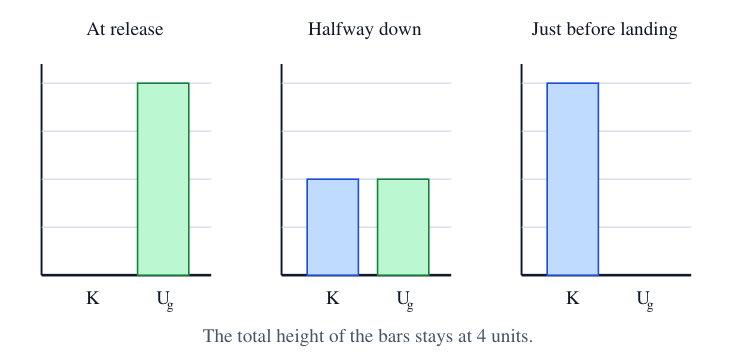
An energy bar chart lets you reason before using algebra. Draw bars for K, U_g and U_s at the start and at the end, and make the totals agree. If friction acts, add a thermal bar. Once you can sketch the bars, the equation follows directly.
On a frictionless track, the speed at a point depends only on the height dropped, not on the shape of the track. For a block entering a vertical loop of radius R, the top of the loop needs a speed of at least √(gR). Energy conservation then gives a minimum release height of h = 2.5R.
Energy does not give you time or direction. Use it when a problem compares two positions, and use forces or kinematics when it asks how long something takes.
On the exam: write the energy statement before substituting numbers, and say why mechanical energy is or is not conserved.
Worked AP Physics 1: Algebra-Based Problem: Gravitational & Elastic Potential Energy, Conservation of Mechanical Energy, and Nonconservative Work
A 0.50 kg block is pushed against a horizontal spring (k = 200 N/m), compressing it by x = 0.30 m, and released from rest. The block slides across a rough patch of length d = 1.0 m (μ_k = 0.25, g = 10.0 m/s²) before rising up a frictionless ramp. Find the maximum vertical height h reached on the ramp.
Step 1 (Initial Elastic Potential Energy): U_s,i = (1/2)k·x² = 0.5(200 N/m)·(0.30 m)² = 9.0 J.
Step 2 (Thermal Energy Dissipated Across Rough Patch): ΔE_thermal = f_k·d = (μ_k·m·g)·d = 0.25(0.50 kg)(10.0 m/s²)(1.0 m) = 1.25 J.
Step 3 (Energy Conservation for Block-Spring-Earth-Track System): U_s,i = U_g,f + ΔE_thermal → m·g·h = 9.0 J - 1.25 J = 7.75 J.
Step 4 (Solve for Maximum Ramp Height): h = 7.75 J / [(0.50 kg)(10.0 m/s²)] = 7.75 / 5.0 = 1.55 m.
A single isolated object can ONLY possess kinetic energy; gravitational potential energy U_g requires including Earth in your system, and spring potential energy U_s requires including the spring.
Practice procedure
To clear a frictionless vertical loop of radius R starting from rest at height h, set mgh = mg(2R) + (1/2)m(gR) → h_min = 2.5 R.
Common mistakes
Assigning gravitational potential energy to a 'block-only' system on an AP Physics 1 energy bar chart.
Forgetting that at the top of a vertical loop, the cart still has kinetic energy K = (1/2)mv_min² = (1/2)mgR, so h_min = 2.5R rather than 2.0R.
Saying a falling ball has potential energy without including Earth in the system.
Using energy to find a time. Energy compares positions and does not tell you how long a motion takes.
Key terms
Term: Conservative Force
Definition: A force (such as gravity or an ideal spring force) whose work is path-independent and can be represented by a potential energy function.
Term: Mechanical Energy
Definition: The sum of kinetic and potential energies E_mech = K + U_g + U_s within a system.