What to practice
- Calculate momentum and change in momentum with correct signs, including rebounds.
- Find impulse from the area under a force–time graph and use it to find a change in velocity.
- Explain how a longer contact time lowers the average force.
Framework
Linear Momentum: p = m·v | Impulse: J = area under the F-t graph = F_avg·Δt = Δp = m·v_f - m·v_i
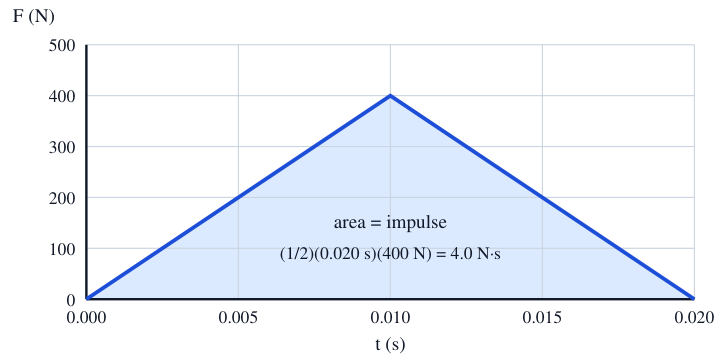
Momentum, p = mv, is a vector, so every problem needs a sign convention. Impulse is the area under a force–time graph and equals F_avg Δt, and it equals the change in momentum of the object. The impulse–momentum idea explains why a longer contact time means a smaller average force for the same change in momentum.
Because momentum has direction, a rebound matters. A ball that arrives at +8 m/s and leaves at −6 m/s has a velocity change of 14 m/s, not 2 m/s. The magnitudes add whenever the object reverses. That is why a bouncing object receives a larger impulse than one that stops and stays, nearly twice as large if it bounces back at almost the same speed.
On a force–time graph, the area is the impulse. Divide the impulse by the mass to find the change in velocity. A triangular pulse has an area of (1/2)(peak force)(time), and the average force is the impulse divided by the contact time.
Air bags, gym mats and catching a ball with soft hands all work the same way. The speeds fix the change in momentum, so stretching the contact time lowers the average force.
Momentum and kinetic energy are different quantities. Two objects with the same momentum can have very different kinetic energies, because K = p²/(2m).
On the exam: set a positive direction first, and show the sign of each velocity in Δp = m(v_f − v_i).
Worked AP Physics 1: Algebra-Based Problem: Linear Momentum, Impulse-Momentum Theorem, and Force-Time Graphs
A 0.20 kg rubber ball moving horizontally right at v_i = +15.0 m/s strikes a vertical wall and rebounds horizontally left at v_f = -10.0 m/s after a contact duration of Δt = 0.025 s. Calculate the impulse J delivered to the ball and the magnitude of the average force exerted by the wall.
Step 1 (Define Coordinate Sign Convention): Let rightward be positive (+x) and leftward be negative (-x), so v_i = +15.0 m/s and v_f = -10.0 m/s.
Step 2 (Calculate Change in Momentum / Impulse): J_x = Δp_x = m·(v_f - v_i) = (0.20 kg)(-10.0 m/s - 15.0 m/s) = (0.20 kg)(-25.0 m/s) = -5.0 N·s (5.0 N·s directed left).
Step 3 (Magnitude of Average Wall Force): |F_avg| = |J_x| / Δt = 5.0 N·s / 0.025 s = 200 N.
Step 4 (Compare with Sticking Collision): Had the ball stuck to the wall (v_f = 0), |Δp| would have been only (0.20)(15.0) = 3.0 N·s; rebounding increases the impulse and force!
Momentum and impulse are vectors: when an object rebounds in the opposite direction, the magnitude of its velocity change is |v_f| + |v_i|, NEVER |v_f| - |v_i|.
Practice procedure
On a Force-vs.-Time (F-t) graph, compute the area under the curve to find Impulse J = Δp, then divide by mass m to find Δv.
Common mistakes
Confusing the area under an F-t graph (Impulse = Δp) with the area under an F-x graph (Work = ΔK).
Subtracting speeds for a rebound (15 − 10 = 5 m/s). When the direction reverses, the magnitudes add, so the velocity change is −10 − 15 = −25 m/s.
Thinking equal momentum means equal kinetic energy. The lighter object has more kinetic energy.
Key terms
Term: Impulse (J)
Definition: The product of average net force and contact time J = F_avg·Δt (area under F-t curve), equal to change in momentum Δp.
Term: Impulse-Momentum Theorem
Definition: Vector theorem J_net = Δp derived from integrating Newton's Second Law F_net = Δp/Δt over time.