What to practice
- Apply conservation of momentum in one and two dimensions, using components.
- Classify a collision as elastic, inelastic or perfectly inelastic from data.
- Split a problem into a momentum stage and an energy stage.
- Explain why the center of mass keeps a constant velocity when the net external force is zero.
Framework
Momentum Conservation: m_1 v_1i + m_2 v_2i = m_1 v_1f + m_2 v_2f | 1D Elastic: v_1i - v_2i = -(v_1f - v_2f) | v_cm = P_total / M_total
When the net external force on a system is zero, the system's total momentum stays constant, whatever happens inside it. Momentum is conserved in every isolated collision, but kinetic energy is conserved only in elastic ones. In two dimensions, conserve each component separately. When a problem has a collision and then a swing or slide, use momentum for the collision and energy for the part after it.
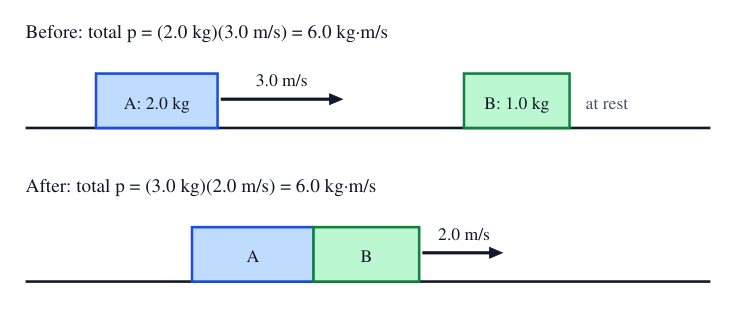
Use conservation of momentum in three steps. Define the system, check that external forces are negligible during the interaction, and then set the total momentum before equal to the total momentum after, with signs. In a collision the forces between the objects are large and brief, so outside forces such as friction hardly matter during the impact.
To classify a collision, compare the total kinetic energy before and after. If it stays the same, the collision is elastic. If it falls, the collision is inelastic, and if the objects stick together, it is perfectly inelastic. Momentum is conserved in all three.
Some problems come in two stages. In a ballistic pendulum, a projectile embeds in a hanging block and the block swings up. Use momentum for the impact, where mechanical energy is not conserved, and then energy for the swing. Setting the projectile's starting kinetic energy equal to mgh skips the first stage and gives a wrong answer.
With no net external force, the center of mass of a system keeps a constant velocity, even through collisions and explosions.
On the exam: say which stage each conservation law applies to, and why.
Worked AP Physics 1: Algebra-Based Problem: Conservation of Linear Momentum: Elastic, Inelastic, 2D Collisions, and Center-of-Mass Velocity
In a ballistic pendulum, a bullet of mass m = 0.050 kg traveling horizontally at v_0 = 210 m/s embeds into a stationary wooden block of mass M = 1.45 kg suspended by strings (take g = 10.0 m/s²). Find (a) the speed V of the bullet-block system immediately after impact, (b) the maximum height h the pendulum rises, and (c) the fraction of initial kinetic energy lost during the impact.
Step 1 (Stage 1 — Perfectly Inelastic Collision Conserves Momentum): m·v_0 = (m + M)·V → V = (0.050 kg·210 m/s) / (0.050 + 1.45 kg) = 10.5 / 1.50 = 7.0 m/s.
Step 2 (Stage 2 — Post-Collision Swing Conserves Mechanical Energy): (1/2)(m + M)V² = (m + M)g·h → h = V² / (2g) = (7.0 m/s)² / (20.0 m/s²) = 49.0 / 20.0 = 2.45 m.
Step 3 (Kinetic Energy Ratio): K_i = (1/2)(0.050)(210)² = 1,102.5 J, whereas K_after = (1/2)(1.50)(7.0)² = 36.75 J. Thus K_after / K_i = m / (m + M) = 0.050 / 1.50 = 1/30 (3.33%).
Step 4 (Fraction of Kinetic Energy Converted to Thermal/Deformation Energy): 1 - 1/30 = 29/30 = 96.7% of the initial kinetic energy was dissipated during the embedding collision.
A ballistic pendulum is ALWAYS a two-stage problem: conserve linear momentum FIRST during the brief inelastic impact (where mechanical energy is NOT conserved), then conserve mechanical energy during the upward swing.
Practice procedure
Remember that as long as F_net,ext = 0 during any collision (elastic or inelastic), the velocity of the system's center of mass v_cm remains completely constant.
Common mistakes
Assuming momentum is not conserved in an inelastic collision (momentum is conserved in ALL isolated collisions).
Setting (1/2)mv_0² = (m + M)gh directly in a ballistic pendulum. Mechanical energy is lost during the collision, so use momentum for the impact and energy only for the swing.
Assuming kinetic energy is conserved because momentum is. Only elastic collisions conserve both.
Key terms
Term: Elastic Collision
Definition: Collision in which BOTH total linear momentum and total translational kinetic energy of the system are conserved.
Term: Perfectly Inelastic Collision
Definition: Collision in which the colliding objects stick together and move with a common final velocity v_cm, maximizing kinetic energy loss.