What to practice
- Connect rotational quantities to their linear partners and solve constant-α problems.
- Calculate torque from a force and its lever arm.
- Find rotational inertia, including with the parallel axis theorem.
- Solve static equilibrium problems by choosing a useful pivot.
Framework
ω = ω_0 + α·t | τ = r·F·sin(φ) = r_perp·F | I = sum m_i r_i² | I_parallel = I_cm + M·d² | Στ = I·α
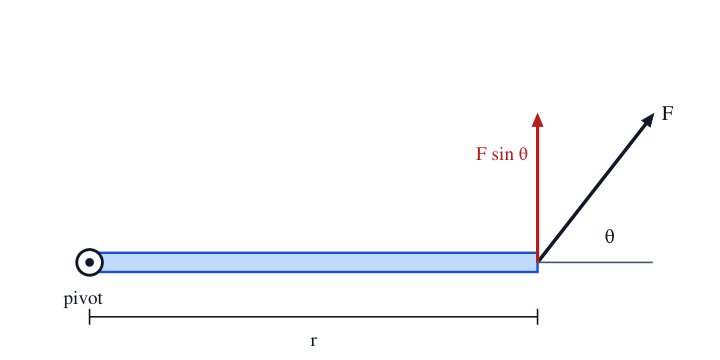
Rotation has a parallel set of ideas to linear motion: angle, angular velocity and angular acceleration, with v = rω and a_t = rα linking the two. Torque is τ = rF sin θ, which depends on the size of the force, where it acts and at what angle. Rotational inertia, I = Σmr², measures resistance to angular acceleration, and Στ = Iα is Newton's second law for rotation. An object in equilibrium has zero net force and zero net torque about every axis.
Every rotational quantity has a linear partner. Angle matches position, ω matches velocity, α matches acceleration, torque matches force and rotational inertia matches mass. The constant-acceleration equations carry over in the same form, such as ω = ω_0 + αt. Every point on a rigid object has the same ω, but points farther from the axis have a larger linear speed.
You can also think of torque as the force multiplied by its lever arm, the perpendicular distance from the axis to the line of the force. Moving mass farther from the axis raises rotational inertia quickly, because r is squared. If you know the rotational inertia about the center of mass, the parallel axis theorem gives I = I_cm + Md² about a parallel axis a distance d away.
For static equilibrium, write both conditions: ΣF = 0 and Στ = 0. The net torque is zero about every point, so you may choose any pivot. Put it where an unknown force acts, so that force drops out of the torque equation.
For a pulley with rotational inertia I and radius R, the tensions on the two sides differ. Write (T_1 − T_2)R = Iα and link the motions with α = a/R.
On the exam: state your pivot, and give each torque a sign based on the rotation it would cause.
Worked AP Physics 1: Algebra-Based Problem: Rotational Kinematics, Torque, Rotational Inertia, and Rotational Equilibrium
A uniform horizontal beam of length L = 4.0 m and mass M = 10.0 kg is hinged to a wall at its left end (x = 0) and supported by a vertical cable attached at its right end (x = L). A sign of mass m = 15.0 kg hangs at x = 3.0 m (take g = 10.0 m/s²). Find the cable tension T and the vertical hinge force F_y.
Step 1 (Choose Pivot at the Wall Hinge x = 0): Placing the pivot at x = 0 gives zero lever arm to the unknown hinge forces, eliminating them from the torque equation.
Step 2 (Identify Torques About x = 0): The beam's weight M·g = 100 N acts at its center of mass x_cm = 2.0 m (clockwise), the sign's weight m·g = 150 N acts at x = 3.0 m (clockwise), and cable tension T acts at x = 4.0 m (counterclockwise).
Step 3 (Rotational Equilibrium Στ_0 = 0): T·(4.0 m) - (100 N)(2.0 m) - (150 N)(3.0 m) = 0 → 4.0T = 200 + 450 = 650 N·m → T = 162.5 N.
Step 4 (Translational Equilibrium ΣF_y = 0): F_y + T - M·g - m·g = 0 → F_y = 100 N + 150 N - 162.5 N = 87.5 N upward.
Static equilibrium requires BOTH zero net force (ΣF = 0) and zero net torque (Στ = 0) about any chosen pivot; always place your pivot at the point where an unknown force acts.
Practice procedure
For a massive pulley of rotational inertia I and radius R with different cord tensions T_1 and T_2 on either side, write the torque equation (T_1 - T_2)·R = I·α with α = a / R.
Common mistakes
Using the angle between force and the vertical instead of the angle φ between the position vector r and force F in τ = r·F·sin(φ).
Thinking a massive pulley has the same tension on both sides. The difference in tension is what turns it.
Writing only one equilibrium condition. An object at rest needs zero net force and zero net torque.
Key terms
Term: Torque (τ)
Definition: Rotational effectiveness of a force about a pivot, τ = r·F·sin(φ) = r_perp·F in N·m.
Term: Rotational Inertia (I)
Definition: Resistance of a rigid body to angular acceleration about an axis, I = sum m_i r_i², which increases as mass is distributed farther from the axis.