What to practice
- Split the kinetic energy of a rolling object into translation and rotation.
- Rank rolling objects using the shape factor I/(MR²).
- Use angular impulse and conservation of angular momentum for spinning objects and point objects.
- Describe the speed, energy and angular momentum of a satellite in orbit.
Framework
Rolling Without Slipping: v_cm = R·ω, a_cm = R·α | K_total = (1/2)m·v_cm² + (1/2)I·ω² | L = I·ω, L_point = m·v·r_perp | ΔL = τ_net·Δt
A rotating object stores kinetic energy (1/2)Iω², and a torque acting through an angle does work on it. Rolling without slipping ties the two motions together with v = rω, so a rolling object's energy splits between translation and rotation. Angular momentum is L = Iω for a rigid object and L = mvr for a point object with r measured perpendicular to the velocity. With no net external torque, L stays constant. A satellite's angular momentum about the planet stays constant because gravity exerts no torque about the planet.
For an object rolling without slipping, the total kinetic energy is (1/2)mv² + (1/2)Iω², with v = Rω. The two parts share whatever energy gravity supplies. An object with more of its mass far from the axis puts more energy into rotation and moves more slowly. In a race down a ramp, a solid sphere beats a solid disk, which beats a hollow sphere, which beats a hoop. Mass and radius cancel. Only the shape factor I/(MR²) matters: 2/5, 1/2, 2/3 and 1.
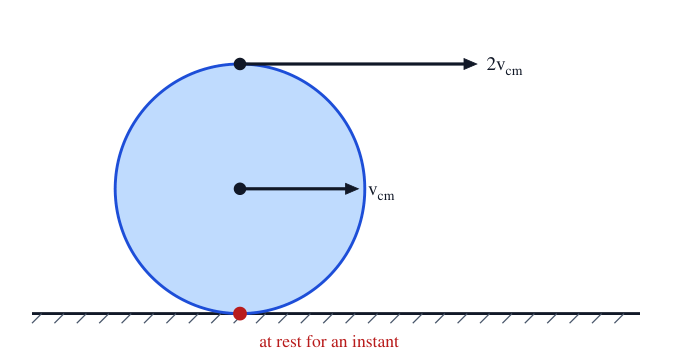
Static friction makes rolling possible, but it does no work during pure rolling, because the contact point is at rest for an instant.
A net torque changes angular momentum: ΔL = τΔt. With no net external torque, L stays constant. A skater who pulls in her arms lowers I, so ω rises. Her kinetic energy rises too, because her muscles do work. A point object moving in a straight line also has angular momentum about a pivot, L = mvr, with r the perpendicular distance from the pivot to its line of motion.
Satellites use the same ideas. In a circular orbit, gravity supplies the centripetal force, so v = √(GM/r). On an elliptical orbit, angular momentum stays constant, so the satellite moves fastest at its closest point.
On the exam: check for an external torque before you conserve L, and remember that kinetic energy can change even when L does not.
Worked AP Physics 1: Algebra-Based Problem: Rotational Kinetic Energy, Rolling Without Slipping, and Conservation of Angular Momentum
A solid cylinder (I = (1/2)M·R²) and a thin hoop (I = M·R²) of the same mass M and radius R are released from rest at the top of a rough incline of vertical height H and roll without slipping to the bottom. Derive their bottom speeds and explain why static friction does zero work.
Step 1 (General Energy Equation for Rolling Shape I = c·M·R²): Because static friction acts at the instantaneous point of contact (where velocity is momentarily zero), W_friction = 0 and mechanical energy is conserved: M·g·H = (1/2)M·v_cm² + (1/2)(c·M·R²)(v_cm / R)² = (1/2)(1 + c)M·v_cm².
Step 2 (Solve for Bottom Center-of-Mass Speed): Canceling M gives v_cm = √(2g·H / (1 + c)), which depends ONLY on the shape factor c = I/(M·R²) and height H, not on M or R.
Step 3 (Compare Solid Cylinder vs. Thin Hoop): For the solid cylinder (c = 1/2), v_cyl = √((4/3)g·H) = 1.15√(g·H). For the thin hoop (c = 1), v_hoop = √(g·H). Thus the solid cylinder reaches the bottom with a higher translational speed and wins the race.
Step 4 (Role of Static Friction vs. Frictionless Ramp): Static friction exerts the torque τ = f_s·R needed to spin up the cylinder, converting part of M·g·H into rotational kinetic energy K_rot; on a frictionless ramp (ω = 0), a sliding block would have all energy in K_trans and move even faster at v = √(2g·H).
In a race down a rough incline, any rolling object with a smaller dimensionless shape factor c = I/(M·R²) (solid sphere c = 2/5 < solid disk c = 1/2 < hollow sphere c = 2/3 < hoop c = 1) wins regardless of its mass M or radius R.
Practice procedure
For a point particle moving in a straight line at speed v with closest-approach distance r_perp to a pivot, its angular momentum about the pivot is constant and equal to L = m·v·r_perp.
Common mistakes
Claiming a particle moving in a straight line has zero angular momentum about an off-line pivot.
Saying static friction dissipates mechanical energy as heat during pure rolling without slipping.
Thinking a heavier object rolls down a ramp faster. Mass cancels, and only the shape matters.
Assuming kinetic energy stays constant when a skater pulls in her arms. Angular momentum stays constant, and kinetic energy rises.
Key terms
Term: Rolling Without Slipping
Definition: Combined translation and rotation where the contact point is momentarily at rest relative to the surface, enforcing v_cm = R·ω.
Term: Conservation of Angular Momentum
Definition: When net external torque about a fixed point is zero (Στ_ext = 0), total angular momentum L_total remains constant.