What to practice
- Describe position, velocity, acceleration and energy at each point of an oscillation.
- Calculate the period of a block on a spring and of a simple pendulum.
- Predict how changes in amplitude, mass, spring constant, length or g affect the motion.
- Read and sketch graphs of simple harmonic motion.
Framework
F_x = -k·x | Mass-Spring Period: T_s = 2π√(m/k) | Simple Pendulum Period: T_p = 2π√(L/g) | E_total = (1/2)k·A² = (1/2)m·v² + (1/2)k·x²
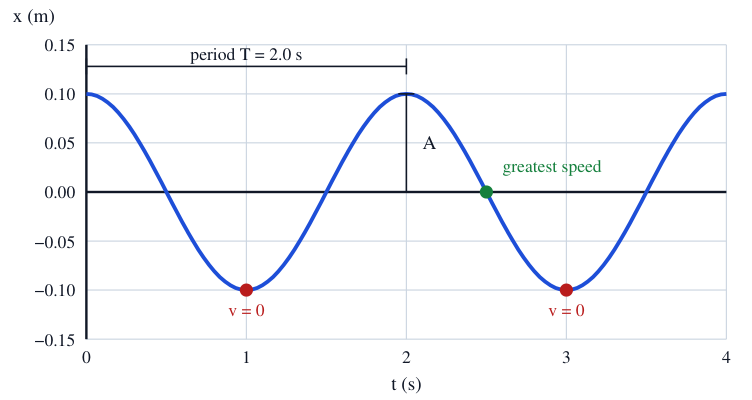
Simple harmonic motion happens when a restoring force is proportional to displacement. Position, velocity and acceleration all vary sinusoidally, with maximum speed at equilibrium and maximum acceleration at the turning points. The period of a block on a spring is T = 2π√(m/k) and of a small-angle pendulum is T = 2π√(L/g). Neither depends on amplitude. The total energy of a block–spring system is (1/2)kA², shared between kinetic and potential energy at every position.
Picture a block on a spring. At the turning points, x = ±A, the block stops for an instant, the spring force and acceleration are at their largest, and all the energy is elastic. At equilibrium the net force is zero, the speed is at its maximum, and all the energy is kinetic. Acceleration always points toward equilibrium, opposite to the displacement.
When the motion starts at x = A, the position is x = A cos(2πft), and T = 1/f. On a graph, the velocity curve is the slope of the position curve, so the velocity is zero where the position is at a peak.
Amplitude changes energy, not timing. Doubling A makes the total energy four times as large and doubles the maximum speed and maximum acceleration, while the period stays the same. Mass and spring constant set the period of a spring oscillator. Length and g set the period of a pendulum, and the mass of the bob does not matter.
Hanging a spring vertically or setting it on a frictionless incline shifts the equilibrium position, but the period is still T = 2π√(m/k).
On the exam: connect two positions with the energy statement (1/2)kA² = (1/2)kx² + (1/2)mv².
Worked AP Physics 1: Algebra-Based Problem: Simple Harmonic Motion (SHM): Mass-Spring Systems, Simple Pendulums, and SHM Graphs
A 0.50 kg block attached to a horizontal spring of force constant k = 200 N/m oscillates in Simple Harmonic Motion with amplitude A = 0.10 m on a frictionless surface. Calculate (a) the angular frequency ω and period T, (b) the total mechanical energy E_total, (c) the maximum speed v_max, and (d) the speed when x = 0.060 m.
Step 1 (Angular Frequency & Period): ω = √(k/m) = √(200 / 0.50) = √(400) = 20.0 rad/s. Period T = 2π / ω = 2π / 20.0 = π/10 = 0.314 s.
Step 2 (Total Mechanical Energy): E_total = (1/2)k·A² = 0.5(200 N/m)·(0.10 m)² = 1.00 J.
Step 3 (Maximum Speed at Equilibrium x = 0): At x = 0, U_s = 0 and K_max = E_total → v_max = A·ω = (0.10 m)(20.0 rad/s) = 2.00 m/s.
Step 4 (Speed at x = 0.060 m): Using (1/2)m·v² + (1/2)k·x² = (1/2)k·A² → v = ω·√(A² - x²) = 20.0√(0.10² - 0.060²) = 20.0(0.080) = 1.60 m/s.
Doubling the amplitude A of an ideal mass-spring oscillator quadruples total energy E = (1/2)kA² and doubles v_max = A·ω and a_max = A·ω², but has ZERO effect on the period T = 2π√(m/k).
Practice procedure
Remember that hanging a spring vertically or placing it on a frictionless incline shifts the equilibrium position x_eq but does NOT change the oscillation period T = 2π√(m/k).
Common mistakes
Thinking that increasing the mass of a pendulum bob or hanging a mass-spring system on the Moon changes both periods in the same way (T_pendulum depends on g and not m; T_spring depends on m and not g).
Assuming kinetic energy and potential energy are equal at the halfway point x = A/2 (at x = A/2, U_s = (1/4)E_total and K = (3/4)E_total; U_s = K occurs at x = A/√(2)).
Thinking a larger amplitude means a longer period. The block travels farther but moves faster, so the period stays the same.
Thinking acceleration is greatest where speed is greatest. Acceleration is largest at the turning points and zero at equilibrium.
Key terms
Term: Simple Harmonic Motion (SHM)
Definition: Periodic oscillation driven by a linear restoring force F_x = -k·x proportional to displacement from equilibrium.
Term: Restoring Equilibrium
Definition: The position where net force is zero (F_net = 0), acceleration is zero, and speed is at its maximum v_max.