What to practice
- Calculate density, gauge pressure and absolute pressure.
- Explain where the buoyant force comes from and calculate it.
- Draw free-body diagrams for floating and submerged objects.
- Find the fraction of a floating object below the surface.
Framework
ρ = m / V | Hydrostatic Pressure: P = P_0 + ρ·g·h (P_gauge = ρ·g·h) | Archimedes' Principle: F_B = ρ_fluid·V_sub·g
Fluids at rest are described by density, ρ = m/V, and pressure, P = F/A. Pressure grows with depth as P = P_0 + ρgh and depends on depth and density, not on the shape of the container. The buoyant force equals the weight of the fluid displaced, F_B = ρ_fluid V_sub g, so use the fluid's density and the submerged volume. A floating object has F_B equal to its weight.
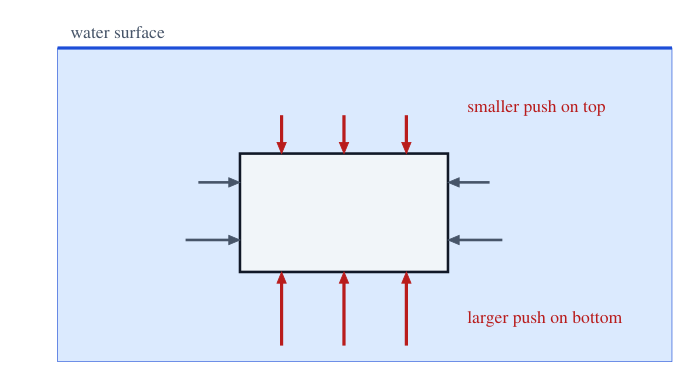
Pressure is force per area, and a fluid pushes on every surface at right angles to it. Gauge pressure is the pressure above the atmosphere, ρgh. Absolute pressure adds the atmosphere, P_0 + ρgh. Read the question to see which one it asks for.
The buoyant force exists because the pressure on the bottom of a submerged object is larger than the pressure on its top. It depends on the fluid's density and the submerged volume, not on the object's own density.
Draw a free-body diagram for any object in a fluid. For a floating object, F_B = mg, and the submerged fraction equals ρ_object/ρ_fluid. For a fully submerged object, V_sub is its whole volume, and a string or a scale may supply another force. A scale reading in water is smaller than in air by exactly the buoyant force.
Pressure applied to an enclosed fluid is passed along through the fluid, an idea called Pascal's principle that explains hydraulic lifts. It is useful background here, but it is not a listed topic in the current course framework.
On the exam: show the forces on the object, and say which volume and which density you used.
Worked AP Physics 1: Algebra-Based Problem: Hydrostatic Pressure, Pascal's Principle, and Archimedes' Buoyancy Principle
A solid metal crown has weight W_air = 30.0 N when weighed in air and apparent weight (scale tension) T_water = 27.0 N when completely submerged in fresh water of density ρ_w = 1,000 kg/m³ (take g = 10.0 m/s²). Determine the buoyant force F_B, the crown's volume V, and its density ρ_crown.
Step 1 (Static Equilibrium of Submerged Crown): Vertically, T_water + F_B - W_air = 0 → F_B = W_air - T_water = 30.0 N - 27.0 N = 3.0 N.
Step 2 (Crown Volume from Archimedes' Principle): Since F_B = ρ_w·V·g, V = F_B / (ρ_w·g) = 3.0 N / [(1,000 kg/m³)(10.0 m/s²)] = 3.0e-4 m³.
Step 3 (Crown Mass and Density): Mass m = W_air / g = 30.0 N / 10.0 m/s² = 3.0 kg → ρ_crown = m / V = 3.0 kg / 3.0e-4 m³ = 10,000 kg/m³ (silver alloy, not pure gold at 19,300 kg/m³!).
Step 4 (Shortcut Specific Gravity Ratio): Notice ρ_crown / ρ_w = W_air / F_B = 30.0 N / 3.0 N = 10.0.
For a floating object (ρ_obj < ρ_fluid), F_B = m_obj·g and the submerged volume fraction is V_sub / V_total = ρ_obj / ρ_fluid; for a completely submerged object, F_B = ρ_fluid·V_total·g.
Practice procedure
Always check whether a fluid problem asks for Gauge Pressure (ρ·g·h) or Absolute Pressure (P_0 + ρ·g·h).
Common mistakes
Using the object's density in the buoyant force. Use the density of the fluid.
Thinking a wider container has a larger pressure at the same depth. Pressure depends on depth and density, not on the shape.
Thinking the buoyant force grows as a fully submerged object sinks deeper. The pressure on every face rises, but the difference between bottom and top stays the same, so the buoyant force does not change.
Key terms
Term: Archimedes' Principle
Definition: Any fluid exerts an upward buoyant force F_B on a submerged or floating object equal to the weight of the fluid displaced: F_B = ρ_fluid·V_sub·g.
Term: Gauge Pressure
Definition: The excess pressure above atmospheric pressure, P_gauge = P_abs - P_0 = ρ·g·h.