What to practice
- Use continuity to relate speed and cross-sectional area.
- Apply Bernoulli's equation between two points, dropping terms with a stated reason.
- Derive and use Torricelli's result.
- Combine fluid flow with projectile motion.
Framework
Continuity: Q = A_1 v_1 = A_2 v_2 (with A = π·r²) | Bernoulli's Equation: P_1 + (1/2)ρ·v_1² + ρ·g·y_1 = P_2 + (1/2)ρ·v_2² + ρ·g·y_2 | Torricelli: v = √(2g·h)
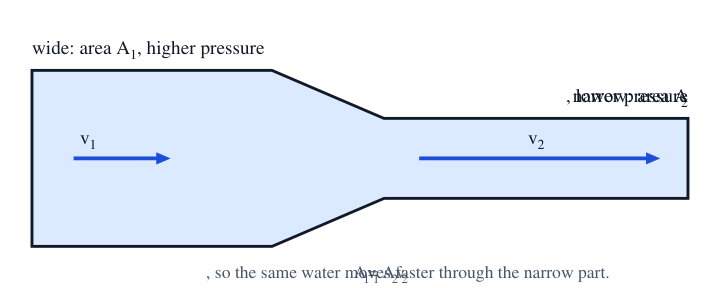
Moving fluids obey two conservation ideas. Continuity says the volume flow rate stays constant, A_1 v_1 = A_2 v_2, so a fluid speeds up where a pipe narrows. Bernoulli's equation applies energy conservation to a flowing fluid: P + (1/2)ρv² + ρgy stays constant along the flow. Torricelli's result, v = √(2gh), is the special case of a fluid leaving a small opening a depth h below an open surface.
Continuity is a bookkeeping rule. The same volume must pass each point every second, so a narrower section means faster flow. Area depends on the radius squared, so cutting the radius in half cuts the area to one-fourth and makes the speed four times as large.
Bernoulli's equation compares two points in the same flow. Each term is an energy per unit volume: P is the pressure term, (1/2)ρv² is the kinetic term and ρgy is the height term. In a level pipe, faster flow means lower pressure. That feels backward at first, but the fluid speeds up because the pressure behind it is larger than the pressure ahead of it.
To apply the equation, pick two points where you know the most, then cancel what you can. If both points are open to the air, P_1 = P_2 = P_atm. If the surface is large compared with the opening, the surface speed is close to zero. Those two steps give Torricelli's result, v = √(2gh).
Water leaving a hole is then a projectile. The exit speed comes from Bernoulli's equation, and the landing point comes from kinematics.
On the exam: name your two points, and say which terms you dropped and why.
Worked AP Physics 1: Algebra-Based Problem: Fluid Dynamics: Volume Flow Rate Continuity and Bernoulli's Conservation of Energy Equation
Water (ρ = 1,000 kg/m³) flows steadily through a horizontal pipe. In wide section 1, the pipe radius is r_1 = 0.040 m, the flow speed is v_1 = 2.0 m/s, and the absolute pressure is P_1 = 180,000 Pa. The pipe narrows in section 2 to radius r_2 = 0.020 m. Find the flow speed v_2 and absolute pressure P_2 in the narrow section.
Step 1 (Cross-Sectional Area Ratio): Since A = π·r², halving the radius from r_1 = 0.040 m to r_2 = 0.020 m reduces the cross-sectional area by a factor of (r_1/r_2)² = 2² = 4 (A_1 = 4A_2).
Step 2 (Speed in Narrow Section via Continuity): By A_1 v_1 = A_2 v_2, v_2 = (A_1 / A_2)·v_1 = 4(2.0 m/s) = 8.0 m/s.
Step 3 (Apply Horizontal Bernoulli's Equation y_1 = y_2): P_1 + (1/2)ρ·v_1² = P_2 + (1/2)ρ·v_2² → P_2 = P_1 + (1/2)ρ·(v_1² - v_2²).
Step 4 (Calculate P_2): P_2 = 180,000 Pa + 0.5(1,000 kg/m³)(2.0² - 8.0² m²/s²) = 180,000 Pa - 500(60) Pa = 180,000 - 30,000 = 150,000 Pa.
When pipe diameter or radius is reduced by a factor of 2, cross-sectional area A = π·r² drops by a factor of 4, flow speed v increases by a factor of 4, and static fluid pressure P DECREASES.
Practice procedure
For a large open storage tank with a small spigot at depth h below the water surface, P_1 = P_2 = P_atm and v_1 ≈ 0, so Bernoulli simplifies to Torricelli's theorem: v_exit = √(2g·h).
Common mistakes
Thinking faster fluid has higher pressure. In a level pipe, faster flow goes with lower pressure.
Forgetting that area depends on radius squared. Halving the radius makes the speed four times as large, not twice.
Using a hole's height above the floor as the h in Torricelli's result. In v = √(2gh), h is the depth of the hole below the fluid's surface.
Key terms
Term: Continuity Equation
Definition: Conservation of mass for an incompressible fluid stating that volume flow rate Q = A·v is constant along a streamline.
Term: Bernoulli's Equation
Definition: Conservation of mechanical energy per unit volume for an ideal, non-viscous, incompressible fluid: P + (1/2)ρ·v² + ρ·g·y = constant.