What to practice
- Use Coulomb's law and superposition for up to four charged objects.
- Describe charging by friction, contact, polarization and grounding using conservation of charge.
- Set up dq, r and the surviving component for the field of a line, ring or arc, and evaluate the integral.
- Check a result with symmetry and with the far-field limit.
Framework
Coulomb's law: F = k|q₁q₂|/r²; Electric field: E = F/q; Field of a charge element: dE = k dq/r²; Long line of charge: E = 2kλ/r; Finite line, on its axis, distance a from the near end: E = kQ/[a(a + L)]; Ring, on its axis: E = kQz/(z² + R²)^(3/2); Semicircular arc, at its center: E = 2kQ/(πR²)
Everything in this course starts with charge. Charge is a scalar that comes in two signs. A proton carries +e and an electron carries −e, where e = 1.60 × 10⁻¹⁹ C, and a neutron carries none. Charge is conserved, so a system's net charge changes only when charge crosses its boundary, usually as electrons moved by friction or contact. A neutral object can still respond to nearby charge. Its charges shift slightly, which is called polarization, and that is why a charged rod attracts a scrap of neutral paper. Grounding connects an object to something so large, such as Earth, that it can give or take charge without changing.
Coulomb's law gives the force between two point charges: F = k|q₁q₂|/r², with k = 1/(4πε₀) = 9.0 × 10⁹ N·m²/C². Like charges repel and unlike charges attract. The 1/r² is what you use to predict changes: double the distance and the force falls to one fourth. With several charges, find the force from each one alone and add the forces as vectors. This is superposition.
The electric field lets you stop tracking the second charge. The field at a point is the force per unit charge on a small positive test charge placed there: E = F/q. It points away from positive charge and toward negative charge. Once you know E, the force on any charge q at that point is F = qE, so a negative charge feels a force opposite the field. Field lines show the direction of E, and they crowd together where the field is strong.
For a charged object with size, cut it into tiny pieces dq, treat each piece as a point charge, and add their fields with an integral. Four moves make this routine. Write dq in terms of position, such as dq = λ dx on a line. Write the distance r from dq to the field point. Use symmetry to find which components cancel, and keep only the component that survives. Then integrate and check that the far-away limit looks like kQ/r².
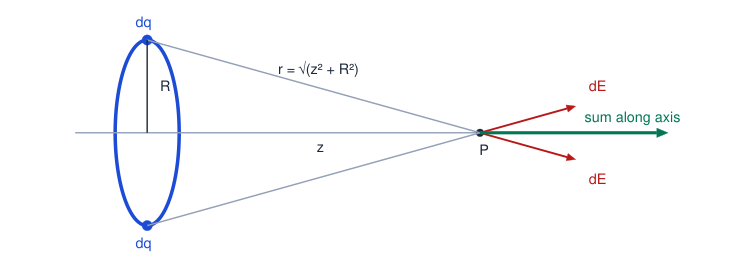
On the axis of a thin ring, every piece of charge is the same distance √(z² + R²) from the field point, and the sideways parts of the field cancel in pairs around the ring. Only the part along the axis survives, which is dE cos θ with cos θ = z/√(z² + R²). The integral then gives E = kQz/(z² + R²)^(3/2). It is zero at the center, as symmetry demands, and it becomes kQ/z² far away, as it must.
Exam boundary: the CED expects calculus only for an infinitely long, uniformly charged wire or cylinder at a distance from its axis, a thin ring on its axis, a semicircular arc or part of one at its center, and a finite line of charge at a point collinear with it or on its perpendicular bisector. You calculate forces among four or fewer charged objects, or more in highly symmetric cases. A charged disk is a common college exercise, but the CED does not list it.
Key relationships
Label: Coulomb's law
Formula: F = k|q₁q₂|/r²
Label: Electric field
Formula: E = F/q
Label: Field of a charge element
Formula: dE = k dq/r²
Label: Long line of charge
Formula: E = 2kλ/r
Label: Finite line, on its axis, distance a from the near end
Formula: E = kQ/[a(a + L)]
Label: Ring, on its axis
Formula: E = kQz/(z² + R²)^(3/2)
Label: Semicircular arc, at its center
Formula: E = 2kQ/(πR²)
Field of a charged rod at a point on its axis
A thin insulating rod of length L lies along the x-axis from x = 0 to x = L and carries uniformly distributed charge +Q, so λ = Q/L. Find the magnitude and direction of the electric field at point P on the x-axis at x = −a.
Step 1 (Define dq and r): A small segment of length dx at position x carries dq = λ dx = (Q/L) dx. Its distance from P is r = x + a.
Step 2 (Set up the integral): Every piece pushes a positive test charge at P in the −x direction, so the magnitudes add with no cancellation: E = ∫ from 0 to L of k dq/(x + a)² = k(Q/L) ∫ from 0 to L of dx/(x + a)².
Step 3 (Evaluate): ∫ from 0 to L of dx/(x + a)² = [−1/(x + a)] from 0 to L = 1/a − 1/(a + L) = L/[a(a + L)].
Step 4 (Simplify and check): E = k(Q/L)(L/[a(a + L)]) = kQ/[a(a + L)], in the −x direction. For a much larger than L, a + L is about a, so E is about kQ/a². From far away the rod looks like a point charge, which is the check we wanted.
After any charge-distribution integral, check the far-field limit. A finite object of total charge Q must look like a point charge from far away.
Practice procedure
Check your work: test the units, test the far-field limit, and test any point where symmetry tells you the answer, such as the center of a ring.
Common mistakes
Writing r = x when the distance from dq to the field point is x + a, or d − x.
Adding field magnitudes from a ring or arc without keeping only the component that survives symmetry.
Treating a negative charge as if the force on it points along E.
Key terms
Term: Charge density
Definition: Charge per unit length λ (C/m), per unit area σ (C/m²) or per unit volume ρ (C/m³).
Term: Superposition
Definition: The net field or force at a point is the vector sum of the contributions from each source acting alone.
Term: Polarization
Definition: A slight separation of charge inside an object, caused by nearby charge, with no change in its net charge.