What to practice
- Find flux from the field and the area vector, including its sign.
- Choose a Gaussian surface for spherical, cylindrical and planar symmetry and solve for E.
- Integrate a given charge density to find the enclosed charge.
- Explain where charge sits on a conductor and why E is zero in the metal.
Framework
Flux, uniform field: Φ_E = E · A = EA cos θ; Flux, general: Φ_E = ∫E · dA; Gauss's law: ∫E · dA over a closed surface = Q_enc/ε₀; Spherical shell element: dV = 4πr² dr; Cylindrical shell element: dV = 2πrL dr; Large sheet: E = σ/(2ε₀)
Electric flux measures how much field passes through an area. For a uniform field and a flat area, Φ_E = E · A = EA cos θ. The area vector A is perpendicular to the surface and, on a closed surface, points outward. So flux is positive where field leaves a closed surface and negative where it enters. When the field varies, add up small pieces: Φ_E = ∫E · dA.
Gauss's law says the net flux through any closed surface depends only on the charge inside: ∫E · dA over a closed surface = Q_enc/ε₀. Charge outside adds flux on one side and removes it on the other, so its net effect is zero. Making the surface bigger changes nothing as long as it encloses the same charge. The law is always true, but it solves for E only when symmetry lets you pull E out of the integral.
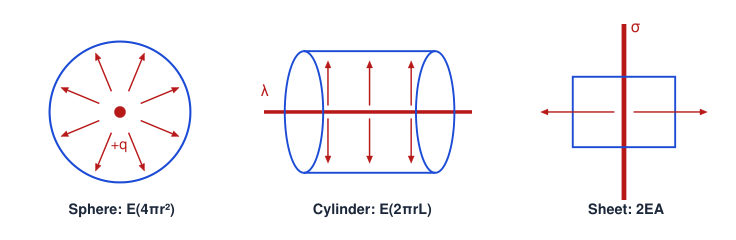
So choose a Gaussian surface where E is either perpendicular to the surface with a constant size, or parallel to it so that it adds no flux. A sphere around a spherical distribution gives E(4πr²). A coaxial cylinder of length L around a long line gives E(2πrL), and the flat ends add nothing. A short cylinder through a large sheet gives 2EA, so E = σ/(2ε₀) on each side, whatever the distance.
The enclosed charge is often the real work. If the density is uniform, Q_enc = ρ times the enclosed volume. If it varies with radius, you must integrate, because each thin shell holds a different density: Q_enc = ∫ρ(r)4πr² dr for a sphere and ∫ρ(r)2πrL dr for a cylinder. Stop the integral at the Gaussian radius r when you are inside the object, and at the object's surface R when you are outside it.
Conductors in equilibrium follow from the same law. The field inside the metal is zero, so a Gaussian surface inside the metal has zero flux and encloses zero net charge. All excess charge therefore sits on surfaces. If a charge +q sits in a cavity, the cavity wall must carry −q so that a surface in the metal around the cavity encloses nothing.
Exam boundary: the CED expects quantitative use of Gauss's law only for point charges and for distributions with spherical, cylindrical or planar symmetry. For other shapes you can still count enclosed charge to find net flux, but you will not solve for E.
Key relationships
Label: Flux, uniform field
Formula: Φ_E = E · A = EA cos θ
Label: Flux, general
Formula: Φ_E = ∫E · dA
Label: Gauss's law
Formula: ∫E · dA over a closed surface = Q_enc/ε₀
Label: Spherical shell element
Formula: dV = 4πr² dr
Label: Cylindrical shell element
Formula: dV = 2πrL dr
Label: Large sheet
Formula: E = σ/(2ε₀)
Non-uniform sphere, inside and outside
A solid non-conducting sphere of radius R has volume charge density ρ(r) = βr for r ≤ R, where β is a positive constant. Use Gauss's law to find E(r) inside and outside the sphere.
Step 1 (Choose the surface): By symmetry E is radial and has one size on a concentric sphere of radius r, so ∫E · dA over a closed surface = E(4πr²).
Step 2 (Integrate the enclosed charge for r < R): Thin shells have dV = 4πr'² dr'. So Q_enc = ∫ from 0 to r of (βr')(4πr'² dr') = 4πβ ∫ from 0 to r of r'³ dr' = πβr⁴.
Step 3 (Solve inside): E(4πr²) = πβr⁴/ε₀, so E = βr²/(4ε₀). The field grows as r² inside.
Step 4 (Solve outside): For r ≥ R the charge stops at R, so Q_total = πβR⁴ and E = βR⁴/(4ε₀r²) = kQ_total/r². Outside, the sphere acts like a point charge.
When density depends on r, integrate shell by shell. Never multiply ρ(r) by (4/3)πr³.
Practice procedure
Check your work: at r = R the inside and outside answers must agree for a charged insulator, since the field there has no surface charge to jump across.
Common mistakes
Multiplying a varying density ρ(r) by the volume (4/3)πr³ instead of integrating.
Integrating past r' = R when the Gaussian surface is outside the object.
Thinking a charge outside a Gaussian surface changes the net flux through it. It changes the field, not the net flux.
Key terms
Term: Gaussian surface
Definition: An imagined closed surface chosen so the flux integral is simple.
Term: Electrostatic equilibrium
Definition: The state in which charges in a conductor have stopped moving, so E = 0 in the metal.
Term: Area vector
Definition: A vector perpendicular to a surface with size equal to the area, pointing outward on a closed surface.