What to practice
- Add potentials from point charges with their signs.
- Set up and evaluate V = ∫k dq/r for a ring, arc or line.
- Move between V and E in both directions, including from graphs.
- Integrate across regions, and explain why V is constant inside a conductor.
Framework
Point charge: V = kq/r; Several charges: V = Σ kqᵢ/rᵢ; Continuous charge: V = ∫k dq/r; Field to potential: ΔV = −∫E · dr; Potential to field: E_x = −dV/dx; Ring, on its axis: V = kQ/√(z² + R²)
Electric potential is potential energy per unit charge, so V is a scalar measured in volts. For a point charge V = kq/r, with V = 0 at infinity. For several charges, add the potentials with their signs. There are no components to break down, which is why potential is often the easier route.
For a continuous object, V = ∫k dq/r. On the axis of a ring every piece is the same distance from the field point, so V = kQ/√(z² + R²) at once. Compare that with the field, where you first had to cancel the sideways parts. The same four habits apply: write dq, write r, integrate, and check the far-away limit.
Potential and field are two views of the same thing. Going from field to potential, ΔV = −∫E · dr. Going from potential to field, E_x = −dV/dx. The minus sign means the field points from high potential to low potential. On a graph of V against x, the slope is −E_x. On a graph of E_x against x, the area is −ΔV. Equipotential surfaces meet field lines at right angles, and moving a charge along an equipotential takes no work.
When the field has different formulas in different regions, split the integral at each boundary. Start at infinity, where V = 0, and integrate inward region by region. Potential stays continuous across a boundary even when the field jumps. Inside a charged conductor E = 0, so V is constant. It is not zero. It keeps the value it has at the surface.
Exam boundary: the CED expects calculus for potential only for the same shapes as the field: a long uniformly charged wire or cylinder, a thin ring on its axis, a semicircular arc or part of one at its center, and a finite line at a point collinear with it or on its perpendicular bisector.
Key relationships
Label: Point charge
Formula: V = kq/r
Label: Several charges
Formula: V = Σ kqᵢ/rᵢ
Label: Continuous charge
Formula: V = ∫k dq/r
Label: Field to potential
Formula: ΔV = −∫E · dr
Label: Potential to field
Formula: E_x = −dV/dx
Label: Ring, on its axis
Formula: V = kQ/√(z² + R²)
Potential of a charged conducting shell
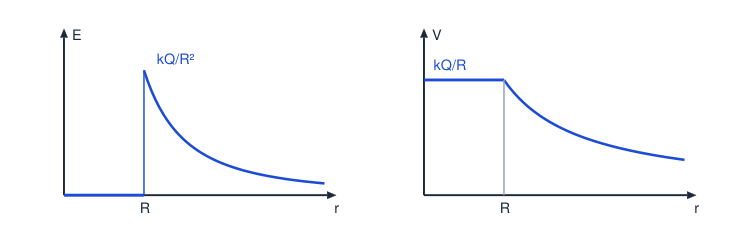
A hollow conducting spherical shell of radius R carries total charge +Q. Taking V = 0 at infinity, find V(r) outside and inside the shell, and explain why V is not zero inside even though E = 0.
Step 1 (Field by region): Gauss's law gives E = kQ/r² outward for r ≥ R. Inside, Q_enc = 0, so E = 0.
Step 2 (Integrate to a point outside): V(r) = −∫ from ∞ to r of (kQ/r'²) dr' = kQ/r. At the surface, V(R) = kQ/R.
Step 3 (Continue inside): Split the path at R. V(r) = V(R) − ∫ from R to r of 0 dr' = kQ/R.
Step 4 (Interpret): E_r = −dV/dr = 0 inside means the slope of V is zero, not V itself. So V stays flat at kQ/R throughout the interior.
Zero field means constant potential, not zero potential.
Practice procedure
Check your work: V must be continuous at every boundary, and the slope of your V(r) must give back the field you started with.
Common mistakes
Saying V = 0 inside a charged conductor because E = 0 there.
Forgetting to split the integral at r = R when you integrate into a sphere.
Treating potential as a vector and trying to take components.
Key terms
Term: Equipotential
Definition: A surface on which every point has the same potential. Field lines cross it at right angles.
Term: Potential difference
Definition: The change in potential energy per unit charge between two points.
Term: Electron volt
Definition: The energy gained by one elementary charge moving through 1 V, or 1.60 × 10⁻¹⁹ J.