What to practice
- Find the potential energy of a set of charges by counting every pair once.
- Explain the sign of U and connect it to the work of an outside agent.
- Use conservation of energy to find speeds and closest approach.
- Tell apart releasing one charge and releasing all of them.
Framework
Two charges: U = kq₁q₂/r; Several charges: U_sys = Σ over pairs of kqᵢqⱼ/rᵢⱼ; Charge moving through ΔV: ΔU = qΔV; Field work: W_field = −ΔU; Energy conservation: K_i + qV_i = K_f + qV_f
Two point charges have potential energy U = kq₁q₂/r, taking U = 0 at infinite separation. That energy equals the work an outside agent must do to bring them together slowly from far apart. The sign tells the story. Like charges give positive U, because you have to push them together. Unlike charges give negative U, because you would have to pull them apart.
For several charges, sum U over every pair, counting each pair once. Three charges have 3 pairs and four charges have 6 pairs. For a square of side s, that means 4 pairs at distance s and 2 pairs at distance s√2.
Keep two ideas apart. The quantity qV is the energy of one charge q in the potential made by the others. The quantity U_sys is the total energy of the whole set, with every pair included. If you release one charge while the others stay fixed, only the pairs that include the moving charge change. If you release all the charges, the whole of U_sys becomes kinetic energy shared among them.
Motion follows from energy conservation: K_i + qV_i = K_f + qV_f. A positive charge speeds up as it moves to lower potential, and a negative charge speeds up as it moves to higher potential. The change in potential energy is ΔU = qΔV, and the field does work W = −ΔU. Energy methods give speeds directly, with no need to know the path or the acceleration.
For a head-on approach to a fixed charge of the same sign, the moving particle stops where all its kinetic energy has become potential energy: ½mv² = kQq/r_min, if it started far away. If the particle has only part of the energy or starts at a finite distance, write the full conservation equation instead.
Key relationships
Label: Two charges
Formula: U = kq₁q₂/r
Label: Several charges
Formula: U_sys = Σ over pairs of kqᵢqⱼ/rᵢⱼ
Label: Charge moving through ΔV
Formula: ΔU = qΔV
Label: Field work
Formula: W_field = −ΔU
Label: Energy conservation
Formula: K_i + qV_i = K_f + qV_f
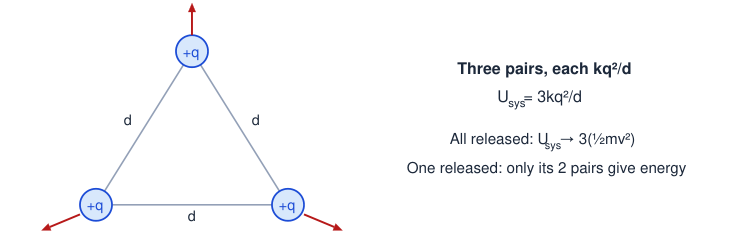
Three charges released from a triangle
Three identical point charges, each of charge +q and mass m, are held at the corners of an equilateral triangle of side d. (a) Find the total potential energy. (b) All three are released from rest. Find the speed of each when they are very far apart.
Step 1 (Count pairs): Three charges form 3 pairs, each separated by d.
Step 2 (Total energy): U_sys = kq²/d + kq²/d + kq²/d = 3kq²/d.
Step 3 (Final state): At infinite separation U = 0. By symmetry all three have the same speed, so K_total = 3(½mv²).
Step 4 (Conserve energy): 3kq²/d = (3/2)mv², so v = √(2kq²/(md)). Compare releasing only one charge with the other two held fixed: only 2kq²/d becomes kinetic energy, so that one charge reaches v = √(4kq²/(md)).
Ask what moves. Only the pairs that change separation give up energy.
Practice procedure
Check your work: a repelling pair should speed up as it separates, so the sign of your ΔU must match the direction of motion.
Common mistakes
Counting each pair twice by summing over all i and j.
Setting ½mv² equal to the total energy when several particles share it.
Mixing up qV for one charge with U_sys for the whole system.
Key terms
Term: System potential energy
Definition: The work needed to assemble the charges from infinite separation.
Term: Closest approach
Definition: The separation at which a charge moving toward a repelling charge momentarily stops.
Term: Conservative force
Definition: A force whose work does not depend on the path. The electrostatic force is one.