What to practice
- Describe where charge sits on a conductor and why the conductor is one equipotential.
- Predict how charge divides when conductors are joined or grounded.
- Derive capacitance for parallel-plate, coaxial and spherical geometry.
- Predict how Q, ΔV, E and U change when a dielectric is added, with and without a battery.
Framework
Capacitance: C = Q/ΔV; Parallel plates: C = κε₀A/d; Coaxial: C = 2πε₀L/ln(b/a); Concentric spheres: C = 4πε₀ab/(b − a); Stored energy: U = ½QΔV = ½C(ΔV)² = Q²/(2C); Dielectric, isolated capacitor: E = E₀/κ
In an ideal conductor, electrons move freely. Excess charge repels itself to the surface within a time too short to matter. Once charges stop moving, the conductor is in electrostatic equilibrium: E = 0 in the metal, and every point of the conductor is at one potential.
When conductors touch or are joined by a wire, charge moves until they share one potential. Two far-apart spheres joined by a thin wire end with kQ₁/r₁ = kQ₂/r₂, so the larger sphere holds more charge. Ground is an ideal reference at zero potential that can supply or absorb any amount of charge. Grounding a conductor while a charged object is nearby leaves it with an induced charge after the ground is removed.
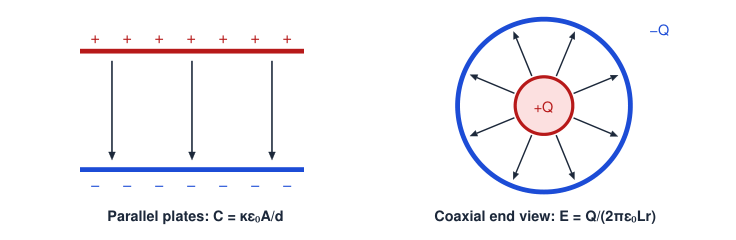
A capacitor is two conductors holding equal and opposite charge. Capacitance is C = Q/ΔV, and it depends only on shape and on the material between the conductors, not on Q or ΔV. For parallel plates C = κε₀A/d, so a larger area or a smaller gap raises C.
Every capacitance derivation takes the same three steps. Assume charge ±Q and find E between the conductors with Gauss's law. Integrate to get ΔV = ∫E dr. Divide C = Q/ΔV, and Q cancels. This gives C = 2πε₀L/ln(b/a) for a coaxial capacitor and C = 4πε₀ab/(b − a) for a concentric spherical one.
A charged capacitor stores energy U = ½QΔV = ½C(ΔV)² = Q²/(2C). Pick the form that holds the fixed quantity. When two capacitors at different voltages are connected, charge is conserved but stored energy falls, because some of it is lost as charge moves.
A dielectric polarizes in the field, and its own field opposes the field between the plates. Filling a capacitor raises C by the factor κ. What happens next depends on the battery. If the capacitor is isolated, Q stays fixed, so ΔV, E and U all fall by the factor κ. If the battery stays connected, ΔV stays fixed, so Q and U rise by the factor κ, and E stays the same.
Exam boundary: the CED expects quantitative work only with parallel-plate, concentric spherical and coaxial cylindrical capacitors.
Key relationships
Label: Capacitance
Formula: C = Q/ΔV
Label: Parallel plates
Formula: C = κε₀A/d
Label: Coaxial
Formula: C = 2πε₀L/ln(b/a)
Label: Concentric spheres
Formula: C = 4πε₀ab/(b − a)
Label: Stored energy
Formula: U = ½QΔV = ½C(ΔV)² = Q²/(2C)
Label: Dielectric, isolated capacitor
Formula: E = E₀/κ
Capacitance of a coaxial capacitor
A coaxial capacitor of length L, much longer than its radii, has an inner conductor of radius a with charge +Q and an outer conductor of radius b with charge −Q. Derive its capacitance, then find the energy it stores.
Step 1 (Gauss's law for a < r < b): A coaxial surface of radius r and length L gives E(2πrL) = Q/ε₀, so E = Q/(2πε₀Lr).
Step 2 (Integrate for ΔV): |ΔV| = ∫ from a to b of E dr = [Q/(2πε₀L)] ∫ from a to b of dr/r = [Q/(2πε₀L)] ln(b/a).
Step 3 (Divide): C = Q/|ΔV| = 2πε₀L/ln(b/a). Q cancels, so C depends only on geometry and on the material between the conductors.
Step 4 (Stored energy): U = Q²/(2C) = Q² ln(b/a)/(4πε₀L).
Assume ±Q, find E, integrate for ΔV, divide. The same three steps work for all three shapes.
Practice procedure
Check your work: C must come out in farads and must not contain Q or ΔV. If either survives, a step went wrong.
Common mistakes
Leaving Q or ΔV inside a formula for capacitance.
Assuming stored energy is conserved when two capacitors at different voltages are connected.
Holding the wrong quantity fixed when a dielectric goes in. Ask first whether the battery is still connected.
Key terms
Term: Dielectric constant κ
Definition: The factor by which an insulator raises capacitance. κ = 1 for vacuum and about 1 for air.
Term: Polarization of a dielectric
Definition: Bound charges shift slightly in a field, which produces a field opposing the external one.
Term: Ground
Definition: An ideal reference at zero potential that can supply or absorb any amount of charge.