What to practice
- Connect current to drift velocity and carrier density.
- Integrate a given current density over a cross-section.
- Find resistance from resistivity, including resistivity that varies along a length.
- Use the three forms of electric power, and rank bulb brightness.
Framework
Current: I = dq/dt = nqv_d A; Current density: J = nqv_d; Current from J: I = ∫J · dA; Uniform wire: R = ρL/A; Varying resistivity: R = ∫ρ(x) dx/A; Ohm's law: ΔV = IR; Field and current density: E = ρJ; Power: P = IΔV = I²R = (ΔV)²/R
Current is the rate at which charge passes through a cross-section: I = dq/dt. Inside a wire, carriers move with a slow average drift velocity on top of their fast random motion, and I = nqv_d A, where n is the number of carriers per unit volume. If the current is zero, the net motion is zero, but individual carriers still move.
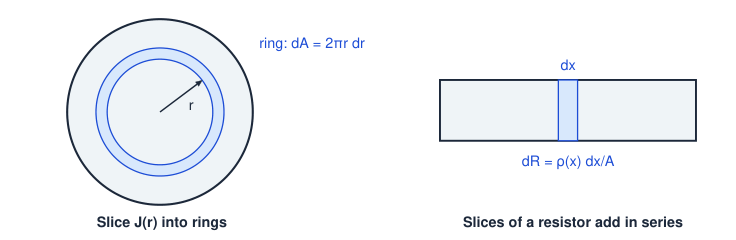
Current density is current per unit area, J = nqv_d, and it is a vector along the motion of positive charge. If J is uniform, I = JA. If J varies across the wire, integrate: I = ∫J · dA. For J that depends on radius, use thin rings of area dA = 2πr dr. Multiplying J(R) by πR² gives the wrong answer, because J is not the same everywhere.
Resistance measures how strongly an object opposes charge flow. For a uniform wire R = ρL/A. Resistivity ρ belongs to the material and usually rises with temperature. If the shape is uniform but the resistivity changes along the length, add thin slices in series: R = ∫ρ(x) dx/A.
Ohm's law, ΔV = IR, describes ohmic materials, which give a straight line through the origin on a graph of I against ΔV. The same idea point by point is E = ρJ. A curved I against ΔV graph means the resistance changes as conditions change, as it does in a lightbulb filament that heats up.
Power is the rate of energy transfer: P = IΔV = I²R = (ΔV)²/R. Choose the form that matches what stays the same. For a resistor, this energy leaves the circuit as thermal energy. Brighter bulbs have more power, so you can rank brightness by ranking power.
Exam boundary: the CED covers resistors of uniform geometry, including resistivity that varies along the length. Tapered or spherical resistors appear in some college courses, but the CED does not list them.
Key relationships
Label: Current
Formula: I = dq/dt = nqv_d A
Label: Current density
Formula: J = nqv_d
Label: Current from J
Formula: I = ∫J · dA
Label: Uniform wire
Formula: R = ρL/A
Label: Varying resistivity
Formula: R = ∫ρ(x) dx/A
Label: Ohm's law
Formula: ΔV = IR
Label: Field and current density
Formula: E = ρJ
Label: Power
Formula: P = IΔV = I²R = (ΔV)²/R
Current in a wire with non-uniform density
A long cylindrical wire of radius R carries current density J(r) = J₀(r/R)² along its axis. Find (a) the total current and (b) the fraction of the current within r ≤ R/2.
Step 1 (Choose the area element): J depends on r, so slice the cross-section into thin rings of radius r and thickness dr, with dA = 2πr dr.
Step 2 (Total current): I = ∫ from 0 to R of J₀(r/R)²(2πr dr) = (2πJ₀/R²) ∫ from 0 to R of r³ dr = (2πJ₀/R²)(R⁴/4) = ½J₀πR².
Step 3 (Inner half of the radius): I(R/2) = (2πJ₀/R²)[(R/2)⁴/4] = I/16.
Step 4 (Interpret): The integrand grows as r³, so only 1/16 of the current is in the inner half of the radius, and 15/16 is in the outer part.
If J depends on position, integrate with an area element on which J is constant.
Practice procedure
Check your work: a total current must come out in amperes, and for this kind of J it must be less than the peak density times the full area.
Common mistakes
Computing I = J(R)πR² when J varies with r.
Using the wire's side area 2πrL in place of the cross-section ring 2πr dr.
Using P = I²R when the voltage is the fixed quantity. Comparing bulbs across a fixed voltage is easier with P = (ΔV)²/R.
Key terms
Term: Drift velocity
Definition: The slow average velocity of charge carriers along a conductor.
Term: Current density
Definition: Current per unit area, a vector with magnitude J = nqv_d.
Term: Resistivity
Definition: A property of a material that sets how strongly it opposes charge motion. It usually rises with temperature.