What to practice
- Reduce networks of resistors and of capacitors.
- Apply the loop and junction rules to circuits that do not reduce.
- Find currents and charges just after a switch moves and after a long time.
- Derive and use the RC equations, and account for the energy.
Framework
Terminal voltage: ΔV = ε − Ir; Series and parallel resistors: R_eq = R₁ + R₂; 1/R_eq = 1/R₁ + 1/R₂; Series and parallel capacitors: 1/C_eq = 1/C₁ + 1/C₂; C_eq = C₁ + C₂; Loop rule: Σ ΔV = 0 around a loop; Junction rule: Σ I_in = Σ I_out; Charging: q = Cε(1 − e^(−t/τ)), I = (ε/R)e^(−t/τ); Discharging: q = Q₀e^(−t/τ); Time constant: τ = R_eq C
A circuit needs a closed path. An open circuit has a break, and a short circuit gives charge a path with no change in potential. Unless a problem says otherwise, batteries, wires and meters are ideal. A real battery acts like an ideal emf ε in series with an internal resistance r, so its terminal voltage is ΔV = ε − Ir while it delivers current.
Series elements carry the same current, and parallel branches share the same potential difference. Resistors combine as R_eq = R₁ + R₂ in series and 1/R_eq = 1/R₁ + 1/R₂ in parallel. Capacitors do the opposite: 1/C_eq = 1/C₁ + 1/C₂ in series and C_eq = C₁ + C₂ in parallel. Capacitors in series all hold the same charge, and their equivalent is smaller than any one of them.
Kirchhoff's rules work when reduction does not. The loop rule says the potential changes around any closed loop add to zero, which is conservation of energy. The junction rule says the current in equals the current out, which is conservation of charge. Choose a direction for each current, walk each loop, and let a negative answer tell you that the true direction is reversed. Going through a resistor with the current is a drop of IR.
A capacitor changes how a circuit behaves over time. At the instant a switch closes, an uncharged capacitor has no potential difference, so it acts like a wire. After a long time it is fully charged and no current flows in its branch, so it acts like a break. Solve these two limits first. They usually answer half the question.
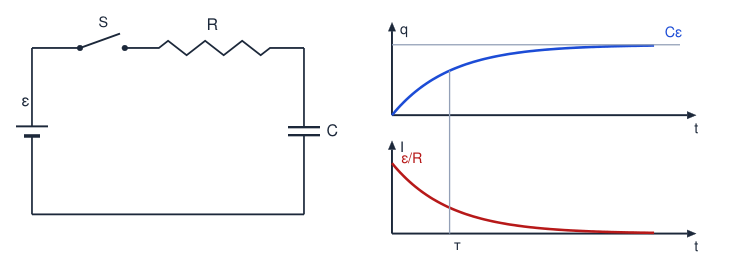
In between, the loop rule gives ε − IR − q/C = 0 with I = dq/dt. Separating variables gives q(t) = Cε(1 − e^(−t/τ)) and I(t) = (ε/R)e^(−t/τ), with τ = RC. After one time constant a charging capacitor reaches about 63 percent of its final charge, and a discharging capacitor falls to about 37 percent of its initial charge. With several resistors, τ = R_eq C, where R_eq is the resistance the capacitor sees with the battery replaced by a wire.
Energy gives one more result. The battery does work Cε² while charging the capacitor. The capacitor stores ½Cε², and the resistor gets the other ½Cε², whatever the value of R.
Exam boundary: circuits with batteries of different potential differences connected in parallel are not assessed. Schematics use conventional current unless a problem says otherwise.
Key relationships
Label: Terminal voltage
Formula: ΔV = ε − Ir
Label: Series and parallel resistors
Formula: R_eq = R₁ + R₂; 1/R_eq = 1/R₁ + 1/R₂
Label: Series and parallel capacitors
Formula: 1/C_eq = 1/C₁ + 1/C₂; C_eq = C₁ + C₂
Label: Loop rule
Formula: Σ ΔV = 0 around a loop
Label: Junction rule
Formula: Σ I_in = Σ I_out
Label: Charging
Formula: q = Cε(1 − e^(−t/τ)), I = (ε/R)e^(−t/τ)
Label: Discharging
Formula: q = Q₀e^(−t/τ)
Label: Time constant
Formula: τ = R_eq C
Charging a capacitor: equation, solution and energy
An uncharged capacitor C is in series with a resistor R, a switch and an ideal battery of emf ε. The switch closes at t = 0. (a) Write the loop rule as a differential equation. (b) Solve for q(t) and I(t). (c) Show that the battery does work Cε², the capacitor stores ½Cε² and the resistor receives ½Cε².
Step 1 (Loop rule): ε − IR − q/C = 0. With I = dq/dt, this is R(dq/dt) + q/C = ε, or dq/dt = (Cε − q)/(RC).
Step 2 (Separate and integrate): ∫ from 0 to q of dq'/(Cε − q') = ∫ from 0 to t of dt'/(RC), which gives −ln[(Cε − q)/(Cε)] = t/(RC).
Step 3 (Solve): q(t) = Cε(1 − e^(−t/RC)). Differentiating gives I(t) = (ε/R)e^(−t/RC).
Step 4 (Energy): The battery moves charge Cε through ε, so it does work Cε². The resistor receives ∫ from 0 to ∞ of I²R dt = (ε²/R)(RC/2) = ½Cε². The capacitor stores ½Cε². The two parts add up to the battery's work, whatever R is.
Half the battery's work ends up in the capacitor and half in the resistance, no matter how large R is.
Practice procedure
Check your work: put t = 0 and t → ∞ into your equations. They must match your two limit cases, with the capacitor as a wire and then as a break.
Common mistakes
Using R₁ + R₂ for the time constant when the capacitor sees R₁ and R₂ in parallel.
Treating an uncharged capacitor as a break at t = 0. At that moment it acts like a wire.
Adding capacitors in series the way resistors add.
Key terms
Term: emf
Definition: The potential difference a battery would supply with no current in it.
Term: Internal resistance
Definition: The resistance of a real battery, modeled as a resistor in series with an ideal emf.
Term: Time constant
Definition: τ = R_eq C, the time for a discharging capacitor to fall to about 37 percent of its starting value.