What to practice
- Describe magnetic dipoles, closed field lines and how materials respond to a field.
- Find the size and direction of the magnetic force on a moving charge.
- Analyze circular motion, velocity selectors and the Hall effect.
- Find the force on a current-carrying wire.
Framework
Force on a moving charge: F = q(v × B), size qvB sin θ; Circular path: r = mv/(qB), T = 2πm/(qB); Velocity selector: v = E/B; Hall potential difference: ΔV_H = v_d Bw; Force on a wire: F = ∫I dL × B, straight wire ILB sin θ; Gauss's law for magnetism: ∫B · dA over a closed surface = 0
Magnetic fields come from moving charge. In a magnet, the motion of electrons makes tiny magnetic dipoles, and many aligned dipoles make a magnetic system. Every magnet has north and south poles together. Break a bar magnet in half and you get two dipoles, never a lone pole. So magnetic field lines form closed loops. They leave the north end, return to the south end and continue through the magnet. That is Gauss's law for magnetism: ∫B · dA over a closed surface = 0.
Materials respond in different ways. Ferromagnetic materials such as iron align strongly and can stay magnetized. Paramagnetic materials align weakly with an applied field, and diamagnetic materials align weakly against it. Magnetic permeability measures this response, and free space has the constant value μ₀. A compass is a dipole that turns to line up with the field, and Earth's field can be modeled as a dipole.
A moving charge also makes a magnetic field, which is perpendicular to both its velocity and the line to the field point. A magnetic field in turn exerts a force on a moving charge: F = q(v × B), with size qvB sin θ. A charge at rest feels nothing, and neither does a charge moving along B. Use the right-hand rule for v × B, and reverse the direction for a negative charge. The force is always perpendicular to v, so it does no work and cannot change the speed.
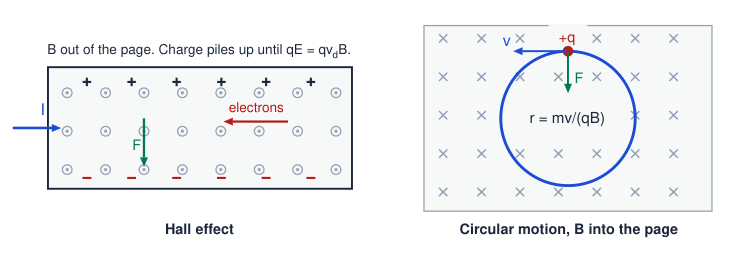
In a uniform field, a charge moving perpendicular to B travels in a circle. Setting qvB = mv²/r gives r = mv/(qB). The period T = 2πm/(qB) does not depend on speed: a faster particle takes a larger circle in the same time. If v has a part along B as well, that part is unchanged and the path is a helix.
When both fields are present, the forces act independently: F = qE + q(v × B). In a velocity selector they balance, so qE = qvB and only v = E/B passes straight through. The Hall effect is the same balance inside a conductor. Carriers are pushed to one edge until the electric field they build up cancels the magnetic force. That leaves a potential difference ΔV_H = v_d Bw across a strip of width w, and its sign shows the sign of the carriers.
A wire carrying current feels the force on all its moving charges: F = ∫I dL × B, or ILB sin θ for a straight wire. In a uniform field, the net force on a closed loop is zero, because ∫dL around a closed loop is zero. A curved wire in a uniform field feels the same force as a straight wire joining its ends.
Exam boundary: the torque on a current loop, τ = μ × B, is a standard topic in college courses, but it is not in the CED. A student preparing for this exam can skip the calculation. Know only that a dipole tends to line up with the field.
Key relationships
Label: Force on a moving charge
Formula: F = q(v × B), size qvB sin θ
Label: Circular path
Formula: r = mv/(qB), T = 2πm/(qB)
Label: Velocity selector
Formula: v = E/B
Label: Hall potential difference
Formula: ΔV_H = v_d Bw
Label: Force on a wire
Formula: F = ∫I dL × B, straight wire ILB sin θ
Label: Gauss's law for magnetism
Formula: ∫B · dA over a closed surface = 0
Hall potential difference in a copper strip
A copper strip lies in the xy-plane. It is 2.0 cm wide along y and 0.50 mm thick, and it carries 20 A in the +x direction. A 0.80 T magnetic field points in the +z direction. Copper has n = 8.5 × 10²⁸ free electrons per m³. Find the drift speed, the Hall potential difference across the width, and which edge is at lower potential.
Step 1 (Drift speed): The cross-section is A = (0.020 m)(5.0 × 10⁻⁴ m) = 1.0 × 10⁻⁵ m². So v_d = I/(neA) = 20/[(8.5 × 10²⁸)(1.60 × 10⁻¹⁹)(1.0 × 10⁻⁵)] = 1.5 × 10⁻⁴ m/s.
Step 2 (Force balance): Electrons pile up on one edge until the electric force balances the magnetic force: eE = ev_d B. So E = v_d B = (1.5 × 10⁻⁴ m/s)(0.80 T) = 1.2 × 10⁻⁴ V/m.
Step 3 (Potential difference): ΔV_H = Ew = (1.2 × 10⁻⁴ V/m)(0.020 m) = 2.4 × 10⁻⁶ V, about 2.4 μV.
Step 4 (Which edge): Electrons drift in the −x direction. For a negative charge F = q(v × B), which points in the −y direction. Electrons gather on the −y edge, so that edge is at lower potential. Positive carriers moving in +x would also be pushed to −y, and they would make that edge higher. So the sign of ΔV_H reveals the sign of the carriers.
A steady Hall voltage means electric and magnetic forces on the carriers are balanced, just as in a velocity selector.
Practice procedure
Check your work: a magnetic force must be perpendicular to both v and B. If your answer has a part along either one, go back to the right-hand rule.
Common mistakes
Forgetting to reverse the right-hand-rule direction for a negative charge.
Saying the magnetic force changes a particle's speed. It changes only the direction of motion.
Claiming a uniform magnetic field exerts a net force on a closed current loop.
Key terms
Term: Magnetic dipole
Definition: A pair of north and south poles, produced by the circular motion of charge. A lone pole has never been found.
Term: Hall effect
Definition: A potential difference across a conductor carrying current in a magnetic field. Its sign shows the sign of the carriers.
Term: Magnetic permeability
Definition: A measure of how much a material magnetizes in response to a field. Free space has the value μ₀.