What to practice
- Find B from wires by superposition and the right-hand rule.
- Use the Biot-Savart law for arcs, loops and the perpendicular bisector of a wire.
- Use Ampère's law for wires, cylinders, slabs and solenoids.
- Integrate a given current density to find enclosed current.
Framework
Long straight wire: B = μ₀I/(2πr); Biot-Savart law: dB = (μ₀I/4π)(dL × r-hat)/r²; Arc at its center: B = μ₀Iθ/(4πR); Loop at its center: B = μ₀I/(2R); Loop, on its axis: B = μ₀IR²/[2(z² + R²)^(3/2)]; Ampère's law: ∫B · dL around a closed loop = μ₀I_enc; Long solenoid: B = μ₀nI
A long straight wire makes a field that circles the wire: B = μ₀I/(2πr). Grip the wire with your right thumb along the current and your fingers curl along B. With several wires, find each field and add the vectors.
The Biot-Savart law gives the field of one small piece of current: dB = (μ₀I/4π)(dL × r-hat)/r². Think of it as the magnetic version of Coulomb's law for a piece of charge. For an arc at its center, every dL is perpendicular to r-hat and every piece is the same distance R away. So B = μ₀Iθ/(4πR) with θ in radians, and a full loop gives B = μ₀I/(2R).
On the axis of a circular loop, every piece gives the same size of dB. The parts perpendicular to the axis cancel around the loop, and the parts along the axis add. The result is B = μ₀IR²/[2(z² + R²)^(3/2)]. For a straight wire of length L, at distance r on its perpendicular bisector, the integral gives B = μ₀IL/[4πr√(r² + L²/4)]. When L is much larger than r, this becomes the long-wire result.
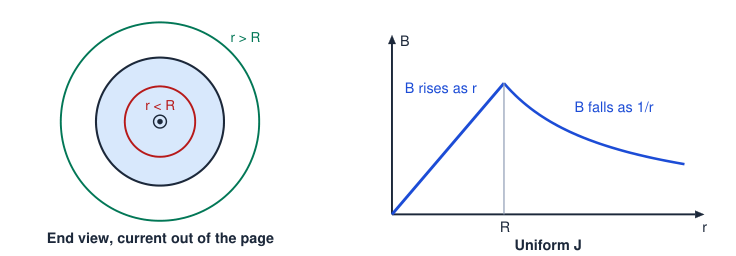
Ampère's law plays the role that Gauss's law played for E: ∫B · dL around a closed loop = μ₀I_enc. Only current passing through the loop counts. As with Gauss's law, it is always true, but it gives B only when symmetry makes B constant along the parts of the loop that matter and perpendicular to the rest. For a long solid wire with uniform current, B = μ₀Ir/(2πR²) inside and μ₀I/(2πr) outside. For a long solenoid, B = μ₀nI inside and about zero outside.
If the current density varies, find the enclosed current first: I_enc = ∫J(r)2πr dr, with the upper limit at the loop's radius when you are inside the conductor. This is the same habit as integrating ρ(r) in Gauss's law.
Choose your tool by the geometry. Use Ampère's law for long wires and cylinders, long solenoids and wide slabs. Use Biot-Savart for loops, arcs and short straight pieces, where symmetry is not enough.
Exam boundary: the CED expects Biot-Savart calculations for a point on the perpendicular bisector of a straight conductor, on the central axis of a circular loop, and at the center of a segment of a circular loop. It applies Ampère's law to long straight wires, long solenoids, and conductive slabs or cylindrical conductors carrying a current density. Toroids are not on that list.
Key relationships
Label: Long straight wire
Formula: B = μ₀I/(2πr)
Label: Biot-Savart law
Formula: dB = (μ₀I/4π)(dL × r-hat)/r²
Label: Arc at its center
Formula: B = μ₀Iθ/(4πR)
Label: Loop at its center
Formula: B = μ₀I/(2R)
Label: Loop, on its axis
Formula: B = μ₀IR²/[2(z² + R²)^(3/2)]
Label: Ampère's law
Formula: ∫B · dL around a closed loop = μ₀I_enc
Label: Long solenoid
Formula: B = μ₀nI
Non-uniform current in a cylinder, and a semicircular wire
A long solid cylindrical conductor of radius R carries current density J(r) = βr along its axis. Use Ampère's law to find B(r) inside and outside. Then, separately, use the Biot-Savart law to find B at the center of a semicircular wire of radius a carrying current I.
Step 1 (Ampère's law setup): By symmetry B is tangent to a concentric circle of radius r and has one size around it, so ∫B · dL around a closed loop = B(2πr) = μ₀I_enc.
Step 2 (Enclosed current for r < R): I_enc = ∫ from 0 to r of (βr')(2πr' dr') = (2/3)πβr³.
Step 3 (Solve): Inside, B(2πr) = μ₀(2/3)πβr³, so B = (1/3)μ₀βr². Outside, I_total = (2/3)πβR³, so B = μ₀βR³/(3r) = μ₀I_total/(2πr).
Step 4 (Semicircle): Each dL is perpendicular to r-hat at the same distance a. So B = (μ₀I/4πa²) ∫dL = (μ₀I/4πa²)(πa) = μ₀I/(4a), which is half the field of a full loop.
Use Ampère's law when symmetry allows it, and Biot-Savart for loops and arcs.
Practice procedure
Check your work: outside a cylinder, your answer must become μ₀I/(2πr). Inside a slab of thickness 2d with uniform J, a rectangular loop gives B = μ₀Jy at distance y from the center plane.
Common mistakes
Using B(2πr) = μ₀I for the center of a circular loop. That formula is for a long straight wire, and a loop's center field is μ₀I/(2R).
Forgetting to integrate J(r)2πr dr when current density varies.
Counting current outside the Amperian loop as enclosed current.
Key terms
Term: Amperian loop
Definition: An imagined closed path chosen so the line integral of B is simple.
Term: Solenoid
Definition: A long coil. Inside, the field is nearly uniform at B = μ₀nI, where n is turns per unit length.
Term: Right-hand rule for currents
Definition: With your thumb along the current, your fingers curl in the direction of B.