What to practice
- Find flux, integrating when the field varies across the area.
- Find induced emf for a changing field, area or angle.
- Use Lenz's law to find the direction of induced current.
- Analyze a bar on rails with force, energy and a differential equation.
- Explain how a changing magnetic field produces an electric field.
Framework
Magnetic flux: Φ_B = ∫B · dA; Faraday's law: ε = −N dΦ_B/dt; Motional emf: ε = BLv; Drag on a bar: F = B²L²v/R; Maxwell's third equation: ∫E · dL around a closed loop = −dΦ_B/dt
Magnetic flux counts the field through an area: Φ_B = ∫B · dA, which is BA cos θ for a uniform field and a flat area. When B changes across the area, as it does near a long wire, slice the area into strips on which B is constant, and integrate.
Faraday's law says a changing flux induces an emf: ε = −dΦ_B/dt, and N turns multiply this by N. The flux can change in three ways: the field changes, the area changes, or the angle changes. Do not look for a formula for each case. Write Φ_B first, then differentiate it.
Lenz's law gives the direction through that minus sign. The induced current makes a field that opposes the change in flux, not the flux itself. Work in order. Which way does the flux point? Is it growing or shrinking? Which way must the induced field point to oppose that change? Then use the right-hand rule to get the current.
A bar of length L moving at speed v across a field makes a motional emf ε = BLv, since the area of the circuit grows at the rate Lv. With circuit resistance R, the current is I = BLv/R, and the field pushes back on the bar with force F = ILB = B²L²v/R. This drag always opposes the motion. Pulling at constant speed takes mechanical power Fv, and this equals the electrical power I²R, as energy conservation requires.
That force makes a differential equation. With no driving force, m(dv/dt) = −B²L²v/R, so v = v₀e^(−t/τ) with τ = mR/(B²L²). With a constant driving force F, the bar speeds up until the drag matches F, at terminal speed v_T = FR/(B²L²).
A changing magnetic field also makes an electric field, even with no wire present: ∫E · dL around a closed loop = −dΦ_B/dt. This is Maxwell's third equation. The field lines form closed loops, so a charge carried around one gains energy, and this electric field has no potential function. Inside a long solenoid of radius R, the induced field at radius r is E = (r/2)|dB/dt|, and outside it is E = [R²/(2r)]|dB/dt|.
Key relationships
Label: Magnetic flux
Formula: Φ_B = ∫B · dA
Label: Faraday's law
Formula: ε = −N dΦ_B/dt
Label: Motional emf
Formula: ε = BLv
Label: Drag on a bar
Formula: F = B²L²v/R
Label: Maxwell's third equation
Formula: ∫E · dL around a closed loop = −dΦ_B/dt
Flux through a loop beside a long wire
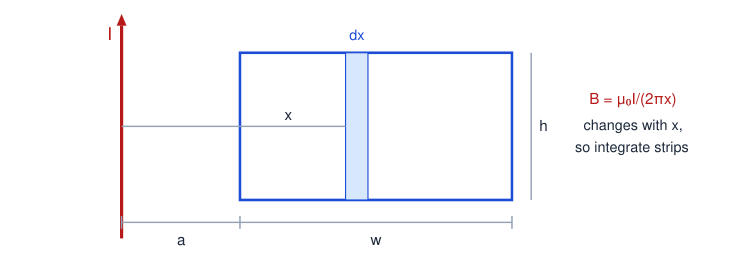
A long straight wire along the y-axis carries current I₀. A rectangular loop of width w and height h lies in the xy-plane, with its near side at x = a and its far side at x = a + w. Find (a) the flux through the loop, and (b) the induced emf if the current decays as I(t) = I₀e^(−αt).
Step 1 (Why integrate): B = μ₀I₀/(2πx) changes across the loop, so you cannot multiply B by the area wh.
Step 2 (Slice the loop): A strip of width dx and height h at distance x has area dA = h dx, and B is constant on it.
Step 3 (Integrate): Φ_B = ∫ from a to a+w of [μ₀I₀/(2πx)](h dx) = [μ₀I₀h/(2π)] ln((a + w)/a).
Step 4 (Differentiate): With I(t) = I₀e^(−αt), the flux keeps the same form with I(t) in place of I₀, so |ε| = |dΦ_B/dt| = [αμ₀I₀h/(2π)] ln((a + w)/a) e^(−αt).
When B varies across a loop, slice the loop into strips on which B is constant, then integrate.
Practice procedure
Check your work: for Lenz's law, confirm that your induced current would slow the change, not speed it up. For a bar on rails, confirm that mechanical power equals I²R.
Common mistakes
Using the field at the center of the loop and multiplying by the area when B varies across the loop.
Saying the induced field opposes the flux. It opposes the change in flux.
Giving an induced electric field a potential. Its closed-loop integral is not zero.
Key terms
Term: Magnetic flux
Definition: The field through an area, Φ_B = ∫B · dA, measured in webers.
Term: Lenz's law
Definition: An induced current makes a field that opposes the change in flux that caused it.
Term: Motional emf
Definition: The emf in a conductor moving across a magnetic field, ε = BLv.