What to practice
- Find inductance, induced emf and stored energy.
- Find currents just after a switch moves and after a long time.
- Derive and use the LR equations and the time constant.
- Derive the LC equation and use energy to find the maximum current.
Framework
Inductor emf: ε = −L dI/dt; Solenoid inductance: L = μ₀N²A/l; Stored energy: U_L = ½LI²; LR loop rule: ε = IR + L(dI/dt); Current rise: I = (ε/R)(1 − e^(−t/τ)), τ = L/R; Current decay: I = I₀e^(−t/τ); LC frequency: ω = 1/√(LC); LC energy: Q²/(2C) = ½LI_max²
Inductance is the tendency of a conductor to oppose a change in its own current. Straight wires are modeled as having zero inductance, and a coil has a lot. Applying Faraday's law to a coil gives ε = −L dI/dt. For a solenoid of N turns, length l and area A, L = μ₀N²A/l. The minus sign is Lenz's law again: the inductor pushes back against whatever the current is trying to do.
Because a sudden jump in current would take an infinite emf, the current in an inductor cannot change instantly. That single fact solves most switch problems. An inductor stores energy in its magnetic field: U_L = ½LI².
In a series LR circuit (also called an RL circuit) with a battery, the loop rule gives ε = IR + L(dI/dt). The current rises as I(t) = (ε/R)(1 − e^(−t/τ)) with τ = L/R. Just after the switch closes the current is still zero, so the inductor acts like a break and its emf is equal and opposite to the applied potential difference. After a long time dI/dt = 0, so the inductor acts like a wire. After one time constant the rising current reaches about 63 percent of its final value.
If the battery is removed and the current continues through a resistor, it decays as I = I₀e^(−t/τ), reaching about 37 percent after one time constant. The stored energy ½LI₀² is dissipated in the resistor. Note that the time constant of an LR circuit is L/R, while for an RC circuit it is RC.
A capacitor and an inductor are opposites at the two key moments. An uncharged capacitor acts like a wire at first and a break later. An inductor with no current acts like a break at first and a wire later.
Connect a charged capacitor to an inductor with no resistance and energy moves back and forth between them. The loop rule gives d²q/dt² = −q/(LC), which is the equation of simple harmonic motion, with ω = 1/√(LC). If the charge starts at Q, then q = Q cos ωt and the current is largest when the capacitor is empty. Find that maximum from energy: Q²/(2C) = ½LI_max².
Key relationships
Label: Inductor emf
Formula: ε = −L dI/dt
Label: Solenoid inductance
Formula: L = μ₀N²A/l
Label: Stored energy
Formula: U_L = ½LI²
Label: LR loop rule
Formula: ε = IR + L(dI/dt)
Label: Current rise
Formula: I = (ε/R)(1 − e^(−t/τ)), τ = L/R
Label: Current decay
Formula: I = I₀e^(−t/τ)
Label: LC frequency
Formula: ω = 1/√(LC)
Label: LC energy
Formula: Q²/(2C) = ½LI_max²
An inductor in a two-resistor circuit
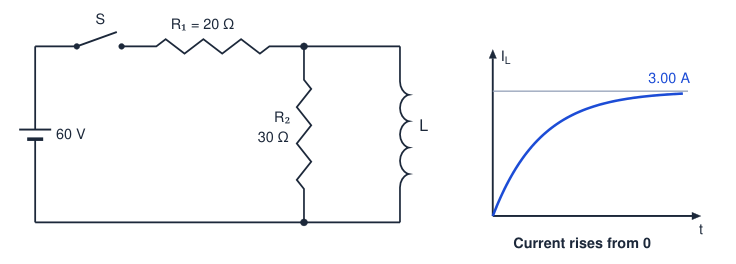
An ideal 60 V battery, a switch and a resistor R₁ = 20 Ω are in series with a parallel pair of branches. One branch is a resistor R₂ = 30 Ω, and the other is an ideal inductor L = 0.40 H. The switch closes at t = 0. Find (a) the battery current just after the switch closes, (b) the battery current and inductor current after a long time, and (c) the energy then stored in the inductor.
Step 1 (Just after closing): The inductor current cannot jump, so I_L = 0. The inductor branch acts like a break.
Step 2 (Current at t = 0): The current goes through R₁ and R₂ in series: I = 60 V/(20 Ω + 30 Ω) = 1.20 A.
Step 3 (After a long time): dI/dt = 0, so the inductor has no potential difference. It acts like a wire and shorts out R₂. So I_battery = I_L = 60 V/20 Ω = 3.00 A, and the current in R₂ is 0.
Step 4 (Stored energy): U_L = ½LI_L² = ½(0.40 H)(3.00 A)² = 1.80 J.
Current in an inductor cannot jump. Treat it as a break at the first instant and a wire after a long time.
Practice procedure
Check your work: for an LR circuit the time constant is L/R, which has units of seconds. If you wrote LR, the units will tell you.
Common mistakes
Writing τ = LR in place of τ = L/R.
Letting the current in an inductor drop to zero the instant a switch opens. It must have the same value just after as just before.
Mixing up the first-instant behavior of inductors and capacitors.
Key terms
Term: Inductance
Definition: The ratio of a coil's flux linkage to its current, in henries. It sets the emf for a given dI/dt.
Term: LR time constant
Definition: τ = L/R, the time for a decaying current to fall to about 37 percent of its starting value.
Term: LC oscillation
Definition: The back-and-forth transfer of energy between a capacitor and an inductor at ω = 1/√(LC).