What to practice
- Explain what each of Maxwell's four equations says physically.
- Choose the right equation for a situation and apply it in the symmetric cases the exam uses.
- Explain in words why a changing electric field produces a magnetic field, as in the gap of a charging capacitor.
- Recognize the four free-response types and their point values.
Framework
Maxwell's four equations: (1) ∫E · dA over a closed surface = Q_enc/ε₀; (2) ∫B · dA over a closed surface = 0; (3) ∫E · dL around a closed loop = −dΦ_B/dt; (4) ∫B · dL around a closed loop = μ₀I_enc for steady currents, with Maxwell's addition that a changing electric field also produces a magnetic field.
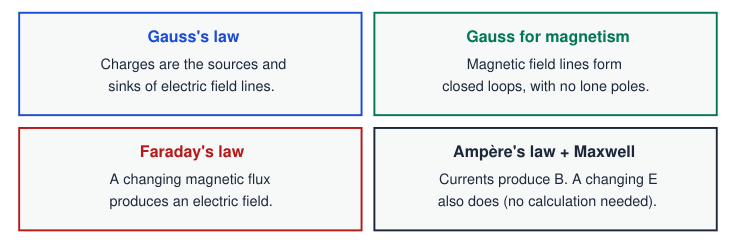
Maxwell's four equations gather the laws of this course into one set. (1) Gauss's law for electricity: charges are the sources and sinks of electric field lines. (2) Gauss's law for magnetism: the net magnetic flux through any closed surface is zero, so magnetic field lines form closed loops. (3) Faraday's law: a changing magnetic flux induces an emf, so a changing magnetic field produces an electric field. (4) Ampère's law: a current produces a magnetic field around it. Maxwell added that a changing electric field also produces a magnetic field, as happens in the gap of a charging capacitor.
Exam boundary: the CED asks you to understand Maxwell's addition in words, and it does not expect you to use the fourth equation with a changing electric field. College textbooks call that term the displacement current, and you will not calculate it on the AP Exam.
What to do with this: know what each equation says physically, choose the one that fits a situation and apply it in the symmetric cases from Units 8, 12 and 13, using the fourth equation for steady currents only.
This chapter also reviews the four free-response types: Mathematical Routines (10 points), Translation Between Representations (12 points), Experimental Design and Analysis (10 points) and Qualitative/Quantitative Translation (8 points). A Mathematical Routines task asks you to derive, calculate, and create and use representations such as a sketched graph. A Translation task asks you to move between a graph, an equation and words. An Experimental Design task asks you to plan data collection and analyze a graph. A Qualitative/Quantitative Translation task asks you to make a claim and back it with an equation.
Key relationships
Label: Gauss's law for electricity
Formula: ∫E · dA over a closed surface = Q_enc/ε₀
Label: Gauss's law for magnetism
Formula: ∫B · dA over a closed surface = 0
Label: Faraday's law
Formula: ∫E · dL around a closed loop = −dΦ_B/dt
Label: Ampère's law, steady currents
Formula: ∫B · dL around a closed loop = μ₀I_enc
One solenoid, four equations
A long solenoid of radius R = 0.030 m has n = 2000 turns per meter. Its current rises at a steady 50 A/s. Find the rate of change of the magnetic field inside and the induced electric field at r = 0.020 m from the axis. Name the Maxwell equation used at each step.
Step 1 (Ampère's law, steady-current form): Inside the solenoid B = μ₀nI, so dB/dt = μ₀n(dI/dt) = (4π × 10⁻⁷)(2000)(50) = 0.13 T/s.
Step 2 (Gauss's law for magnetism): The field lines inside the solenoid return around the outside, so the net flux through any closed surface is zero. The lines have no ends.
Step 3 (Faraday's law): For a circle of radius r inside the solenoid, the flux is Φ_B = Bπr². The induced field circles the axis, so E(2πr) = πr²(dB/dt).
Step 4 (Solve): E = (r/2)(dB/dt) = (0.020 m/2)(0.126 T/s) = 1.3 × 10⁻³ V/m. Lenz's law sets the direction around the circle.
Step 5 (Gauss's law for electricity): The circle of field lines starts and ends on no charge, so the net electric flux through a closed surface here is zero. These lines are closed loops, unlike lines that start on charges.
Choose the equation by asking what is changing and what is enclosed. Each law answers a different question about the same system.
Practice procedure
Know what each of Maxwell's four equations says physically: (1) Gauss's law for electricity (charges produce diverging electric fields), (2) Gauss's law for magnetism (magnetic field lines always form closed loops), (3) Faraday's law (a changing magnetic flux induces an emf), (4) Ampère's law with Maxwell's addition (currents and changing electric fields produce magnetic fields).
Common mistakes
Saying no magnetic field exists around the gap of a charging capacitor because no charge crosses the gap. The changing electric field in the gap produces one.
Mixing up the two changing-field ideas. A changing magnetic field produces an electric field (Faraday's law), and a changing electric field produces a magnetic field (Maxwell's addition).
Key terms
Term: Maxwell's addition to Ampère's law
Definition: A changing electric field produces a magnetic field, as a current does. Know the idea in words. The exam does not ask you to calculate with it.
Term: Gauss's law for magnetism
Definition: The net magnetic flux through any closed surface is zero, so magnetic field lines have no ends.