What to practice
- Rehearse materials, timing, formula meaning, answer checking and the final review cycle.
A practice exam helps only if you take it under exam conditions and review it part by part. This chapter covers what to check beforehand, how to pace each part and how to turn results into repairs.
Check readiness before a timed attempt
Take a full practice exam when every unit chapter's printed practice has been scored and logged, and your wrong-and-sure log entries have been retried at least once. Then confirm the following.
- Calculator. For this exam, only approved graphing calculators are allowed, and you may bring up to two (calculator policy). Bluebook's built-in Desmos is available in Parts I-B and II-A only. Set every device to radian mode and check its batteries.
- Interface. Bluebook's AP test preview is short and untimed and gives no score or feedback, so use it to learn the tools, not to judge readiness. College Board directs AP students to AP Classroom for further practice (Bluebook practice).
- Paper. Free-response answers are handwritten in a paper booklet, so practice them on paper.
- Reporting rules. The course description's free-response instructions ask you to show your work, use radians, avoid rounding intermediate values, and give decimals accurate to three places after the decimal point unless a question says otherwise (course description).
- Time. Reserve 175 minutes of uninterrupted working time, and time each part separately.
Know what each formula means
The exam information in the course description does not mention a formula or reference sheet, so check current College Board materials and plan to know these relationships and their conditions.
| Relationship | Meaning | Condition |
|---|---|---|
| Average rate of change, in output units per input unit | ||
| A product inside a logarithm becomes a sum | , , , | |
| for | Each unit increase in multiplies the output by | , , |
| Period of is | Input length of one full cycle | |
| The angle in whose sine is | ||
| , | Polar to rectangular coordinates | may be negative |
| Residual = actual − predicted | A positive residual means the model underestimated | Same input for both values |
Pace each part
Each part has its own time limit. Figure 22.1 shows suggested checkpoints: finish a first pass a few minutes early, then use the reserved time to check.
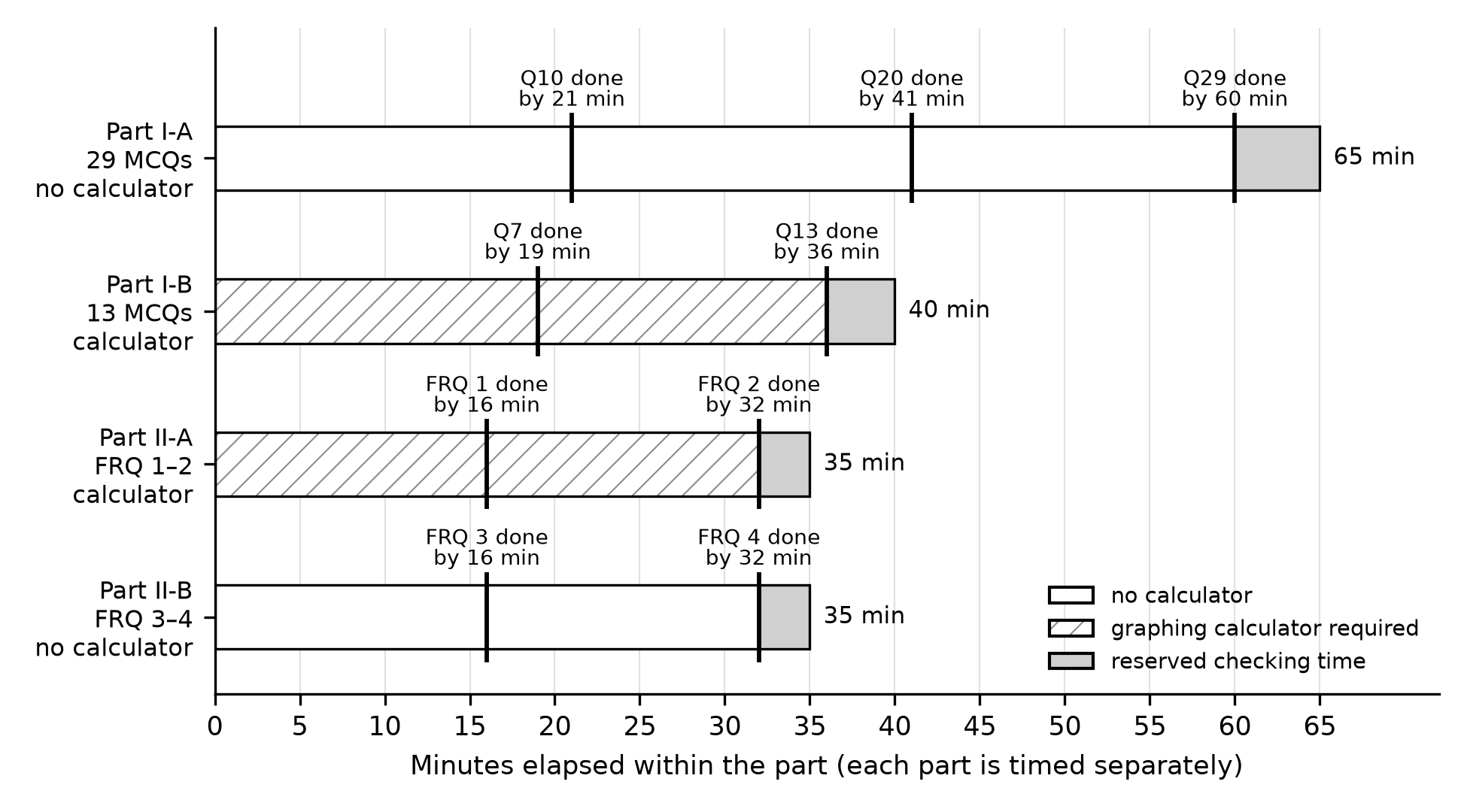
Figure 22.1. Suggested pacing checkpoints, not an official rule. Hatched bars mark calculator-required parts; gray segments are reserved checking time.
In Part I-A, a first pass ending at 60 minutes allows about minutes per question; in Part I-B, about . If a question has taken twice its share, choose your best answer, note its number and move on. In each free-response part, spend about 16 minutes per question. When a part stalls, write what you can for it and move to the next part, because points are awarded part by part.
Check answers efficiently
Spend reserved time on these checks.
- Original conditions. Substitute a solution into the original equation, and confirm logarithm arguments are positive and inverse-trigonometric inputs lie between −1 and 1.
- The question asked. Reread the final sentence: did it ask for an input or an output, an exact value or a decimal, one solution or all solutions in an interval?
- Reasonableness. Compare the answer with a sketch, a sign or the context.
- Free-response form. Check that each answer is labeled with its part, includes units when the context has them, and shows the setup a scorer needs to see.
Review a practice exam by components
Score each practice exam with Answers, explanations and written responses, then record six numbers: Part I-A correct out of 29 (), Part I-B correct out of 13 (), and each free-response score out of 6. Let be the free-response total out of 24.
The component scores are the main result. For one summary number, this book uses an optional weighted practice index built from the published section weights:
The index runs from 0 to 100 and lets you compare your own attempts. It is an instructional summary, not an AP score, and this book does not convert it to the 1–5 scale. The weights show that one Part I-A question is worth about 1.509 index points, one Part I-B question about 1.442, and one free-response point about 1.563: a free-response point counts about as much as a multiple-choice question.
Worked review
The following results are constructed practice data, not a real student's scores.
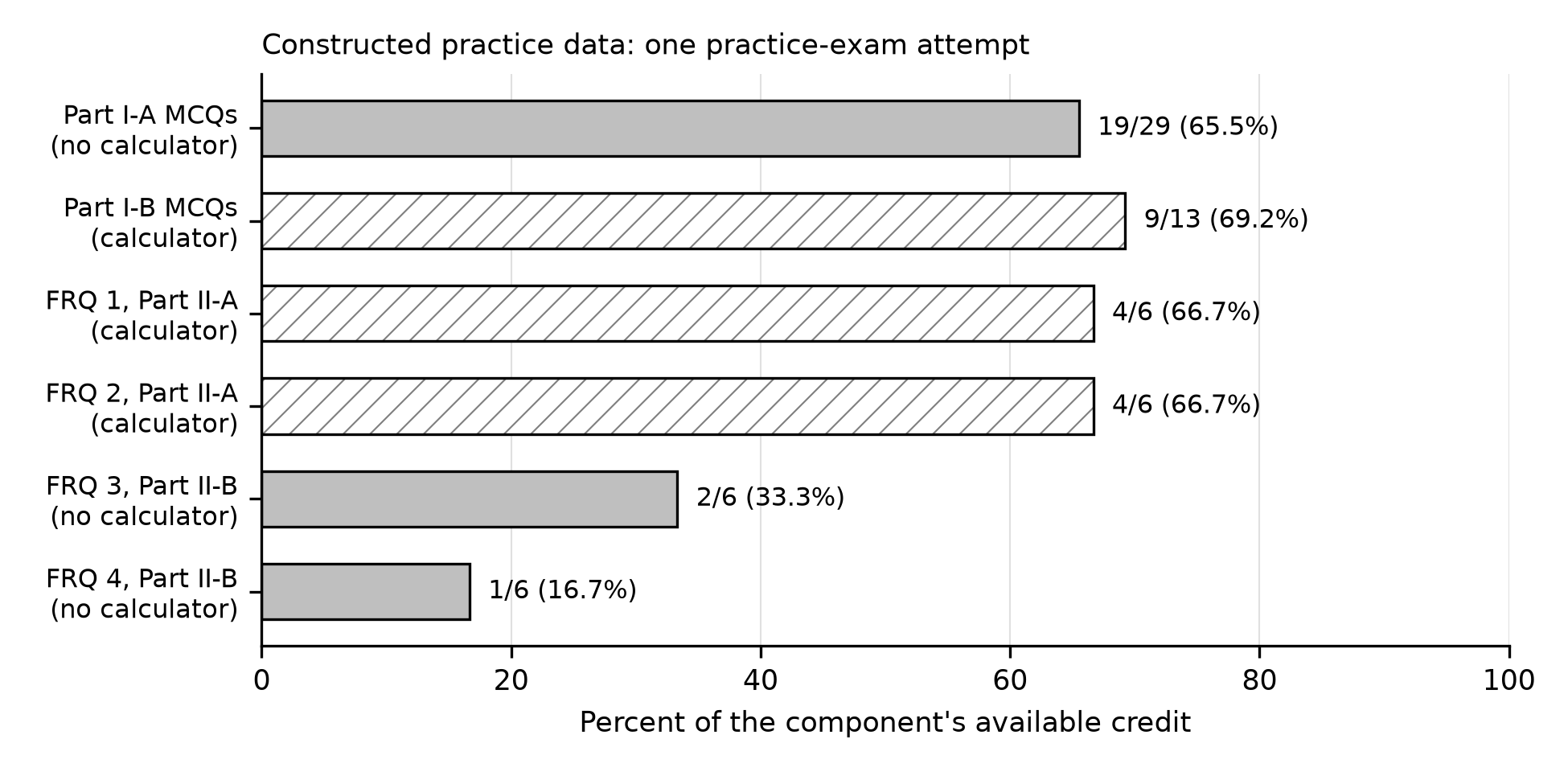
Figure 22.2. Constructed practice data: component results from one attempt. Hatched bars are calculator-required components.
Summary. , and the index is .
Diagnosis. The two calculator parts earned 9 of 13 and 8 of 12. Part II-B earned only 3 of 12, so the student's weakness is no-calculator written work on periodic models and symbolic manipulation, not calculator use.
Error tally. Give each log entry its error type and count with denominators. Here, the 10 Part I-A misses were 4 execution, 3 validity, 2 meaning and 1 representation. Execution and validity account for 7 of 10, so the repair includes slower algebra and checking original conditions.
Repair plan. Chapters 13 and 14 for sinusoidal models; Chapters 11, 12 and 16 for symbolic manipulation; Chapter 19 for written reasoning. Retry each lost free-response part without the scoring guide, then compare.
Try it
Try it 22.1. A constructed attempt earns Part I-A 24 of 29, Part I-B 6 of 13, and free-response scores 2, 3, 5 and 6. (a) Find and the weighted practice index. (b) Which part needs repair first? (c) Would two more Part I-B questions or two more free-response points raise the index more?
Check your try-it work
22.1. (a) . The index is . (b) The calculator parts: Part I-B earned 6 of 13 and Part II-A 5 of 12, while Part I-A earned 24 of 29 and Part II-B 11 of 12. Repair with Chapter 18's workflow, then Chapters 6, 9 and 10 for models and function concepts. (c) Two free-response points add 3.125; two Part I-B questions add about 2.885.
Plan the final review cycle
After Practice Exam A, spend several study blocks on repair before Practice Exam B. Retry first-priority log entries next session and again a week later, then work a mixed set from Chapter 20. Take Exam B under the same part timing and compare component by component, because part-level changes show more than the index does. Spaced review and practice testing are recommendations of an IES practice guide. In the final two days, do light retrieval only, prepare devices and materials, and rest.
Practice
Chapter 22 has no numbered questions. Do Try it 22.1, with its solution under "Check your try-it work." Then take Practice Exam A in Chapter 23, Questions 1–42 and Written tasks 1–4, timing each part separately. Score it with Answers, explanations and written responses, review it by components, and repair before taking Practice Exam B in Chapter 24.
Review later
- Before Exam A: set every device to radian mode and rehearse the four checks.
- After Exam A: record the six component scores and an error tally with denominators.
- After Exam B: compare each component with Exam A and choose the final repair blocks.