What to practice
- connect molecular interactions with an observed property
Start with one question
On a hot afternoon, why does a pond stay cool while a nearby parking lot becomes too hot to touch, and why does sweat cool your skin? Both answers begin with how a water molecule is built and how water molecules attract one another. This chapter covers topics 1.1 to 1.3 of the AP Biology Course and Exam Description through one chain of reasoning: structure → interaction → property → biological consequence. Use that chain whenever a question asks you to explain a property of water or a reaction that builds or breaks a biological molecule.
Two kinds of attraction in water
A water molecule is one oxygen atom joined to two hydrogen atoms by covalent bonds, in which atoms share electrons. Oxygen attracts the shared electrons more strongly than hydrogen does, so the sharing is unequal. Each O–H bond is a polar covalent bond: the oxygen end carries a partial negative charge (δ−) and each hydrogen a partial positive charge (δ+). Because the molecule is bent, these partial charges do not cancel, and the whole molecule is polar, although it is electrically neutral overall (OpenStax Biology 2e, Water).
Opposite partial charges on neighboring molecules attract. The attraction between a δ+ hydrogen of one water molecule and the δ− oxygen of another is a hydrogen bond. Hydrogen bonds are much weaker than covalent bonds; in liquid water they constantly break and re-form, and each molecule can take part in up to four at once (Figure 4.1).
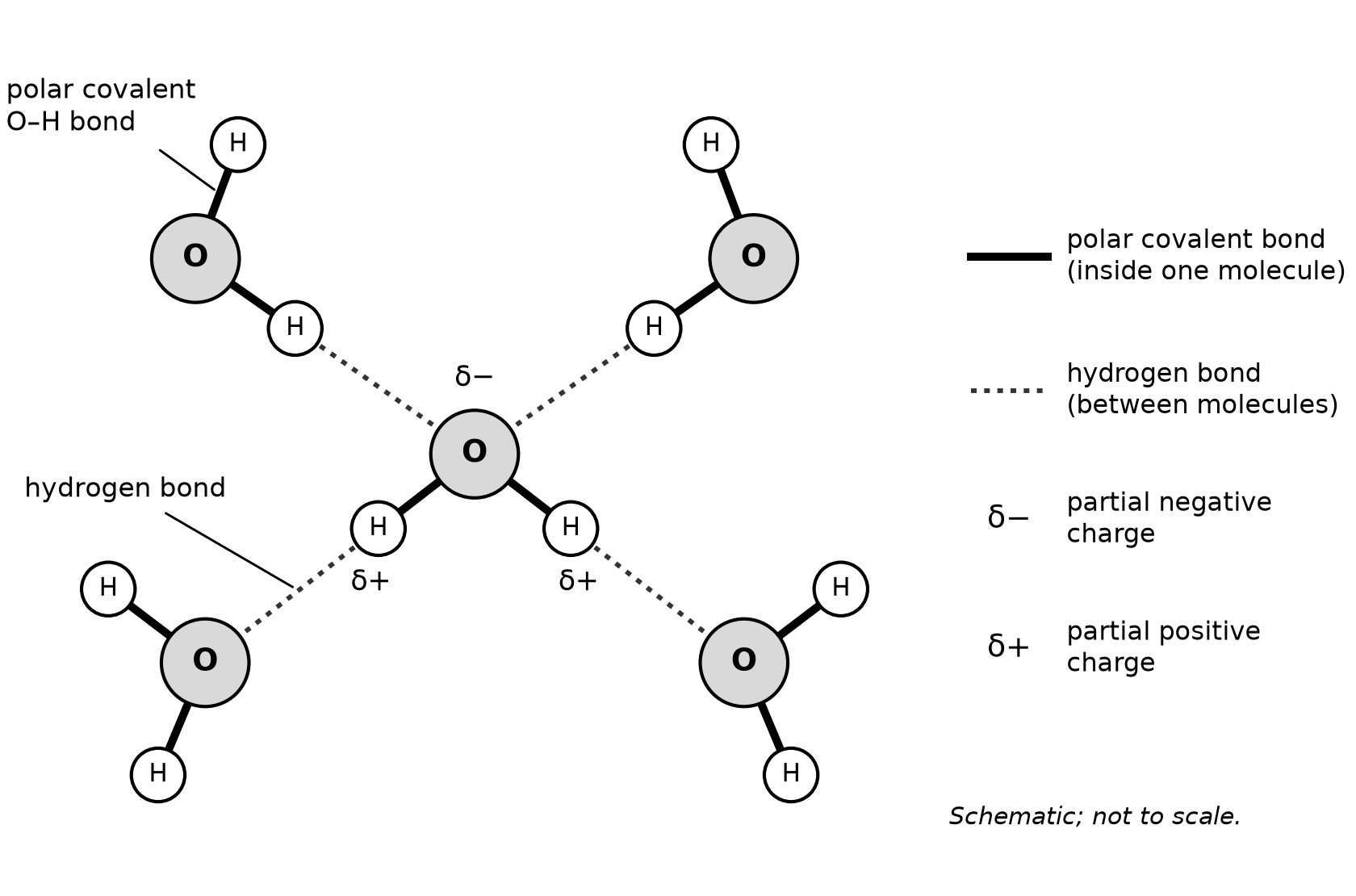
Figure 4.1. Polar covalent bonds hold each water molecule together; hydrogen bonds attract separate molecules to one another. Schematic, not to scale.
Worked example: which interaction breaks when water evaporates?
Prompt. When liquid water evaporates, which attractions break?
Reasoning. Water vapor is still made of H₂O molecules, so the covalent O–H bonds inside each molecule stay intact. What changes is that molecules escape from their neighbors.
Answer. Hydrogen bonds between water molecules break; covalent bonds within molecules do not. "Evaporation breaks water molecules apart" is a common error that costs credit.
From hydrogen bonds to properties organisms use
Cohesion, adhesion and surface tension
Cohesion is the attraction of water molecules to one another through hydrogen bonds. At an air–water boundary, cohesion produces surface tension, strong enough to support a water strider. Adhesion is the attraction of water to other polar or charged surfaces, such as a glass tube or the walls of plant xylem cells (USGS Water Science School, Adhesion and cohesion of water).
In a plant, water forms continuous columns in the xylem from roots to leaves. As water evaporates from leaves, cohesion transmits a pull down the column, so water moves upward and more enters the roots; adhesion to the xylem walls helps the column resist gravity.
Heat capacity and evaporative cooling
Specific heat is the energy needed to raise the temperature of 1 gram of a substance by 1 °C. Water's is high, 1 calorie per gram per degree, about five times that of sand, because much of the added energy disrupts hydrogen bonds before the molecules can move faster. Water-rich tissues and large bodies of water therefore change temperature slowly, which helps organisms hold internal conditions steady (OpenStax Biology 2e, Water).
Water's heat of vaporization is also high: about 586 calories must be absorbed to change 1 gram of liquid water to vapor. A molecule escapes only after its hydrogen bonds break, and the escaping molecules are the most energetic ones, so they carry energy away and the remaining liquid cools. This evaporative cooling explains why sweating cools a mammal and why evaporation lowers leaf temperature.
Worked example: read a heating comparison
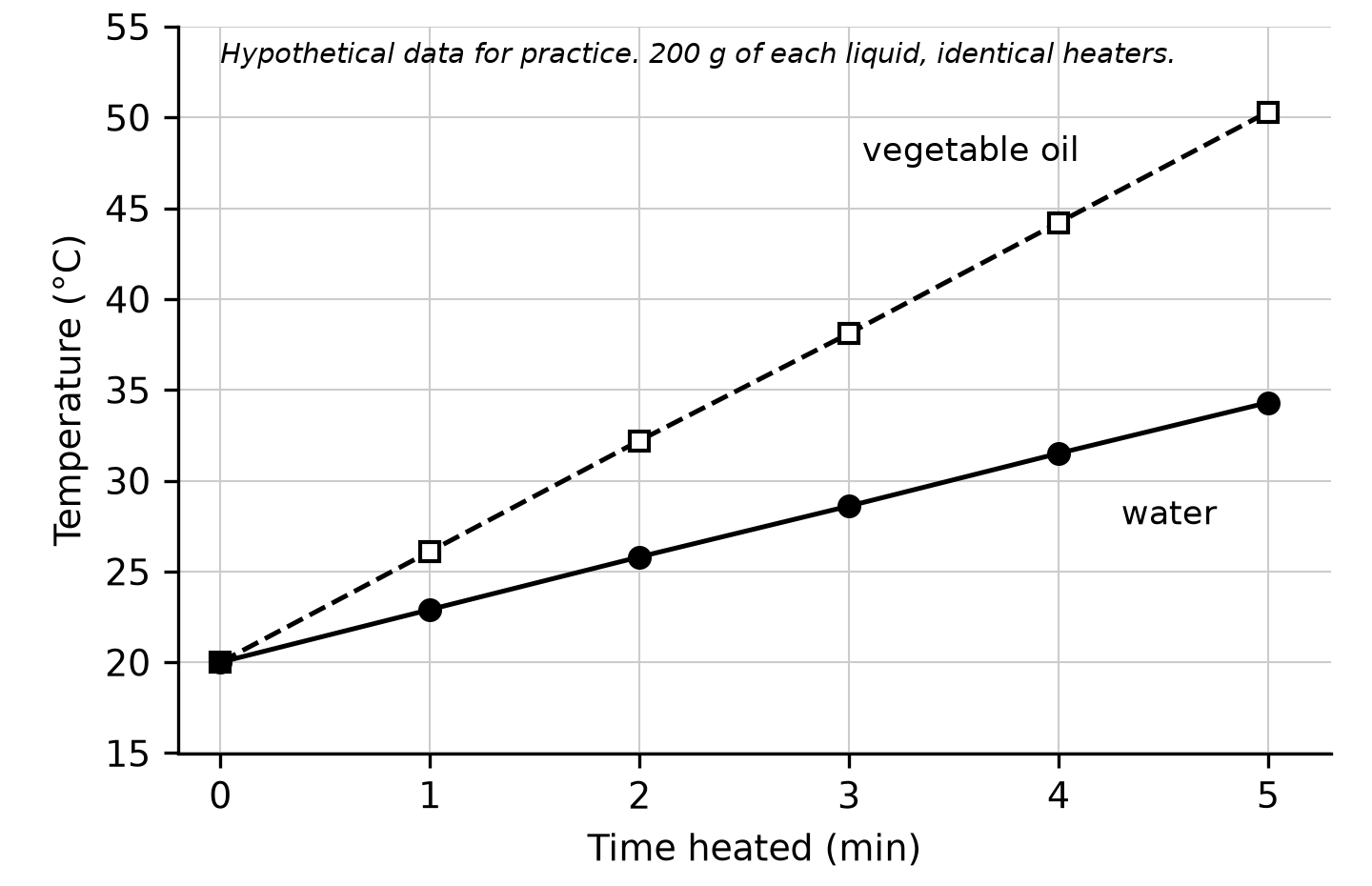
Figure 4.2. Hypothetical data for practice: equal masses of water and vegetable oil warmed by identical heaters.
Prompt. Use Figure 4.2 to compare how the two liquids responded to the same energy input, and state one limit of the comparison.
Reasoning. In 5 minutes, water rose from 20.0 to 34.3 °C, a 14.3 °C increase (2.86 °C per minute). Oil rose from 20.0 to 50.3 °C, a 30.3 °C increase (6.06 °C per minute), about 2.1 times as fast. Mass, heater and time were controlled, so the difference reflects how each liquid absorbs energy.
Answer. Water warmed less than half as fast as oil for the same input, consistent with water's higher specific heat. Limit: each liquid was tested once, and heat lost to the air may differ between liquids, so repeated trials with insulated containers would strengthen the claim. The graph shows the property; hydrogen bonding explains it.
Water as a solvent
Because water is polar, it dissolves ions and other polar molecules. Water molecules cluster around a dissolved ion, with their δ− oxygens toward a positive ion and their δ+ hydrogens toward a negative ion, separating the ions from one another. Nonpolar substances such as oils do not form these attractions; they are hydrophobic and cluster together in water, a fact you will use for lipids and membranes in Chapter 5.
The elements that build biological molecules
Carbon, hydrogen and oxygen are the most abundant elements in biological molecules. Three others mark particular kinds of molecules:
| Element | Found in | Example |
|---|---|---|
| Nitrogen (N) | Proteins and nucleic acids | Amino groups of amino acids; nitrogenous bases |
| Phosphorus (P) | Nucleic acids and phospholipids | Phosphate groups of the DNA backbone; phospholipid heads |
| Sulfur (S) | Proteins | Side chains of some amino acids |
Organisms must obtain these elements from their surroundings to build new molecules. A plant takes up nitrogen and phosphorus from soil; an animal gets them from food.
Worked example: choose an isotope label
Prompt. Algae are grown in water whose phosphate contains radioactive phosphorus, ³²P. Which molecules become labeled?
Reasoning. Follow the element. Phosphorus is in nucleotides, so DNA, RNA and ATP become labeled. It is in phospholipid heads, so membranes become labeled. Starch and cellulose contain only C, H and O, and amino acids contain no phosphorus.
Answer. Nucleic acids, ATP and phospholipids are labeled; polysaccharides are not, and proteins are not labeled through their amino acids. To label one class of molecule but not another, choose an element that one class contains and the other lacks.
Building and breaking polymers
Most large biological molecules are polymers, chains of repeating subunits called monomers. In dehydration synthesis, an enzyme joins two monomers by a new covalent bond: an –OH from one monomer and an H from the other leave together as one water molecule. Hydrolysis reverses this: a water molecule is split, its H goes to one monomer and its –OH to the other, and the bond breaks. Building polymers requires energy; hydrolysis releases it (Figure 4.3) (OpenStax Biology 2e, Synthesis of Biological Macromolecules).
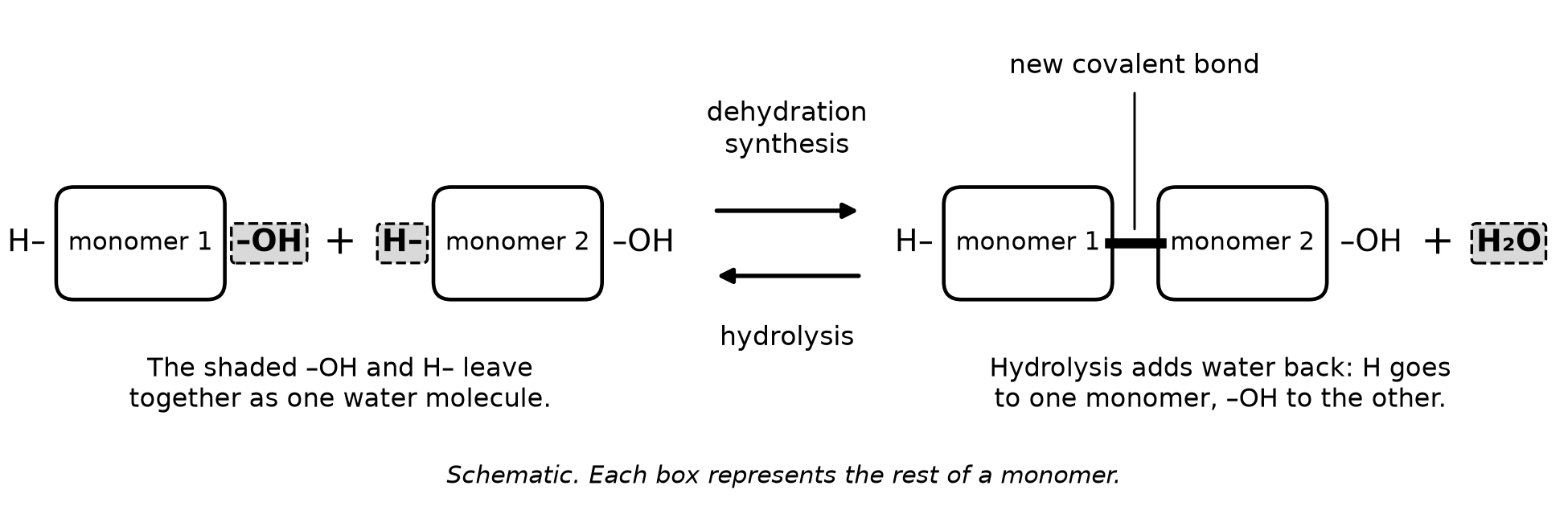
Figure 4.3. Dehydration synthesis releases one water molecule for each covalent bond formed; hydrolysis uses one water molecule for each bond broken.
Worked example: count the water molecules
Prompt. How many water molecules are released when 12 monomers are joined into one unbranched chain?
Reasoning. The first monomer needs no bond; each of the other 11 adds exactly one bond. One water is released per bond.
Answer. 11. The rule "monomers minus one" also holds for branched chains without closed loops, because each added monomer still forms one bond. Complete hydrolysis uses the same number of water molecules.
Common errors to repair
- "Hydrogen bonds hold the atoms of a water molecule together." Covalent bonds do; hydrogen bonds attract separate molecules.
- "Water molecules are negatively charged." The charges are partial, and the molecule is neutral overall.
- "High specific heat means water heats quickly." It means water heats slowly.
- "Proteins contain phosphorus; DNA contains sulfur." Reverse it: sulfur marks proteins, phosphorus marks nucleic acids.
- "Hydrolysis removes water." Hydrolysis adds water; dehydration synthesis releases it.
Try it
Try it 4.1. On a dry day, sweat evaporates and the skin cools. Explain the cooling in terms of hydrogen bonds and energy.
Try it 4.2. A drop of water forms a raised dome on a coin. Adding a drop of soap flattens it. Explain the dome, and predict whether the soap increased or decreased the attraction among surface water molecules.
Try it 4.3. Which of these could be labeled with the nitrogen isotope ¹⁵N: glucose, a fatty acid, an amino acid, a nucleotide, cellulose?
Try it 4.4. (a) How many water molecules are released when 25 glucose monomers form one unbranched chain? (b) How many are used to hydrolyze completely a branched fragment of 300 glucose monomers with no closed loops?
Check your try-it work
4.1. For a water molecule to evaporate, its hydrogen bonds must break, which takes energy. The fastest molecules escape and carry that energy with them, so the water left on the skin, and the skin, cool.
4.2. Cohesion through hydrogen bonds pulls surface molecules inward, producing surface tension that holds the dome. The soap decreased the attraction among surface molecules, so the dome collapsed.
4.3. The amino acid and the nucleotide. Glucose, fatty acids and cellulose contain no nitrogen.
4.4. (a) 24. (b) 299, one water per covalent bond.
Review and retrieval
Without looking back, write the chain structure → interaction → property → consequence for two properties of water. Then sketch Figure 4.3 from memory and label which side releases water. Tomorrow, redo Try it 4.4 on blank paper; in one week, explain evaporative cooling aloud in under a minute. Chapter 5 uses dehydration synthesis and hydrophobic clustering for every macromolecule, and later units return to water's cohesion and polarity.
Practice
Questions 31–40 and Written task 1, a short free-response task, are printed after this chapter. Answer them under timed conditions before checking. Keys, the reasoning behind every choice, and the scoring guide with a sample response are under Chapter 4: answers and explanations in the book's answers section.