What to practice
- connect surface-area constraints, organelles and evidence of origins
A eukaryotic cell is not a bag of dissolved enzymes. Membranes divide it into compartments with different chemistry, and the cell's size and shape limit how fast it can trade materials with its surroundings. Chapter 7 then follows materials across the membranes themselves.
| Topic | You should be able to | Section |
|---|---|---|
| 2.1 Cell structure and function | link organelle structure to function; trace a secreted protein | Follow a protein; Mitochondria and chloroplasts |
| 2.2 Cell size | calculate SA:V and explain its consequences | Why cells stay small |
| 2.9 Compartmentalization | explain what membranes separate and add | Compartments separate competing reactions |
| 2.10 Origins of compartmentalization | weigh evidence for endosymbiosis; compare prokaryotes and eukaryotes | Where compartments came from |
Follow a protein through the cell
Ribosomes build every protein. A ribosome is made of ribosomal RNA (rRNA) and protein, and ribosomes occur in all three domains of life, which is evidence that all living things share a common ancestor (AP Biology Course and Exam Description, topic 2.1). A ribosome free in the cytosol makes a protein that stays in the cytosol. A ribosome attached to the rough endoplasmic reticulum (rough ER) makes membrane and secretory proteins and threads each new chain into the ER's interior space, the lumen, where folding and the first modifications begin (OpenStax Biology 2e, The Endomembrane System and Proteins).
The endomembrane system is the group of membranes that pass material among themselves by direct contact or by vesicles: the nuclear envelope, ER, Golgi complex, lysosomes, vacuoles, transport vesicles and plasma membrane. Mitochondria and chloroplasts are not part of it. Follow the numbers in Figure 6.1.
- Rough ER. The new protein enters the lumen. Rough ER is abundant in cells that secrete large amounts of protein.
- Golgi complex. Transport vesicles bud from the ER and fuse with the Golgi's receiving face. As proteins pass through the Golgi's flattened sacs, they are modified (most often by adding short sugar chains), sorted and packaged (OpenStax Biology 2e, The Endomembrane System and Proteins).
- Secretory vesicle. A vesicle carries the finished product toward the plasma membrane.
- Exocytosis. The vesicle membrane fuses with the plasma membrane, releasing the contents outside. Chapter 7 explains why this step costs energy.
Three other parts of the system complete the picture. Smooth ER has no ribosomes; it synthesizes lipids and detoxifies medications and poisons. Lysosomes are membrane-bound sacs of hydrolytic enzymes that break down proteins, polysaccharides, lipids, nucleic acids and worn-out organelles (OpenStax Biology 2e, Eukaryotic Cells). Lysosomes also take part in programmed cell death, called apoptosis (AP Biology Course and Exam Description, topic 2.1). Vacuoles are membrane-bound sacs used for storage and other jobs. A plant cell's large central vacuole holds water that presses the cytoplasm against the cell wall; when the vacuole loses water, the wall is left unsupported and the plant wilts. Animal cells have smaller vacuoles.
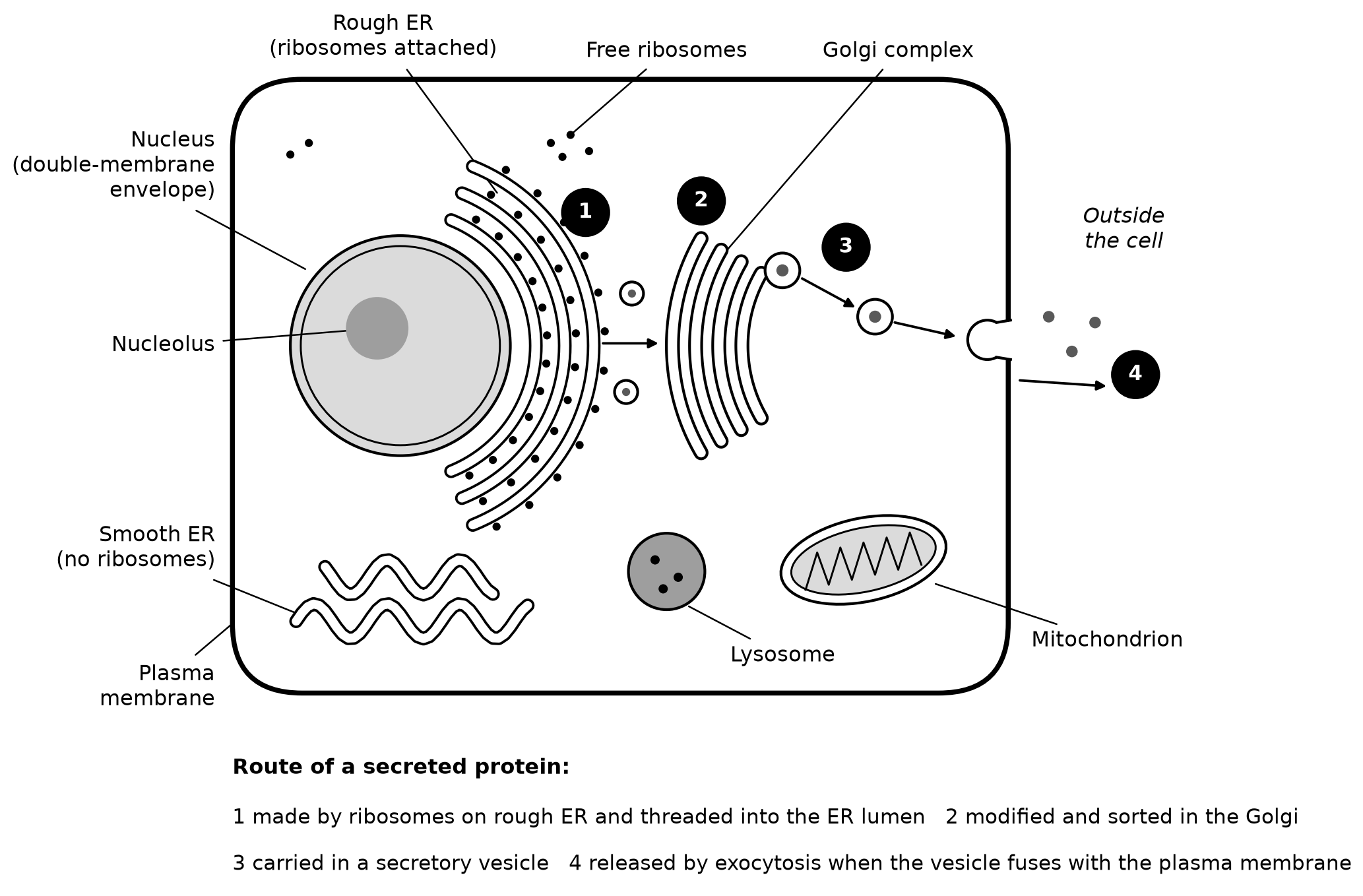
Figure 6.1. Compartments of an animal cell and the route of a secreted protein. Original schematic, not to scale.
Worked example: locate a blocked step
A researcher gives gland cells a brief pulse of radioactive amino acids, then follows a labeled digestive enzyme. In untreated cells, the label passes from the ER through the Golgi and vesicles to the outside within two hours. In cells treated with drug Q, label reaches the Golgi, but no labeled secretory vesicles form and nothing is released.
- Write the route in order: rough ER → Golgi → secretory vesicles → outside.
- Find the last compartment the label reached: the Golgi.
- The blocked step is the first transfer after that compartment: packaging the enzyme into secretory vesicles.
- Test the claim against every observation. The ER still empties, so ER-to-Golgi transport works. Nothing appears outside, as expected.
- Predict a new result: labeled enzyme should pile up in the Golgi over time.
The data do not show whether the Golgi still modifies the enzyme, because nothing measured modification.
Try it 6.1. In a mutant gland cell, the labeled enzyme fills the rough ER lumen but never appears in the Golgi. (a) Which transfer is blocked? (b) Where will most label be at 60 minutes? (c) Will the enzyme be secreted? (d) Explain why the cell's lysosomes might slowly lose function.
Mitochondria and chloroplasts: membranes that do work
Both organelles are enclosed by two membranes. A mitochondrion has a smooth outer membrane and an inner membrane folded into cristae. The space inside the inner membrane is the matrix; the narrow space between the membranes is the intermembrane space. ATP synthesis by cellular respiration happens on the inner membrane, so its folds increase the surface area available for that work (OpenStax Biology 2e, Eukaryotic Cells). A chloroplast also has an inner set of membranes, the thylakoids, stacked into grana. Light-harvesting reactions take place in the thylakoid membranes, and sugar is built in the surrounding fluid, the stroma. Chapter 9 follows both pathways.
Why cells stay small
Everything a cell takes in or releases crosses its plasma membrane, but the demand for exchange comes from its whole volume. Surface area grows with the square of a length, while volume grows with the cube, so the surface area to volume ratio (SA:V) falls as a cell grows. For a sphere, SA:V = 3/r (OpenStax Biology 2e, Animal Form and Function). The exam's formula sheet gives area and volume formulas for common shapes; you supply the reasoning (AP Biology Equations and Formulas).
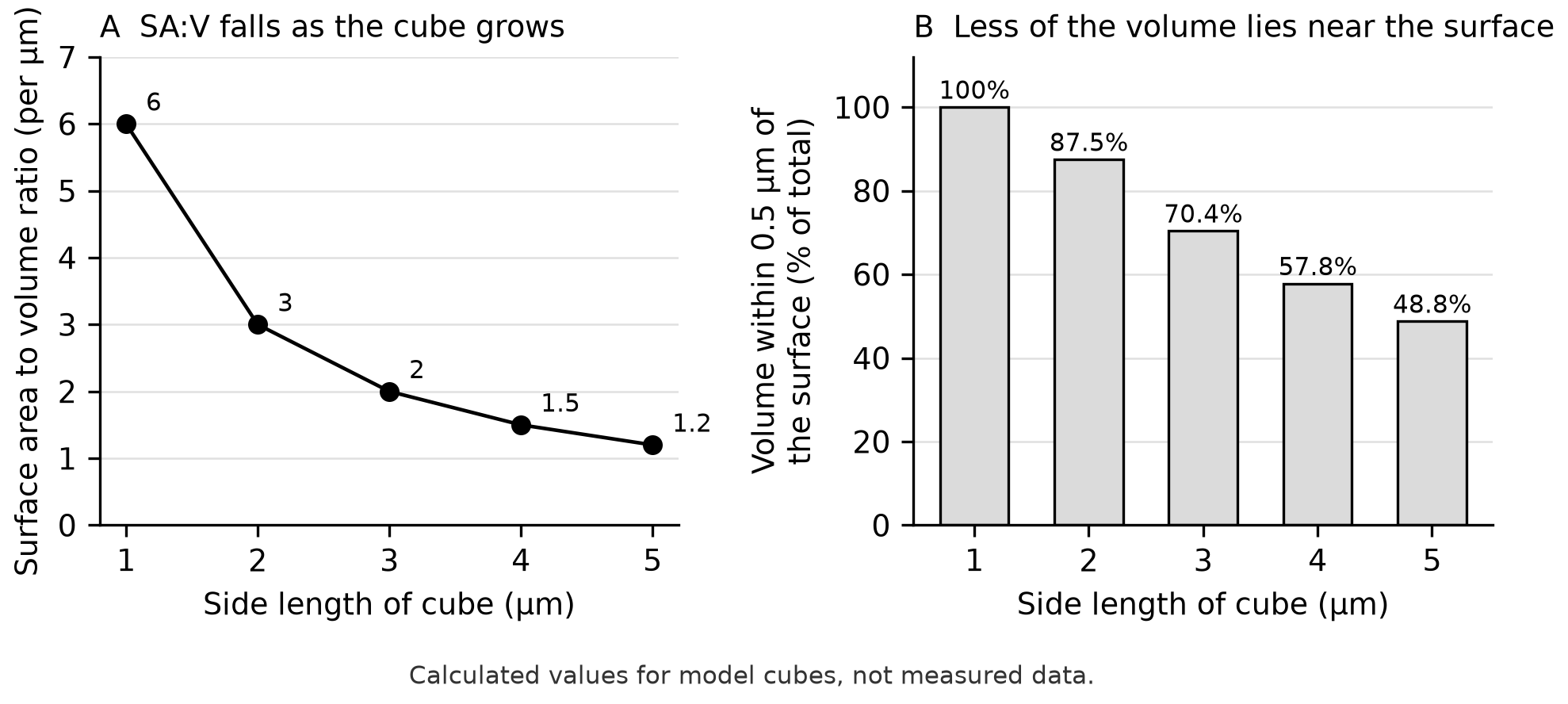
Figure 6.2. Calculated values for model cubes. As the cube grows, SA:V falls (A) and a smaller share of the volume lies close to the membrane (B).
Figure 6.2B shows a second cost of size: more cytoplasm lies far from the membrane. Cells that need heavy exchange fold the membrane, become flat or thin and elongated, or divide (OpenStax Biology 2e, Prokaryotic Cells). The villi and microvilli of the small intestine are folds of this kind that increase absorption (OpenStax Biology 2e, Digestive Systems).
Worked example: same volume, different shape
Compare a spherical cell of radius 3 µm with a cylindrical cell of radius 1 µm and length 36 µm.
- Sphere: SA = 4π(3²) = 36π µm²; V = (4/3)π(3³) = 36π µm³; SA:V = 1.0 per µm.
- Cylinder: V = π(1²)(36) = 36π µm³, the same volume. SA = 2π(1)(36) + 2π(1²) = 74π µm²; SA:V = 74/36 ≈ 2.06 per µm.
Because π appears in every term, it cancels, and a four-function calculator is enough. With equal volumes, the thin cylinder has about twice the surface for exchange.
Try it 6.2. (a) Compare SA:V for a sphere of radius 6 µm and a cylinder of radius 2 µm and length 72 µm. (b) Double the cylinder's length and recalculate. (c) Use your answers to explain why root hairs and nerve-cell extensions are thin rather than merely long.
The same geometry works at the scale of a whole animal, because heat is exchanged across the body surface. A smaller endothermic animal loses heat faster relative to its mass and has a higher metabolic rate per unit of body mass than a larger one (OpenStax Biology 2e, Animal Form and Function).
Try it 6.3. A cell shaped like a cube grows from 10 µm to 20 µm on a side. (a) By what factor do its surface area, volume and SA:V change? (b) Describe one problem this creates and two solutions other than dividing.
Compartments separate competing reactions
Membranes let a cell run incompatible processes at the same time. Lysosomal enzymes work best at a much lower pH than the cytoplasm's, and many cytoplasmic reactions could not run at that low pH (OpenStax Biology 2e, Eukaryotic Cells). The lysosome membrane keeps each set of conditions in its own space. Compartments do three more jobs (AP Biology Course and Exam Description, topic 2.9).
- Concentrate. Enzymes and substrates for one pathway are held together in a small volume.
- Provide surface. Membranes hold enzyme assemblies in place; folding the inner mitochondrial membrane or the thylakoids packs more reaction surface into the same volume.
- Hold gradients. Only a closed membrane can keep a concentration difference across it. The H⁺ gradient that drives ATP synthesis depends on this (Chapter 9).
Worked example: name the job a membrane does
Peroxisomes break down fatty acids in reactions that release hydrogen peroxide, which would damage the cell; enzymes inside break it into oxygen and water (OpenStax Biology 2e, Eukaryotic Cells). Which jobs does the membrane do? It concentrates one pathway's enzymes and keeps peroxide out of the cytosol, separating incompatible chemistry. Prediction: leaky peroxisomes would increase oxidative damage in the cytosol.
Try it 6.4. A toxin makes some lysosome membranes leaky. Predict what happens in the cytosol, and explain why the damage is limited while only a few lysosomes leak.
Where compartments came from
Prokaryotes (bacteria and archaea) lack membrane-bound organelles. Their DNA lies in a region called the nucleoid, and every prokaryote has ribosomes and a plasma membrane (OpenStax Biology 2e, Prokaryotic Cells). Lacking organelles does not mean lacking organization. Many bacteria build microcompartments: enzymes enclosed in a selectively permeable shell made of protein, not membrane. Some carry out carbon dioxide fixation (Kerfeld and colleagues, Bacterial microcompartments, Nature Reviews Microbiology, 2018).
Mitochondria and chloroplasts came from free-living prokaryotes. According to endosymbiotic theory, a host cell engulfed bacteria without digesting them, and over many generations the partners became one organism (OpenStax Biology 2e, Eukaryotic Cells). Mitochondria arose from proteobacteria and chloroplasts from cyanobacteria (Ku and colleagues, Nature, 2015). The evidence includes:
- Two membranes, consistent with one cell enclosed inside another.
- Their own DNA and ribosomes. Some antibiotics that target bacterial ribosomes also inhibit mitochondrial ribosomes (Barnhill and colleagues, Antimicrobial Agents and Chemotherapy, 2012).
- Gene sequences. Mitochondrial genomes place the organelle within the alphaproteobacteria (Gray, Mitochondrial evolution, 2012).
The partnership changed both partners. Organelle genomes are much reduced, and most proteins used inside these organelles are now encoded by nuclear genes, made on cytosolic ribosomes and imported (Ku and colleagues, Nature, 2015).
Worked example: weigh the evidence
Which observation best supports the claim that mitochondria descend specifically from alphaproteobacteria? Sort the evidence by how many explanations it fits. A double membrane fits engulfment of any cell. Bacterial-like ribosomes fit a bacterial origin but not one particular group. Sequence comparisons that place mitochondrial genes inside the alphaproteobacteria name the closest relatives. The most specific evidence is the strongest support for a specific claim.
Try it 6.5. A student writes: "Chloroplasts have their own DNA, so they make all their own proteins." (a) Correct the claim. (b) Predict how a drug that blocks bacterial-type ribosomes, but not cytosolic ribosomes, affects protein synthesis inside chloroplasts and in the cytosol.
Common errors to repair
- "The Golgi makes proteins." Ribosomes make proteins; the Golgi modifies, sorts and packages them.
- "A bigger cell exchanges better because it has more membrane." Total surface rises, but surface per unit volume falls. Compare ratios, not totals.
- "SA:V has no units." It is area divided by volume, so it has units of 1/length, such as per µm.
- "Prokaryotes have no internal organization." They lack membrane-bound organelles but have a nucleoid, ribosomes and, in many cases, protein-shelled microcompartments.
- "Mitochondria are bacteria living inside our cells." They descend from bacteria but are now organelles that depend on nuclear genes.
Check your try-it work
6.1. (a) Transport from the rough ER to the Golgi. (b) Still in the rough ER. (c) No; the enzyme never reaches a secretory vesicle. (d) Lysosomal enzymes are also made on the rough ER and pass through the Golgi, so new enzymes cannot reach the lysosomes.
6.2. (a) Sphere: SA = 144π, V = 288π, SA:V = 0.5 per µm. Cylinder: V = π(2²)(72) = 288π; SA = 2π(2)(72) + 2π(2²) = 296π; SA:V ≈ 1.03 per µm, about twice the sphere's. (b) Length 144 µm: V = 576π, SA = 584π, SA:V ≈ 1.01 per µm, almost unchanged. (c) For a long cylinder, SA:V is close to 2/r, so the radius sets the ratio. A thin cell keeps a high ratio however long it grows.
6.3. (a) Surface area rises 4 times (600 to 2,400 µm²), volume 8 times (1,000 to 8,000 µm³) and SA:V halves (0.6 to 0.3 per µm). (b) Problem: exchange cannot keep up with the cytoplasm's demand, and interior regions lie farther from the membrane. Solutions: fold the membrane, or become flatter or thinner and longer.
6.4. Hydrolytic enzymes enter the cytosol and could break down macromolecules. Damage stays limited at first because those enzymes are far less active at the cytosol's higher pH and because intact lysosomes still hold most of the enzymes.
6.5. (a) Chloroplasts have small genomes. Most chloroplast proteins are encoded by nuclear genes, made on cytosolic ribosomes and imported. (b) Protein synthesis on chloroplast ribosomes would fall, but cytosolic synthesis, including that of imported chloroplast proteins, would continue.
Practice
Questions 55–66 and Written task 4, which asks you to plan an investigation, print after this chapter's companion panel under Printed practice. Answers, the error in every wrong choice, and a sample response with its rubric are in Answers, explanations and written responses at the back of the book, under Chapter 6: answers and explanations. Log each miss by error type. In two days, redraw Figure 6.1 from memory. In one week, redo Try it 6.2 and 6.5 on blank paper.