What to practice
- distinguish transport mechanisms and justify water movement
The plasma membrane decides what enters and leaves a cell, how fast, and at what cost. This chapter builds the membrane from its parts, sorts transport into passive and active routes, and then uses water potential to predict which way water moves. It covers Unit 2 topics 2.3 to 2.8.
| Topic | You should be able to | Section |
|---|---|---|
| 2.3 Plasma membranes | explain how phospholipid and protein structure produce a bilayer | Build the membrane from its parts |
| 2.4 Membrane permeability | predict which substances cross unaided; describe what cell walls add | What crosses the bilayer on its own |
| 2.5 Membrane transport | separate passive, active and bulk transport | Passive transport; Active transport; Moving large cargo |
| 2.6 Facilitated diffusion | explain the roles of channels, carriers and aquaporins | Passive transport |
| 2.7 Tonicity and osmoregulation | calculate water potential and predict water movement | Tonicity and water potential; Osmoregulation |
| 2.8 Mechanisms of transport | explain how ATP-driven pumps build gradients | Active transport |
Build the membrane from its parts
A phospholipid has a hydrophilic head, a phosphate-containing group attached to glycerol, and two hydrophobic fatty-acid tails (OpenStax Biology 2e, Components and Structure). In water, phospholipids form a bilayer: heads face the watery fluid on each side, and tails face each other in the interior, away from water. No covalent bonds hold the two layers together; the arrangement is driven by the polarity of each part.
Proteins sit in this bilayer with the same logic. An integral protein that spans the membrane has a hydrophobic middle region, whose nonpolar amino acids contact the tails, and hydrophilic regions exposed to water on each surface. Peripheral proteins attach loosely to the surface.
The fluid mosaic model describes a membrane of phospholipids, cholesterol, proteins and carbohydrates whose components can move within the layer. Cholesterol dampens the effect of temperature on fluidity. Carbohydrates attached to lipids (glycolipids) and to proteins (glycoproteins) extend from the outer surface and help cells recognize one another (OpenStax Biology 2e, Components and Structure).
Worked example: predict membrane fluidity from structure
A fish moves from water at 25 °C to water at 5 °C. Predict how its membranes change.
- Name the problem. Cold compresses membranes; straight saturated tails press together, making a membrane denser, less fluid and more likely to rupture.
- Use structure. A double bond puts a kink in an unsaturated tail, which keeps neighboring phospholipids apart.
- Predict. Membranes that stay fluid in the cold should contain a larger share of unsaturated fatty acids. Fish are among the organisms that make this change as the temperature falls (OpenStax Biology 2e, Components and Structure).
What crosses the bilayer on its own
The membrane is selectively permeable. Small nonpolar molecules such as N₂, O₂ and CO₂ pass freely through the hydrophobic core. Water and other small polar molecules, such as ammonia, cross in small amounts. Ions and large polar molecules, such as glucose, need transport proteins (AP Biology Course and Exam Description, topic 2.4). Charge, not just size, keeps ions out: an ion is surrounded by water molecules attracted to its charge, and the nonpolar core repels it.
Bacteria, archaea, fungi and plants also have a cell wall outside the membrane. The wall gives the cell a structural boundary, acts as a permeability barrier to some substances, and protects the cell from bursting, called osmotic lysis, when water rushes in (AP Biology Course and Exam Description, topic 2.4). The wall does not choose what crosses into the cytoplasm; the plasma membrane inside it does that.
Passive transport: down the gradient
A concentration gradient exists when a substance is more concentrated in one region than another. In passive transport, net movement runs from higher to lower concentration and the cell spends no metabolic energy. In active transport, a substance moves against its gradient, and the cell must supply energy (AP Biology Course and Exam Description, topic 2.5).
Passive transport takes two forms. In simple diffusion, a substance crosses the bilayer directly. In facilitated diffusion, it crosses through a membrane protein:
- Channel proteins form highly specific pores, many of them gated. Ions such as Na⁺ and K⁺ cannot cross the bilayer itself; they diffuse down their gradients through channels.
- Carrier proteins bind the substance and change shape to carry it across. Each membrane has a finite number of carriers. When all are occupied, they are saturated, and the rate cannot rise further (OpenStax Biology 2e, Passive Transport).
- Aquaporins are channels that let water cross at a very high rate. Peter Agre's group found them by showing that frog egg cells making a red-blood-cell membrane protein swelled quickly in dilute solution, and that mercury blocked the effect (Preston and colleagues, Science, 1992). The discovery shared the 2003 Nobel Prize in Chemistry (Nobel Prize in Chemistry 2003, press release).
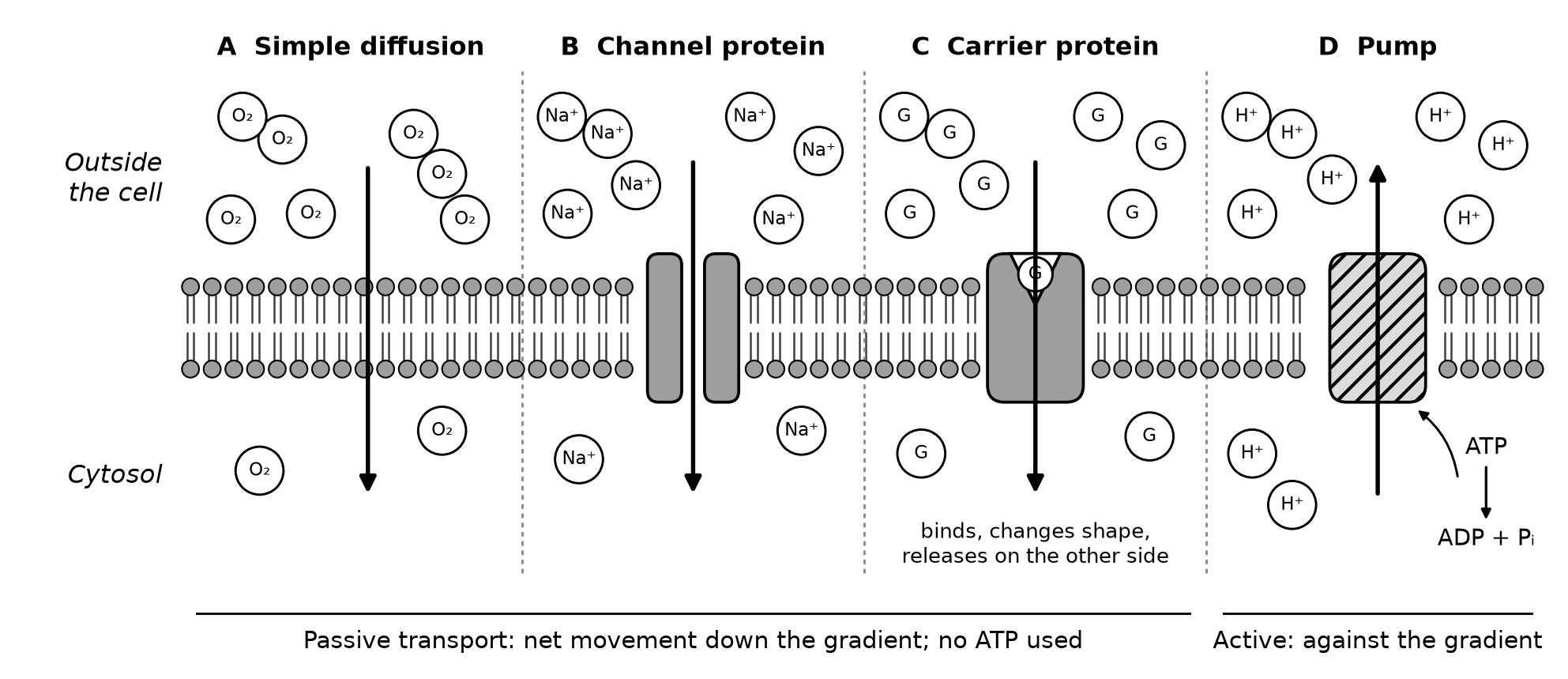
Figure 7.1. Four routes across a membrane. The number of symbols on each side shows the gradient. Original schematic, not to scale.
Worked example: a protein is not proof of active transport
Cells take up sugar S. The initial uptake rate rises quickly at low external concentrations and then levels off. Lowering cellular ATP by 90 percent does not change the rate. How does S enter?
- Read the shape of the curve. A rate that levels off means a limited number of transport proteins are becoming saturated. Simple diffusion through the bilayer would keep rising in proportion to concentration.
- Apply the energy test. If removing most ATP leaves the rate unchanged, the transport does not draw on ATP.
- Name the mechanism. A transport protein plus no energy use indicates facilitated diffusion.
- State what would change your answer. If cells held S at a higher concentration inside than outside, the transport would have to be active.
Saturation shows that a protein is involved; it does not show whether energy is used. Keep the two tests separate.
Try it 7.1. Substance T enters cells at a rate exactly proportional to its external concentration, from 1 to 50 mmol/L, and an ATP-depleting drug has no effect. (a) Identify the most likely route. (b) Predict one property of T's structure.
Active transport and electrochemical gradients
Active transport requires a direct input of energy to move a substance from lower to higher concentration (AP Biology Course and Exam Description, topic 2.8). The best-studied example is the sodium-potassium pump (Na⁺/K⁺ ATPase). In each cycle it hydrolyzes one ATP, moves three Na⁺ out of the cell and moves two K⁺ in, both against their concentration gradients (OpenStax Biology 2e, Active Transport). Each cycle therefore moves one net positive charge out, which helps keep the inside of the cell negative. This difference in charge across the membrane is the membrane potential.
For an ion, the concentration gradient and the electrical gradient combine into an electrochemical gradient. Na⁺ is pushed into the cell by both: it is more concentrated outside, and the negative interior attracts it. K⁺ faces opposing forces: its concentration gradient pushes it out, while the negative interior pulls it in. Gradients built by pumps store energy that other transport proteins can use, as when the Na⁺ gradient powers uptake of another solute against its own gradient.
Worked example: what happens when the pump stops?
A drug blocks the Na⁺/K⁺ pump, but the cell still makes ATP normally. Predict the effects.
- State the pump's job. It uses ATP to move Na⁺ out and K⁺ in, against their concentration gradients.
- Find what continues. Na⁺ still leaks in and K⁺ leaks out through channels, down their electrochemical gradients.
- Trace the result. With nothing restoring them, both gradients slowly run down and the membrane potential shrinks.
- Follow the stored energy. Uptake driven by the Na⁺ gradient slows, even though it uses no ATP directly.
ATP builds and maintains the gradients; the gradients then power other transport. Plenty of ATP cannot help once the pump that spends it is blocked.
Try it 7.2. A cell's interior is negative relative to the outside, and Ca²⁺ is far more concentrated outside the cell. (a) When Ca²⁺ channels open, which way does Ca²⁺ move, and do the two gradients agree? (b) Why must the cell use ATP to keep cytosolic Ca²⁺ low?
Moving large cargo
Proteins, particles and droplets of fluid are too large for channels or carriers. In endocytosis, the plasma membrane surrounds material and pinches off as a vesicle. Phagocytosis engulfs particles, pinocytosis takes in fluid, and receptor-mediated endocytosis takes in one kind of substance bound to surface receptors. In exocytosis, vesicles fuse with the plasma membrane and release their contents, as in the secretory route of Chapter 6 (OpenStax Biology 2e, Bulk Transport). Both processes require energy.
Tonicity and water potential
Osmosis is the net movement of water across a selectively permeable membrane. Water moves from the side with lower osmolarity (more water relative to solute) to the side with higher osmolarity (OpenStax Biology 2e, Passive Transport). Tonicity compares a solution with a cell, counting only solutes that cannot cross the membrane:
- Hypotonic solution: lower solute concentration than the cell; water enters. An animal cell swells and may burst (lyse). A plant cell becomes firm, or turgid, as its wall pushes back.
- Isotonic solution: no net water movement.
- Hypertonic solution: water leaves; an animal cell shrivels, and a plant cell's membrane pulls away from its wall.
Water potential (Ψ) turns these predictions into numbers. Water moves from higher to lower Ψ. Pure water in an open container has Ψ = 0, and the formula sheet gives
Ψ = ΨP + ΨS and ΨS = −iCRT.
Here i is the ionization constant (1 for sucrose; about 2 for NaCl in idealized problems), C is molar concentration, R = 0.0831 L·bar/(mol·K) and T is temperature in kelvins (°C + 273) (AP Biology Equations and Formulas). Solutes always make ΨS negative. Pressure potential ΨP is positive when a wall pushes back on a swollen cell and 0 in an open beaker.
Worked example: a plant cell in sucrose
A plant cell has ΨS = −9.0 bar and ΨP = +5.0 bar. It is placed in an open beaker of 0.12 mol/L sucrose at 20 °C.
- Solution. T = 20 + 273 = 293 K. ΨS = −(1)(0.12)(0.0831)(293) = −2.92 bar. With ΨP = 0, Ψ = −2.92 bar.
- Cell. Ψ = −9.0 + 5.0 = −4.0 bar.
- Direction. −2.92 is higher than −4.0, so net water moves into the cell.
- Equilibrium. As water enters, the wall pushes back and ΨP rises. Assuming the small volume taken in barely changes ΨS, movement stops when the cell's Ψ reaches −2.92 bar, at ΨP = −2.92 − (−9.0) = +6.08 bar.
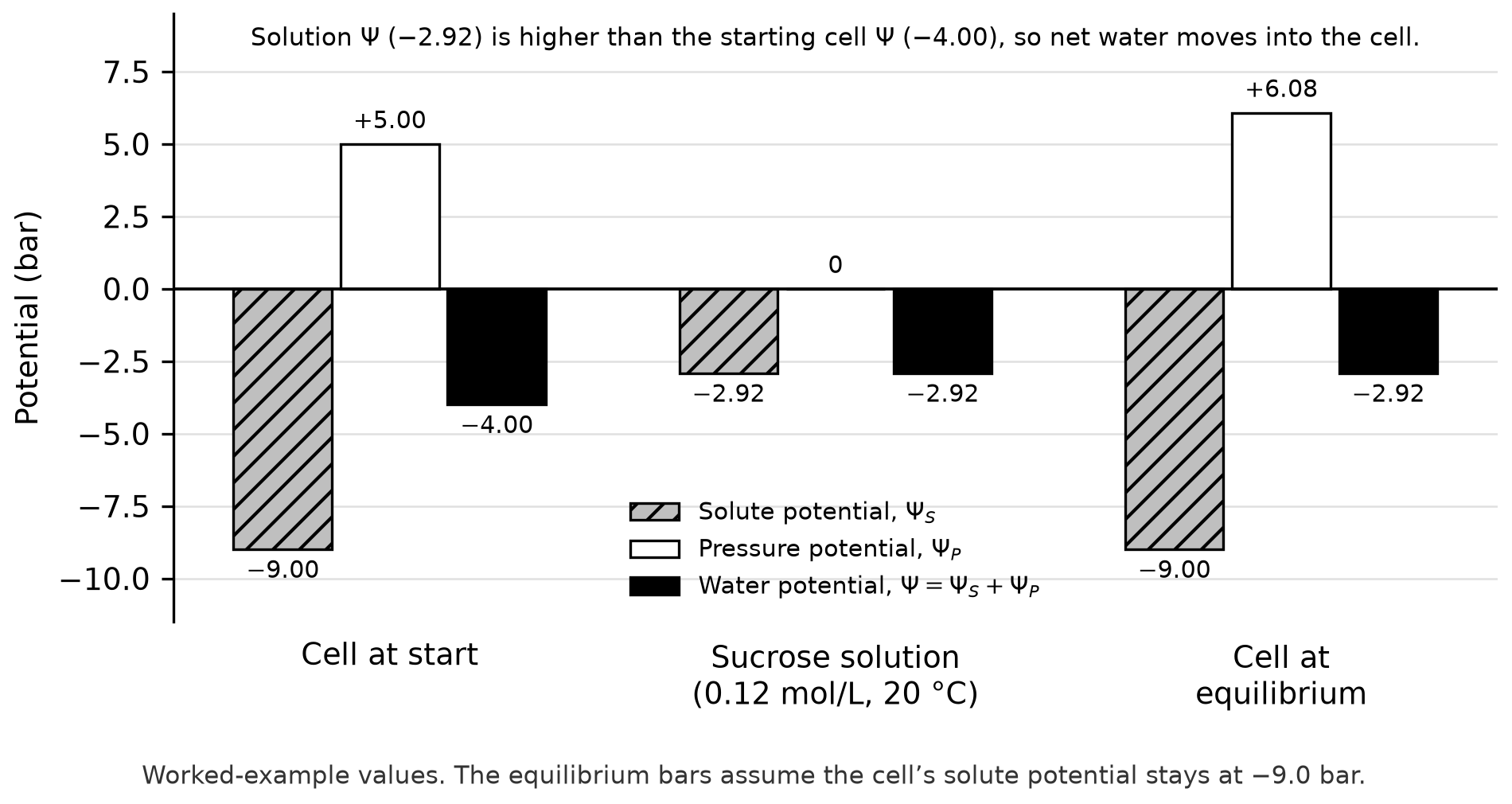
Figure 7.2. Water potential components in the worked example. Water enters the cell until its water potential matches the solution's.
Try it 7.3. (a) Find the water potential of 0.050 mol/L sucrose in an open beaker at 15 °C. (b) A plant cell with ΨS = −6.0 bar and ΨP = +4.0 bar is placed in it. Predict net water movement. (c) What stops the movement?
Try it 7.4. A solute crosses a cell's membrane freely. A cell is placed in a solution of that solute whose concentration matches the cell's total solute concentration. Explain why the cell swells, even though the two solutions start at equal concentration.
Osmoregulation
Organisms must keep water and solutes in balance. A plant cell in fresh water relies on its wall and large central vacuole: water entering the vacuole raises turgor pressure, which supports nonwoody plants. Protists such as paramecia and amoebas lack walls and live in water hypotonic to their cytosol. A contractile vacuole collects the water that keeps entering and expels it, which keeps the cell from bursting (OpenStax Biology 2e, Passive Transport).
This work costs energy: the contractile vacuole complex uses proton pumps powered by ATP (Allen and Naitoh, Osmoregulation and contractile vacuoles of protozoa, 2002). Because the cost tracks the water load, output is regulated. In Paramecium, the expulsion rate rises in strongly hypotonic water, falls in weakly hypotonic solutions and drops to zero in isotonic or hypertonic solutions (Stock and colleagues, Journal of Experimental Biology, 2001).
Try it 7.5. A wall-less pond protist has cytosol with ΨS = −2.5 bar and ΨP = 0. Pond water has Ψ = −0.4 bar. (a) Predict net water movement. (b) Explain why the protist needs a contractile vacuole but a plant cell in the same pond does not.
Common errors to repair
- "Water moves toward higher water potential." It moves toward lower, more negative Ψ.
- Dropping i or kelvins. Forgetting i = 2 for NaCl halves ΨS; using °C makes it far too small.
- "A transport protein means active transport." Channels and carriers also work passively. Ask whether energy is used.
- "Osmosis is the movement of solute." Osmosis is net movement of water.
- "In a U-tube, the concentrations end up equal." When the solute cannot cross, rising liquid pressure on one side stops net water movement first.
- "Hypotonic means the cell has less solute." The term describes the solution relative to the cell: a hypotonic solution has less solute than the cell.
Check your try-it work
7.1. (a) Simple diffusion through the bilayer: the rate never levels off, so no limited set of proteins is involved, and no ATP is used. (b) T is probably small and nonpolar.
7.2. (a) Into the cell. Both gradients agree: Ca²⁺ is more concentrated outside, and the negative interior attracts positive ions. (b) Ca²⁺ constantly leaks inward down its electrochemical gradient, so keeping cytosolic levels low means pumping it out against that gradient, which requires energy.
7.3. (a) T = 288 K; ΨS = −(1)(0.050)(0.0831)(288) = −1.20 bar, so Ψ = −1.20 bar. (b) Cell Ψ = −6.0 + 4.0 = −2.0 bar, lower than −1.20 bar, so net water enters the cell. (c) As water enters, the wall pushes back and ΨP rises until the cell's Ψ equals −1.20 bar.
7.4. The solute diffuses into the cell down its own gradient, while the cell's other solutes cannot leave. The cell then contains more total solute than before, its water potential falls below the solution's, and water follows. Tonicity depends only on solutes that cannot cross.
7.5. (a) Pond water (−0.4 bar) has higher Ψ than the cytosol (−2.5 bar), so water enters continuously. (b) The protist has no wall, so without expelling water it would swell and burst. A plant cell's wall pushes back, raising ΨP until net water entry stops.
Practice
Questions 67–82 print after this chapter's companion panel under Printed practice, followed by two written tasks: Written task 5, a long free-response question on water-channel data, and Written task 6, a short question analyzing contractile-vacuole data. Answers, the error in every wrong choice, and sample responses with rubrics are in Answers, explanations and written responses at the back of the book, under Chapter 7: answers and explanations. Log each miss by error type. In two days, redo the plant-cell worked example with 0.20 mol/L sucrose at 25 °C. In one week, redraw Figure 7.1 from memory and label which panels need ATP.