What to practice
- trace carbon, electrons and energy through distinct pathways
Before you read. Without notes, write two sentences: one explaining how a concentration gradient can do work as ions move down it (Chapter 7), and one explaining how ATP lets a cell run an uphill reaction (Chapter 8). This chapter, which covers AP Biology topics 3.4 and 3.5, depends on both ideas.
Keep three separate ledgers
Photosynthesis and cellular respiration are easiest to follow if you keep three ledgers and never mix them.
- Carbon (matter). Carbon atoms move from CO₂ into sugar during photosynthesis and back to CO₂ during respiration. Atoms are rearranged, never created or destroyed, so matter can cycle.
- Electrons. Electrons move with hydrogen in carriers: NADPH in photosynthesis, NADH and FADH₂ in respiration. Following the electrons tells you where energy is being stored or released.
- Energy. Energy enters as light, is stored in chemical bonds, is transferred to ATP and is used for work. At every transfer some is lost as heat, so energy flows one way and must be supplied continuously.
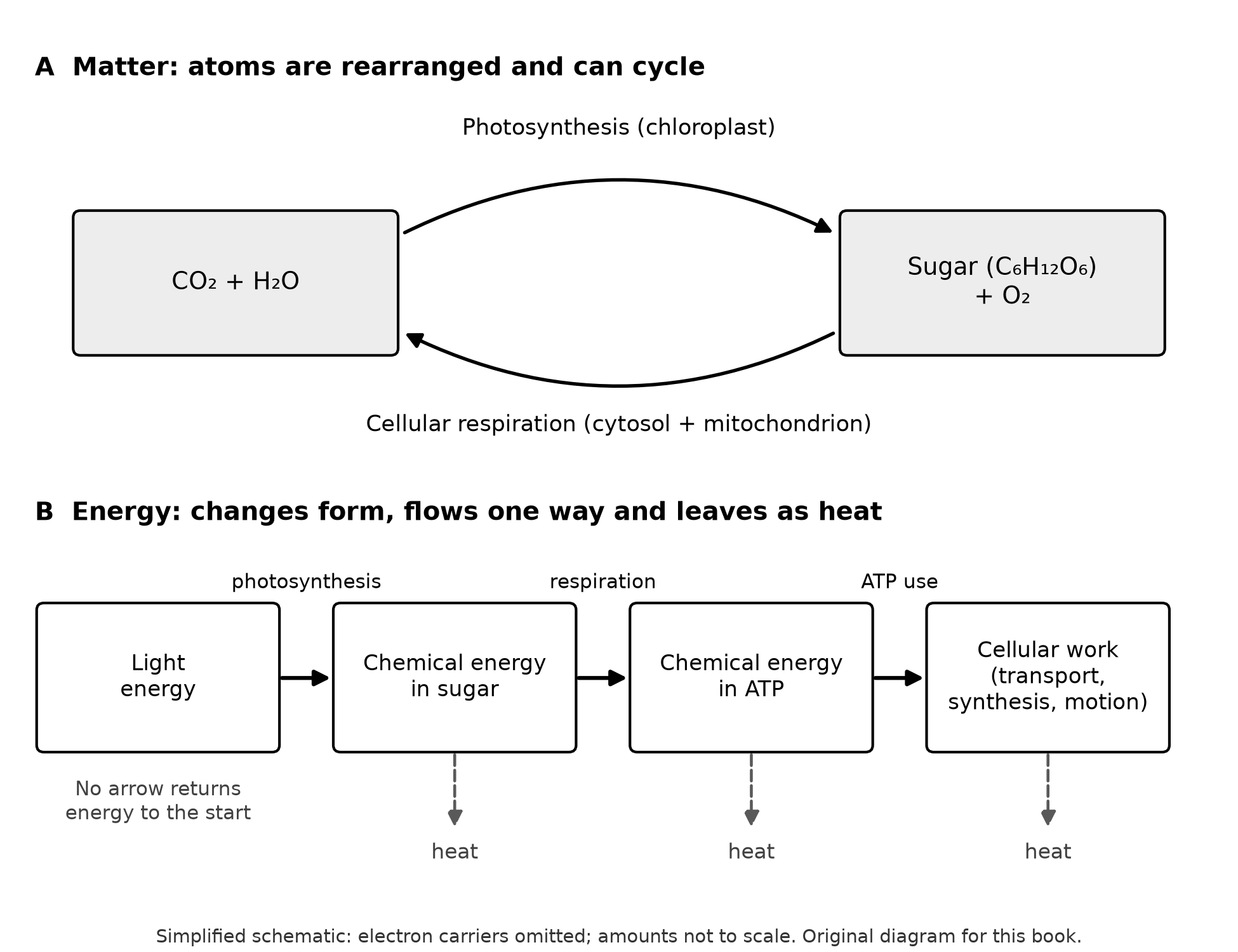
Figure 9.1. Matter cycles; energy flows through and leaves as heat. Original schematic; electron carriers omitted.
Photosynthesis: capture light, then build sugar
Structure sets the locations
A chloroplast has an outer and an inner membrane. Inside is a third membrane system, the thylakoids: flattened sacs, often stacked into grana, that enclose a space called the thylakoid lumen. The fluid around the thylakoids is the stroma (OpenStax Biology 2e, Overview of photosynthesis). The light-dependent reactions take place in the thylakoid membranes, and the Calvin cycle takes place in the stroma. Stacking many thylakoids packs a large membrane area, and therefore many photosystems, into a small space.
The light reactions: electrons from water, protons into the lumen
Chlorophyll and other pigments in photosystem II (PSII) absorb light, and the energy boosts electrons to a higher energy level. PSII replaces those electrons by splitting water, which releases O₂ and adds H⁺ to the lumen. The energized electrons pass along an electron transport chain to photosystem I (PSI). As they move, the chain uses some of their energy to move H⁺ from the stroma into the lumen. PSI absorbs light and re-energizes the electrons, which are finally passed to NADP⁺, forming NADPH on the stroma side (OpenStax Biology 2e, The light-dependent reactions of photosynthesis).
The result is a low pH in the lumen and a high pH in the stroma. H⁺ flows back to the stroma through ATP synthase, and that flow drives the synthesis of ATP from ADP and phosphate, a process called photophosphorylation.
The Calvin cycle: carbon from CO₂, power from ATP and NADPH
In the stroma, the Calvin cycle attaches carbon from CO₂ to an existing organic molecule, then uses ATP and the electrons carried by NADPH to convert the products into sugar. The cycle releases ADP, phosphate and NADP⁺, which return to the thylakoids to be recharged. The cycle must turn three times to export one three-carbon sugar and six times to supply the carbon for one glucose (OpenStax Biology 2e, Using light energy to make organic molecules). The AP exam does not require the cycle's individual steps or enzyme names. It does require the connection: no light reactions, no ATP and NADPH, no Calvin cycle.
Worked example: the two stages depend on each other
Predict what happens in an illuminated algal culture in each case.
Case A: a compound blocks electron flow out of photosystem II.
- Electron flow. Electrons can no longer leave PSII, so PSII cannot accept replacement electrons from water. Water splitting, and therefore O₂ release, stops.
- Products. No electrons reach NADP⁺, so NADPH production stops. H⁺ is no longer added to the lumen by water splitting or by the chain, so the gradient fades and ATP synthesis falls.
- Carbon. The Calvin cycle runs out of ATP and NADPH, so CO₂ fixation slows and stops, even though CO₂ and light are both present.
Case B: the culture is bubbled with CO₂-free air.
- Carbon. The Calvin cycle has no CO₂ to fix, so it stops using ATP and NADPH.
- Recycling. ADP, phosphate and NADP⁺ are no longer returned to the thylakoids. With little NADP⁺ left to accept electrons, electron flow and O₂ release slow, even in bright light.
The two stages form a loop of carriers: the light reactions charge them, and the Calvin cycle discharges them. Stopping either stage soon stops the other.
Worked example: trace labeled atoms
A balanced equation that tracks every oxygen atom is 6 CO₂ + 12 H₂O → C₆H₁₂O₆ + 6 O₂ + 6 H₂O. Use it to predict where an isotope label goes.
| Labeled starting atom | Where the label ends up | Why |
|---|---|---|
| Carbon in CO₂ | Sugar | The Calvin cycle fixes CO₂ into organic molecules |
| Oxygen in CO₂ | Sugar and the new water | CO₂ oxygen is built into organic molecules; extra oxygen leaves as water |
| Oxygen in H₂O | Released O₂ | Water is split at photosystem II |
| Hydrogen in H₂O | Sugar, by way of NADPH | Electrons and H⁺ from water reduce NADP⁺, and NADPH reduces carbon compounds |
Table 9.1. Where the atoms of photosynthesis go.
The simpler equation 6 CO₂ + 6 H₂O → C₆H₁₂O₆ + 6 O₂ balances, but it hides the fact that all twelve oxygen atoms in the six O₂ come from water. Count them in the fuller equation: 12 water molecules supply 12 oxygen atoms, exactly enough for six O₂.
Photosynthesis began in prokaryotes
Oxygen-releasing photosynthesis first evolved in prokaryotes, in the lineage that gave rise to cyanobacteria. The O₂ they released, beginning more than two billion years ago, accumulated in the oceans and atmosphere, changed Earth's chemistry and made aerobic respiration possible (Fischer, Hemp and Johnson, 2016, Annual Review of Earth and Planetary Sciences). Eukaryotic photosynthesis was built on these prokaryotic pathways: chloroplasts descend from cyanobacteria that lived inside an ancestral eukaryotic cell (OpenStax Biology 2e, Eukaryotic origins).
Cellular respiration: release energy in controlled steps
Glycolysis in the cytosol
Glycolysis splits one glucose into two three-carbon pyruvate molecules. It invests two ATP early and produces four later, so the net gain is two ATP per glucose, along with two NADH (OpenStax Biology 2e, Glycolysis). Glycolysis does not use O₂ directly, but it does need a steady supply of NAD⁺ to accept electrons. That requirement explains fermentation later in this chapter.
Pyruvate oxidation and the Krebs cycle in the matrix
In eukaryotes, pyruvate enters the mitochondrial matrix. There it is oxidized to a two-carbon acetyl group, releasing one CO₂ and forming one NADH for each pyruvate. The acetyl group enters the Krebs cycle (citric acid cycle). Each turn releases two CO₂ and produces three NADH, one FADH₂ and one ATP or GTP (OpenStax Biology 2e, Oxidation of pyruvate and the citric acid cycle). Two pyruvates mean two turns, so all six carbons of the original glucose leave as CO₂. Most of glucose's usable energy now sits in the electrons carried by NADH and FADH₂.
Electron transport and chemiosmosis on the inner membrane
NADH and FADH₂ deliver electrons to a chain of proteins in the inner mitochondrial membrane. As electrons pass along the chain, energy is used to pump H⁺ from the matrix into the intermembrane space. At the end of the chain the electrons, with H⁺, reduce O₂ to water. O₂ is the terminal electron acceptor (OpenStax Biology 2e, Oxidative phosphorylation). The H⁺ concentration is now higher in the intermembrane space, so the matrix has the higher pH. H⁺ flows back into the matrix through ATP synthase, which makes ATP. Folding of the inner membrane into cristae increases its surface area, so more chain proteins and ATP synthases fit in each mitochondrion (OpenStax Biology 2e, Eukaryotic cells; AP Biology Course and Exam Description).
Peter Mitchell proposed this chemiosmotic mechanism in 1961 (Mitchell, 1961, Nature). A striking test came in 1966, when André Jagendorf and Ernest Uribe soaked spinach chloroplasts in acid in the dark, then moved them to a basic solution with ADP and phosphate. ATP formed without light: a pH difference alone was enough to drive ATP synthase (Jagendorf and Uribe, 1966, PNAS).
Electron transport and ATP synthesis are separate events joined only by the H⁺ gradient. If H⁺ leaks back across the membrane without passing through ATP synthase, electrons keep flowing and O₂ is still consumed, but the energy is released as heat instead of being captured in ATP. Brown fat cells use this on purpose: the protein UCP1 lets H⁺ leak across the inner membrane, producing heat that helps mammals stay warm (Cannon and Nedergaard, 2004, Physiological Reviews).
How much energy is captured
Respiration does not capture all the energy in glucose. Overall, glucose breakdown captures about 34 percent of the energy in glucose; the rest is released as heat (OpenStax Biology 2e, Oxidative phosphorylation). The exact number of ATP made per glucose is not fixed. It varies with how many H⁺ the chain pumps and with how electrons from NADH made in the cytosol enter the mitochondrion. Avoid memorizing a single total; explain instead why most ATP comes from chemiosmosis rather than from glycolysis and the Krebs cycle directly.
Fermentation keeps glycolysis running
Without O₂, the electron transport chain stops, NADH cannot unload its electrons there and NAD⁺ runs short. Fermentation solves only that problem. Pyruvate, or a molecule made from it, accepts electrons from NADH, regenerating NAD⁺ so glycolysis can continue making its two ATP per glucose. Animal muscle cells and some bacteria produce lactate; yeasts produce ethanol and CO₂ (OpenStax Biology 2e, Metabolism without oxygen). Some prokaryotes respire anaerobically instead: their transport chains pass electrons to a different terminal acceptor, such as sulfate.
| Process | Terminal electron acceptor | Electron transport chain used? | ATP per glucose |
|---|---|---|---|
| Aerobic respiration | O₂, reduced to water | Yes | Many; most from ATP synthase |
| Anaerobic respiration (some prokaryotes) | Another inorganic molecule, such as sulfate | Yes | More than two, because ATP synthase also contributes |
| Fermentation | An organic molecule, such as pyruvate | No | Two, all from glycolysis |
Table 9.2. Three ways cells make ATP from glucose. The key difference is what finally accepts the electrons (OpenStax Biology 2e, Metabolism without oxygen).
Worked example: follow a loss of oxygen through the system
A tissue's oxygen supply is cut off. Trace the consequences in order.
- Electron transport stops. With no terminal acceptor, electrons back up along the chain.
- The gradient fades. Pumping stops, H⁺ leaks back, and ATP synthase slows to a halt.
- The carriers stay loaded. NADH and FADH₂ cannot unload, so NAD⁺ runs short. Pyruvate oxidation and the Krebs cycle, which need NAD⁺, slow and stop.
- Glycolysis survives only with fermentation. Cells that can ferment regenerate NAD⁺ and keep making two ATP per glucose. Cells that cannot ferment soon run out of ATP.
Notice that step 3 links two pathways that never touch O₂ directly. The Krebs cycle stops because of the NAD⁺ supply, not because it uses oxygen.
Try it 9.1. A soil bacterium can grow in three conditions: with O₂; without O₂ but with nitrate, which its transport chain can use as a terminal electron acceptor; and with neither, when it ferments. Use Table 9.2 to identify the condition with the lowest expected ATP yield per glucose, and explain why both other conditions yield more.
Compare the two membranes
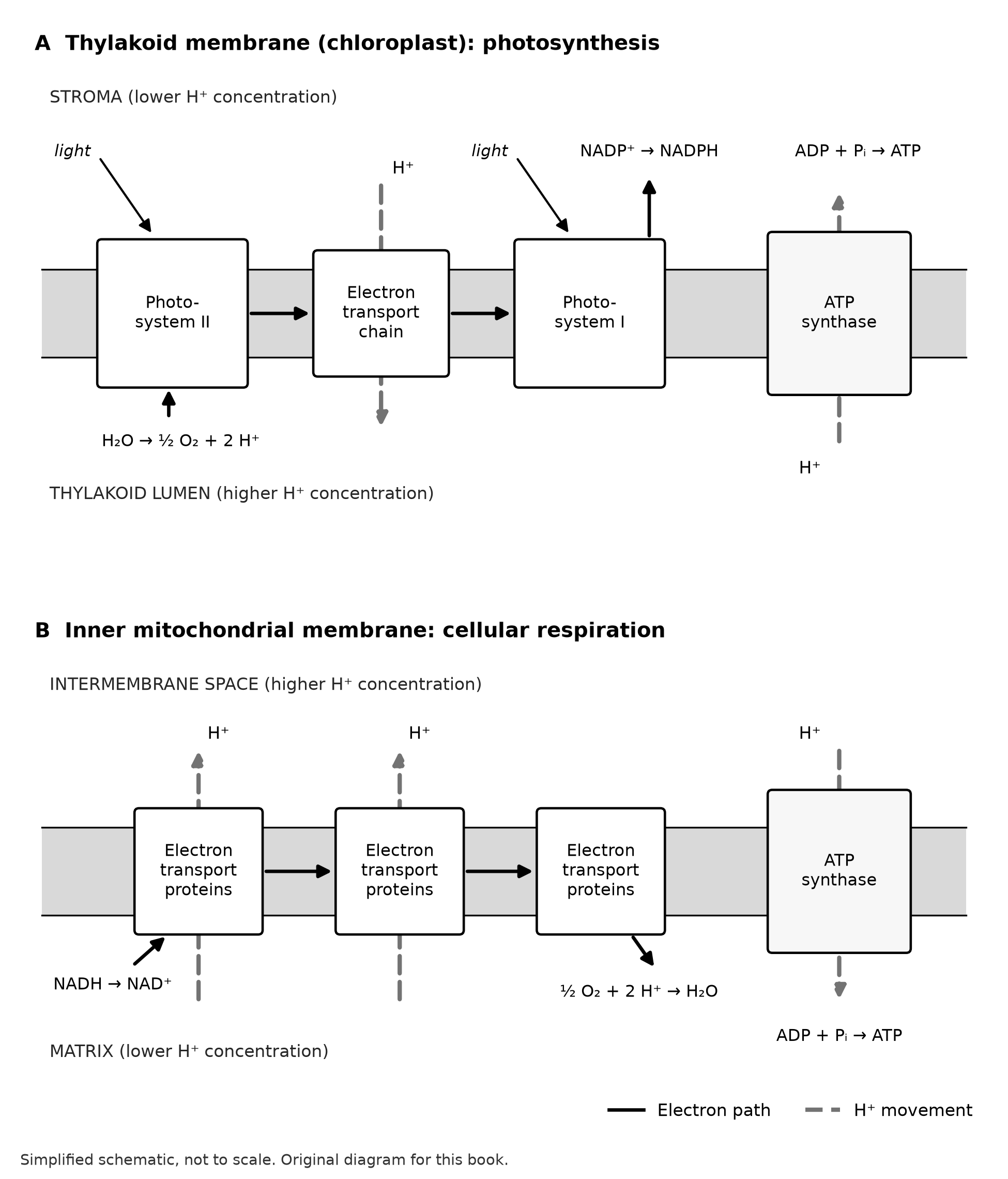
Figure 9.2. The same strategy in two membranes. Solid arrows show electron paths; dashed arrows show H⁺ movement. Original schematic, not to scale.
| Feature | Thylakoid membrane | Inner mitochondrial membrane |
|---|---|---|
| Energy that drives electron flow | Light absorbed by photosystems | Chemical energy in NADH and FADH₂ |
| Electron source | Water, which is split and releases O₂ | NADH and FADH₂ |
| Terminal electron acceptor | NADP⁺, forming NADPH | O₂, forming water |
| H⁺ accumulates in | Thylakoid lumen | Intermembrane space |
| ATP is made in | Stroma | Matrix |
| Extra membrane area | Stacked thylakoids | Cristae |
Table 9.3. Comparison of the two chemiosmotic membranes.
Try it 9.2. A chemical makes thylakoid membranes leaky to H⁺. Predict its effect on (a) ATP production and (b) electron flow from water to NADP⁺. Justify each prediction.
Try it 9.3. A mouse briefly breathes air in which the O₂ is labeled with the isotope ¹⁸O. Does the label first appear in the CO₂ it exhales or in water in its cells? Explain.
Measure photosynthesis and respiration together
A leaf in the light photosynthesizes and respires at the same time, so a sensor in a sealed chamber measures only the net exchange. In darkness, the O₂ uptake shows respiration alone.
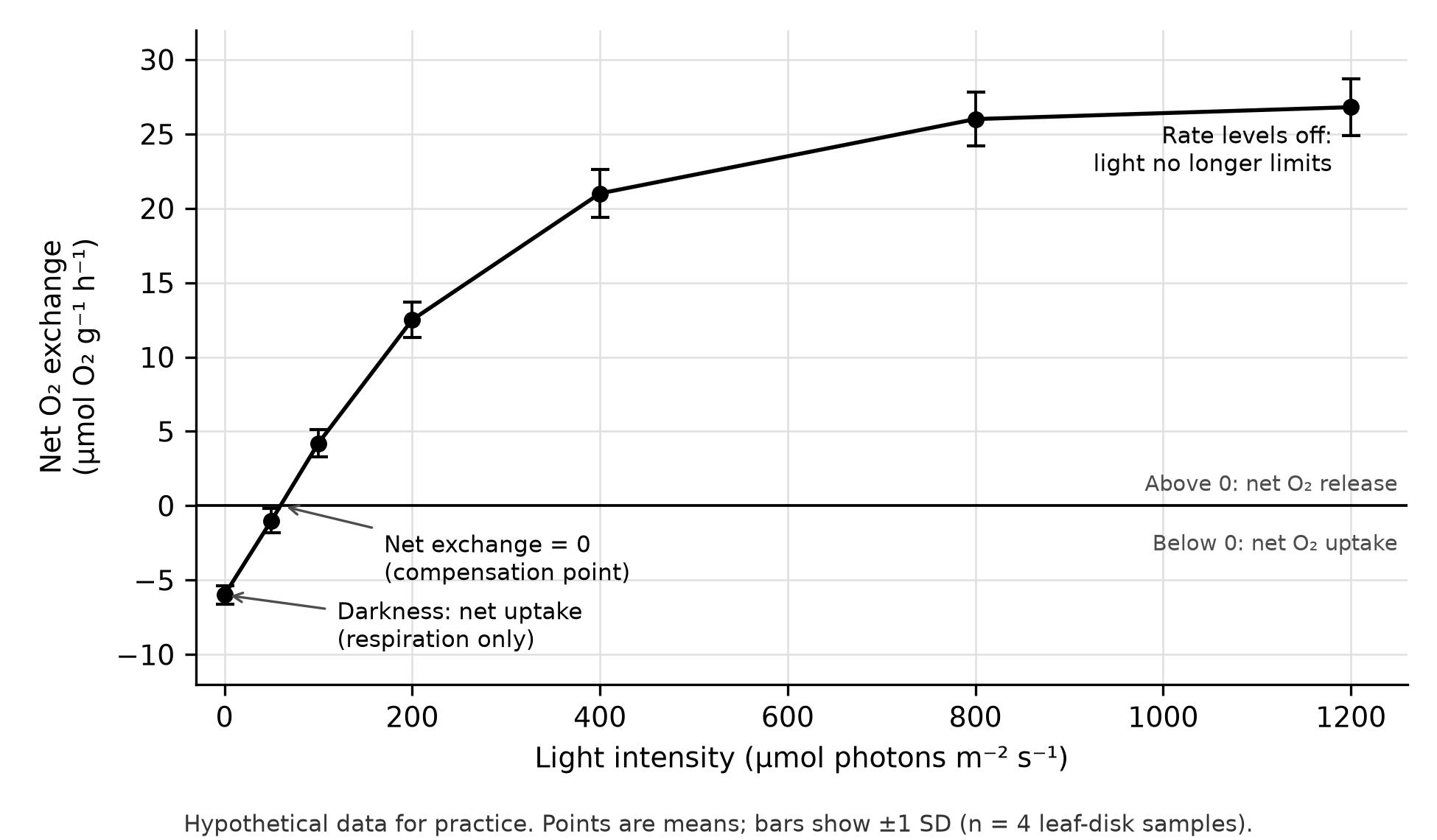
Figure 9.3. Net O₂ exchange of leaf disks at 25 °C: −6.0 at 0, −1.0 at 50, 4.2 at 100, 12.5 at 200, 21.0 at 400, 26.0 at 800 and 26.8 at 1,200 µmol photons m⁻² s⁻¹. Means ± 1 SD, n = 4. Hypothetical data for practice.
Worked example: from net to gross
- Find respiration. In darkness the disks take up 6.0 µmol O₂ per gram per hour.
- Assume, and say so. Assume respiration continues at the same rate in the light. This is an assumption, not a measurement.
- Add back what respiration used. Gross O₂ production = net + respiration. At 200 µmol photons m⁻² s⁻¹, gross = 12.5 + 6.0 = 18.5 µmol O₂ per gram per hour.
- Find the compensation point. Net exchange crosses zero between 50 and 100. Interpolate: 50 + (1.0 ÷ 5.2) × 50 ≈ 60 µmol photons m⁻² s⁻¹. At about this light level, photosynthesis exactly balances respiration.
Report both results as estimates. In the light the standard deviations are about 1 to 2 units, so individual samples varied, interpolation assumes a straight line between 50 and 100, and gross production rests on the respiration assumption in step 2. A stronger study would measure more light levels near the crossing and test whether respiration changes in the light.
Try it 9.4. Use Figure 9.3. (a) Calculate gross O₂ production at 50 and at 400 µmol photons m⁻² s⁻¹. (b) Net exchange rose by 8.3 from 100 to 200 but by only 0.8 from 800 to 1,200. Explain what this change suggests about what limits the rate at high light.
Common errors to repair
- "Plants photosynthesize; animals respire." Plants do both, all the time; in light, net exchange hides the respiration.
- "The O₂ released by photosynthesis comes from CO₂." It comes from water split at photosystem II.
- "Energy is recycled between photosynthesis and respiration." Matter cycles; energy flows through and leaves as heat.
- "ATP synthase pumps protons." It lets H⁺ flow down its gradient and uses that flow to make ATP.
- "Fermentation makes ATP." The ATP comes from glycolysis; fermentation regenerates NAD⁺ so glycolysis can continue.
- "The Calvin cycle is the dark reaction, so it runs at night." It runs in the light, because it depends on ATP and NADPH made by the light reactions.
Check your try-it work
9.1. The condition with neither acceptor yields the least. Without a terminal acceptor the transport chain cannot run, so the cell relies on glycolysis and fermentation: two ATP per glucose, with fermentation only regenerating NAD⁺. With O₂ or with nitrate, the chain passes electrons to the acceptor and builds an H⁺ gradient, so ATP synthase adds ATP beyond the two from glycolysis.
9.2. (a) ATP production falls, because the H⁺ gradient across the thylakoid membrane dissipates instead of driving ATP synthase. (b) Electron flow to NADP⁺ continues, and may even speed up, because light still drives it and a weaker gradient pushes back less against H⁺ pumping. NADPH is still made.
9.3. In water. O₂ is the terminal electron acceptor at the end of the electron transport chain, where it is reduced to H₂O. The oxygen in exhaled CO₂ comes from organic molecules and water broken down in pyruvate oxidation and the Krebs cycle, not from the O₂ just inhaled.
9.4. (a) At 50, gross = −1.0 + 6.0 = 5.0; at 400, gross = 21.0 + 6.0 = 27.0 µmol O₂ per gram per hour. (b) At low light, adding light raises the rate sharply, so light is the limiting factor. At high light the rate barely changes, so something else, such as the CO₂ supply or the rate of the Calvin cycle, limits it.
Practice
The printed practice for this chapter is Questions 95–114 and Written tasks 8 and 9 (a long free-response question with a graph and a short free-response question on data), in that order after this chapter's companion panel. Questions 95–98 share a mitochondria table, 99–102 share a thylakoid table and 103–106 share one cell diagram. Answers, reasoning, the error in each wrong choice, scoring guides and a Repair and retry line are in Answers, explanations and written responses at the back of the book, under Chapter 9: answers and explanations. One week later, redo every item you missed without notes.