What to practice
- follow homologs, chromatids and allele combinations into gametes
Meiosis turns one diploid cell into four haploid cells, each with one chromosome from every homologous pair. Unit 5 of the College Board AP Biology Course and Exam Description asks you to sequence its steps, compare it with mitosis and explain how it generates variation. Two habits help: count chromosomes by centromeres, and track alleles chromatid by chromatid.
Count chromosomes, chromatids and DNA separately
Decide which of three counts a question asks about.
- Chromosomes. Count centromeres. A replicated chromosome, two sister chromatids joined at one centromere, is still one chromosome.
- Chromatids. Count DNA molecules. An unreplicated chromosome has one chromatid; a replicated chromosome has two.
- Ploidy. A diploid (2n) cell has two sets of chromosomes, one from each parent. A haploid (n) cell has one set. Ploidy depends on sets, not on whether the chromosomes are replicated.
Homologous chromosomes are a matched pair, one from each parent, carrying the same genes in the same order, possibly with different alleles. Sister chromatids are the copies made in S phase and are identical apart from rare errors. Table 12.1 follows a cell with 2n = 4.
| Point in the process | Chromosomes | Chromatids | DNA (G1 = 1) | Ploidy |
|---|---|---|---|---|
| G1, before replication | 4 | 4 | 1 | 2n |
| After S phase | 4 | 8 | 2 | 2n |
| Each cell after meiosis I | 2 | 4 | 1 | n |
| Each cell after meiosis II | 2 | 2 | 0.5 | n |
Table 12.1. Counts per cell for a hypothetical organism with 2n = 4.
Common error. Calling the cells after meiosis I diploid "because the chromosomes are still doubled." Each cell holds one member of each homologous pair, so it is haploid even though every chromosome still has two chromatids.
Meiosis I separates homologous chromosomes
Learn to sequence these events (OpenStax Biology 2e, The Process of Meiosis):
- Prophase I. Homologs pair along their length (synapsis). Nonsister chromatids exchange corresponding segments by crossing over, and the exchange points appear as chiasmata. Chiasmata hold each pair together until anaphase I, which helps the homologs separate correctly.
- Metaphase I. Homologous pairs line up at the metaphase plate, one homolog facing each pole.
- Anaphase I. Homologs move to opposite poles. Sister chromatids stay joined at their centromeres.
- Telophase I and cytokinesis. Two haploid cells form. No DNA replication follows.
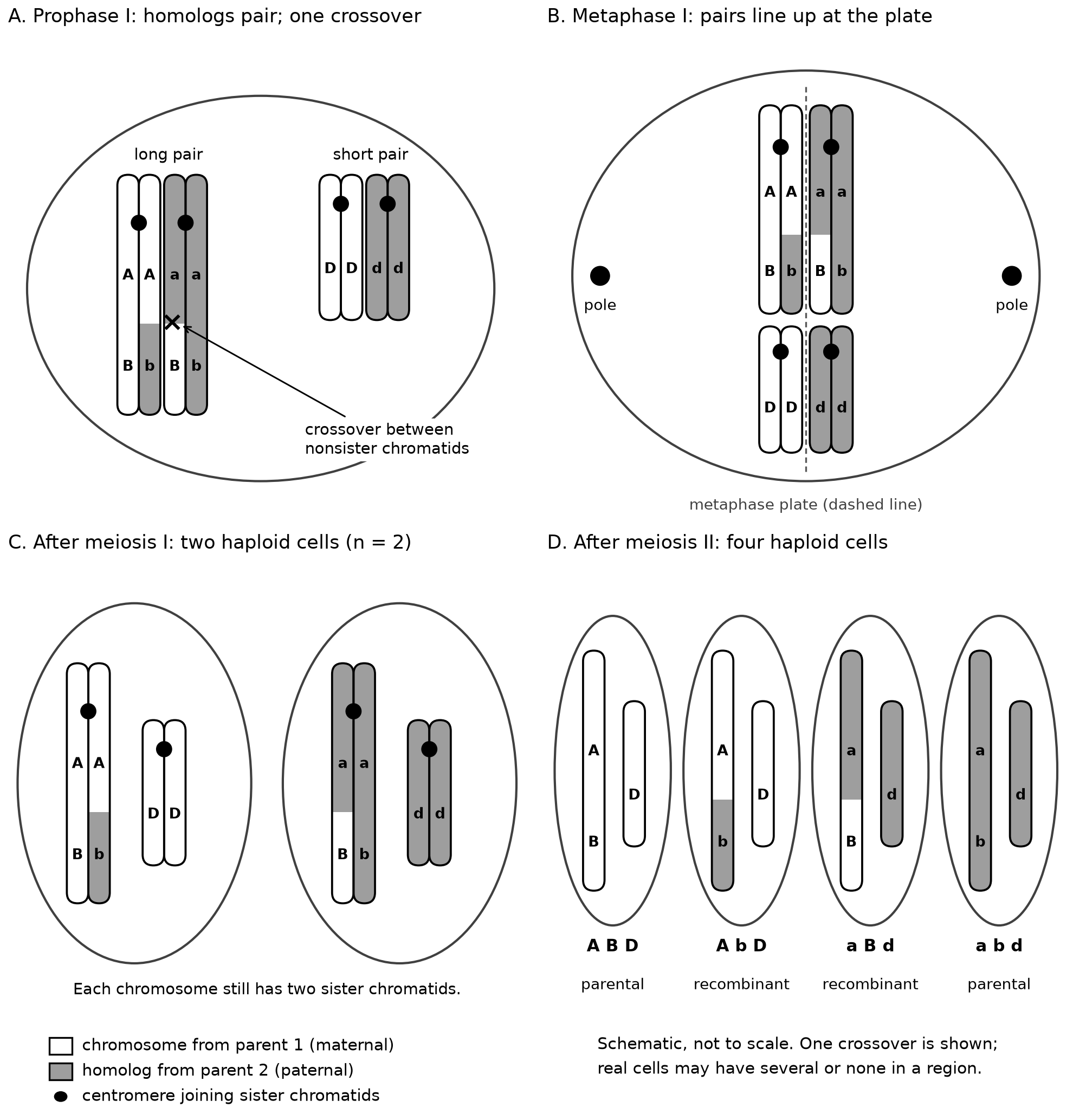
Figure 12.1. One meiosis traced chromatid by chromatid. The prophase I crossover gives two of the four gametes allele combinations absent from both parental chromosomes.
Meiosis II separates sister chromatids
Meiosis II resembles mitosis in each haploid cell: chromosomes line up singly in metaphase II, and sister chromatids separate in anaphase II. The four haploid products usually differ genetically because crossing over has made some sisters differ.
Mitosis and meiosis both use a spindle to move chromosomes; they differ in what separates and what results.
| Feature | Mitosis | Meiosis |
|---|---|---|
| Divisions after one S phase | One | Two |
| Homologs pair and cross over | No | Yes, in prophase I |
| What lines up at the plate | Single replicated chromosomes | Pairs (I); single chromosomes (II) |
| Products | Two cells genetically identical to the parent cell | Four haploid, genetically different cells |
Worked example: the step that halves the number
Question. A student writes, "Meiosis II halves the chromosome number because the chromatids separate." Correct the claim for a cell with 2n = 8.
Solution. After S phase the cell still has 8 chromosomes (16 chromatids). Anaphase I sends 4 replicated chromosomes to each pole, so each cell after meiosis I has 4 chromosomes: it is already n. Anaphase II splits each into two single-chromatid chromosomes, and each daughter cell receives 4. The count stays at n = 4; only the chromatids per chromosome fall from two to one. Separating homologs in meiosis I halves the number.
Three sources of genetic variation
Crossing over. Nonsister chromatids exchange corresponding segments in prophase I, producing recombinant chromatids with new combinations of alleles on one chromosome (NHGRI glossary: Crossing Over). Sister chromatids carry the same alleles, so an exchange between sisters creates no new combination.
Independent assortment. Each homologous pair orients at metaphase I independently of the others. A cell with n pairs can therefore produce combinations of maternal and paternal chromosomes. Humans have n = 23, giving 2²³ = 8,388,608 combinations even without crossing over.
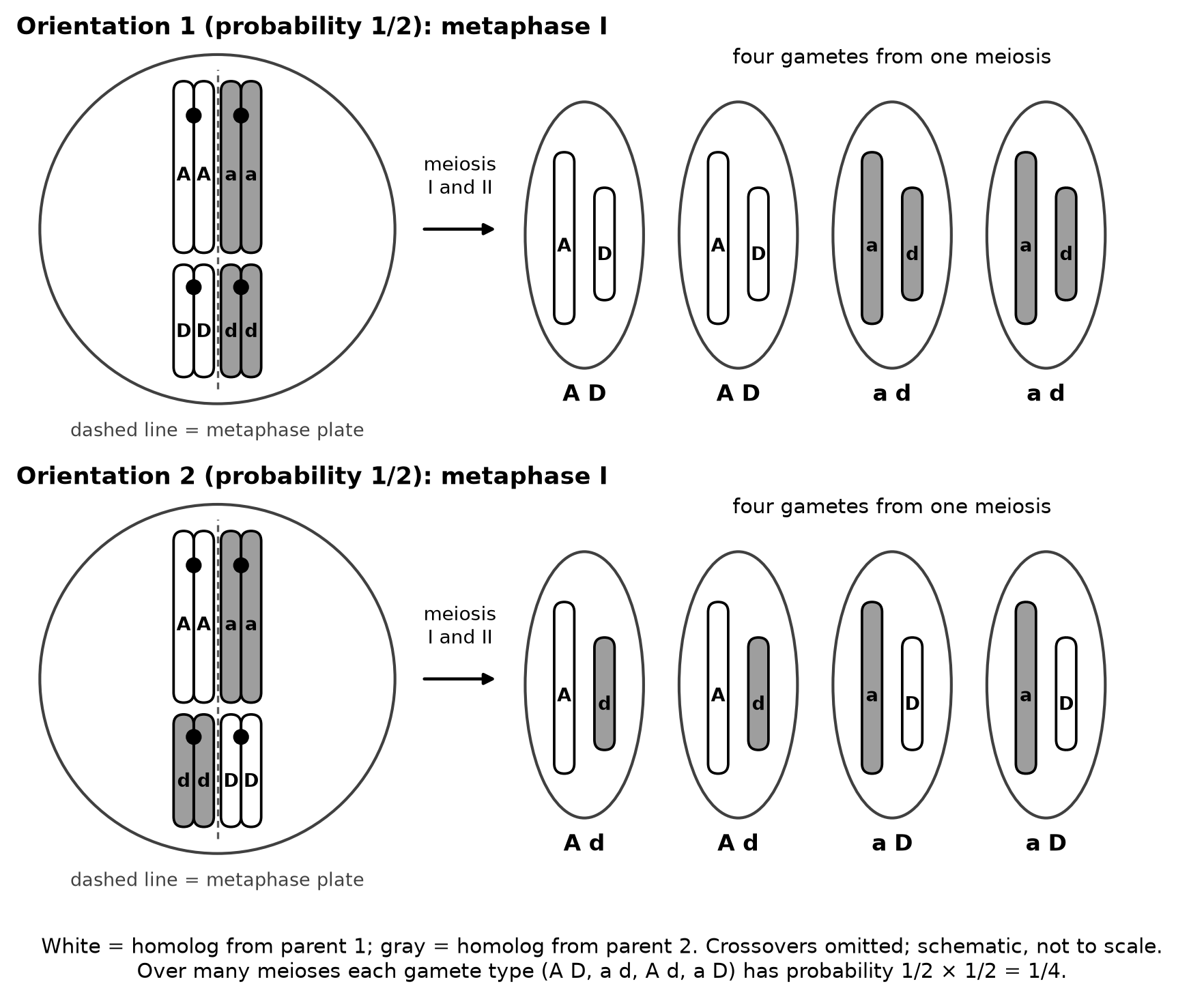
Figure 12.2. Two equally likely orientations at metaphase I. One meiosis yields two gamete types; for genes on different chromosomes, many meioses yield all four equally.
Fertilization. The random union of one gamete from each parent multiplies the possibilities. Ignoring crossovers, two human parents could produce about 70 trillion (8,388,608 × 8,388,608) chromosome combinations.
Worked example: count gamete combinations
Question. A plant has 2n = 6. Ignoring crossing over, how many chromosome combinations can its gametes carry, and what is the probability that a gamete carries only the chromosomes the plant inherited from its mother?
Solution. With 2n = 6 there are n = 3 pairs, so 2³ = 8 combinations. Each pair independently places its maternal homolog in a given gamete with probability 1/2, so P = (1/2)³ = 1/8. Common error: using 6 as the exponent gives 64, which counts chromosomes instead of pairs.
When separation fails
Nondisjunction is the failure of homologs (meiosis I) or sister chromatids (meiosis II) to separate. It produces gametes with an extra or a missing chromosome (OpenStax Biology 2e, Chromosomal Basis of Inherited Disorders).
- In meiosis I, both homologs of one pair go to the same pole, so all four gametes are abnormal: two have n + 1 chromosomes and two have n − 1.
- In meiosis II, the sisters fail to separate in only one of the two cells, giving gametes with n + 1, n − 1, n and n.
A zygote formed from an n + 1 gamete and a normal gamete has three copies of one chromosome (trisomy); one formed from an n − 1 gamete has a single copy (monosomy). Such aneuploidy usually disrupts development because it changes the dose of every gene on that chromosome.
Try it
Try it 12.1. A cell from an organism with 2n = 8 is in metaphase II. How many chromosomes and chromatids does it contain, and is it haploid or diploid?
Try it 12.2. An organism has 2n = 10. Ignoring crossing over, how many chromosome combinations can its gametes carry, and what is the probability that a gamete receives only paternal chromosomes?
Try it 12.3. In a species with 2n = 8, meiosis I is normal, but in one of the two cells one chromosome's sister chromatids fail to separate in meiosis II. Give the chromosome number of each of the four gametes.
Try it 12.4. Use Figure 12.1. Explain why only two of the four gametes are recombinant even though a crossover occurred.
Check your try-it work
12.1. n = 4, so the cell has 4 chromosomes and 8 chromatids. It is haploid: one member of each pair, each still replicated.
12.2. n = 5 pairs, so 2⁵ = 32 combinations, and P(all paternal) = (1/2)⁵ = 1/32.
12.3. Meiosis I gives two cells with 4 chromosomes each. In the cell with the error, both sisters of one chromosome go to the same daughter, giving 5 and 3. The other cell divides normally, giving 4 and 4. Gametes: 5, 3, 4 and 4.
12.4. A crossover involves only two of the four chromatids, one from each homolog. Those two become recombinant (A b and a B); the two chromatids not involved keep the parental combinations (A B and a b).
Review and retrieval
Without looking back, rebuild Table 12.1 for a cell with 2n = 6, then check it. Explain aloud why the cells after meiosis I are haploid. In three days, redo Try it 12.3 for an error in meiosis I. Chapter 11 covers mitosis, Chapter 13 turns these events into offspring predictions, and Chapters 17 and 18 treat variation as the raw material of evolution.
Practice
Chapter 12's printed practice is Questions 143–152 and Written task 13, a short free-response task. Answers, explanations and the scoring guide are under Chapter 12: answers and explanations at the back of the book.