What to practice
- select a probability model and qualify phenotype predictions
Genetics questions ask you to choose a model, calculate what it predicts and decide whether data fit it. This chapter ties each model to the chromosome behavior in Chapter 12, then shows where Mendel's ratios break down: linked genes, other forms of dominance, sex-linked and organelle genes, and environmental effects on phenotype, as set out in topics 5.3 to 5.5 of the College Board AP Biology Course and Exam Description.
From meiosis to Mendel's laws
A genotype is the pair of alleles an individual carries (AA, Aa or aa); a phenotype is the observable trait. A dominant allele determines the phenotype of a heterozygote; a recessive allele affects phenotype only in a homozygote. Dominance describes how two alleles interact in one individual, not how common an allele is. A dominant allele can be rare.
Mendel's two laws describe meiosis (OpenStax Biology 2e, Laws of Inheritance):
- Segregation. The two alleles of a gene enter different gametes because homologs separate in anaphase I. An Aa parent makes A and a gametes in equal proportions.
- Independent assortment. Alleles of genes on different chromosomes enter gametes independently because each pair orients independently at metaphase I (Figure 12.2). An AaBb parent makes AB, Ab, aB and ab gametes, each with probability 1/4.
Fertilization then combines gametes at random, which is why offspring ratios are probabilities.
Probability rules, not promises
- Product rule (and). For independent events, multiply: P(A and B) = P(A) × P(B).
- Sum rule (or). For mutually exclusive outcomes, add: P(A or B) = P(A) + P(B).
A Punnett square applies both rules at once. It assumes that gametes form in the stated proportions, that fertilization is random and that all genotypes survive equally. For three or more genes, work one gene at a time and multiply.
Worked example: a cross with two genes
Question. In a plant, tall (A) is dominant to short (a), and purple (B) is dominant to white (b). The genes are on different chromosomes. For the cross Aa Bb × Aa bb, find the probability of each phenotype.
Solution. Treat each gene separately. Aa × Aa gives 3/4 tall (A_) and 1/4 short (aa). Bb × bb gives 1/2 purple (Bb) and 1/2 white (bb). Multiply along each branch of Figure 13.1: tall purple 3/8, tall white 3/8, short purple 1/8 and short white 1/8.
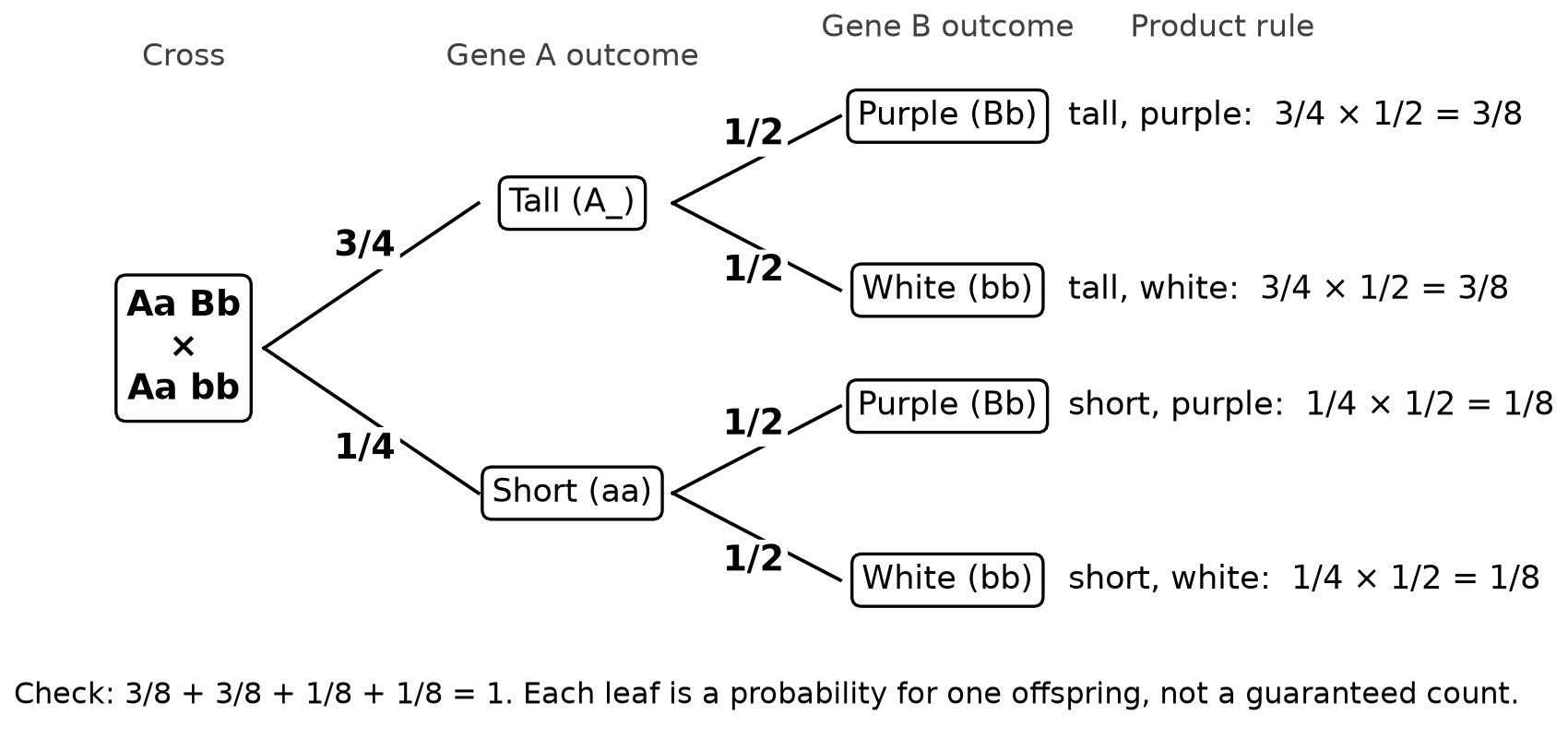
Figure 13.1. A probability tree applies the product rule along each branch. The four outcomes are mutually exclusive, so their probabilities add to 1.
Common error. Applying 3/4 to the Bb × bb cross because "the dominant phenotype is 3/4." That fraction comes only from two heterozygous parents. Read each parent's genotype before choosing a fraction.
Test crosses
To learn whether an individual with the dominant phenotype is homozygous or heterozygous, cross it with a homozygous recessive individual. An AA parent gives only dominant-phenotype offspring; an Aa parent gives about 1 dominant : 1 recessive (OpenStax Biology 2e, Characteristics and Traits). One recessive offspring proves that the tested parent carries a; many dominant offspring make AA likely but cannot prove it.
Read a pedigree
A pedigree records a trait across generations (NHGRI glossary: Pedigree). Squares are males, circles are females and filled symbols are affected. Assuming complete penetrance, test each simple model against the record:
- Autosomal recessive. Two unaffected parents can have an affected child; both parents must be carriers. Both sexes are affected.
- Autosomal dominant. Every affected individual has at least one affected parent.
- X-linked recessive. Mostly males are affected, because a male has one X and expresses whatever allele it carries (NHGRI glossary: X-Linked). An affected daughter must have an affected father.
- X-linked dominant. An affected father passes the trait to all of his daughters and none of his sons.
The strongest evidence is an individual who breaks a model's rule. An affected daughter of an unaffected father, for instance, rules out X-linked recessive inheritance.
Worked example: conditional probability in a family
Question. Two unaffected parents have a child with an autosomal recessive condition. What is the probability that their unaffected son is a carrier?
Solution. Both parents must be Aa, so their offspring are 1/4 AA, 1/2 Aa and 1/4 aa. The son is unaffected, which removes aa. Among the remaining 3/4, carriers make up (1/2) ÷ (3/4) = 2/3. Common error: answering 1/2 by ignoring what his phenotype already rules out.
Test a genetic model with chi-square
A chi-square goodness-of-fit test asks whether the gap between observed and expected counts is small enough to attribute to chance. Chapter 3 teaches the arithmetic; in genetics the critical step is choosing the model.
- State the model and its ratio, such as 1 : 1 : 1 : 1 for a dihybrid testcross with independent assortment.
- Convert the ratio to expected counts using the observed total.
- Calculate χ² = Σ (o − e)² ÷ e, with degrees of freedom equal to the number of classes minus 1.
- Compare with the critical value at p = 0.05: 3.84 for df = 1, 5.99 for df = 2 and 7.81 for df = 3. If χ² is larger, reject the model.
Worked example: is a testcross 1 : 1 : 1 : 1?
Question. A moth from WWKK × wwkk parents is heterozygous for wing color (W) and antenna shape (K). It is testcrossed to wwkk, and its 400 offspring are classified by the alleles they received from it: W K 160, w k 152, W k 44 and w K 44. Test independent assortment.
Solution. Expected = 400 ÷ 4 = 100 per class. χ² = 60²/100 + 52²/100 + 56²/100 + 56²/100 = 36.00 + 27.04 + 31.36 + 31.36 = 125.76. With df = 3, 125.76 > 7.81, so reject independent assortment. The excess of the parental classes W K and w k points to linkage, the next model to examine. Rejection does not prove linkage; it says only that the 1 : 1 : 1 : 1 model fits poorly.
When ratios depart from Mendel's
Linked genes and map distance
Genes close together on one chromosome tend to be inherited together unless crossing over separates them (OpenStax Biology 2e, Chromosomal Theory and Genetic Linkage). In a testcross, the common classes are parental, matching the heterozygote's two chromosomes; the rare classes are recombinant.
Recombination frequency = recombinant offspring ÷ total offspring, and one map unit equals 1 percent recombination. For the moth, (44 + 44) ÷ 400 = 0.22, so W and K are about 22 map units apart. Recombination frequency cannot exceed 50 percent; genes far apart on a chromosome assort as if they were on different chromosomes.
Common error. Assuming the dominant alleles travel together. Parental classes are set by which alleles share a chromosome in the heterozygote. A moth that inherited W k from one parent and w K from the other makes mostly W k and w K gametes, so those are its parental classes.
Dominance has several forms
- Incomplete dominance. The heterozygote is intermediate. Red × white snapdragons give pink offspring, and pink × pink gives 1 red : 2 pink : 1 white. The alleles do not blend: red and white reappear.
- Codominance. The heterozygote shows both allele products fully. People with the MN blood type carry both M and N surface molecules (OpenStax, Characteristics and Traits).
In both cases each genotype has its own phenotype, so a cross between two heterozygotes gives a 1 : 2 : 1 phenotype ratio.
Sex-linked genes
In mammals, females are XX and males XY. Males are hemizygous for X-linked genes, so a recessive X-linked allele is expressed in every male that carries it. A son receives his X from his mother, so a carrier mother passes the allele to each son with probability 1/2. Other animals use other systems: in birds, females are ZW and males ZZ, so Z-linked recessive traits appear more often in females; in honeybees, males develop from unfertilized eggs and are haploid.
Pleiotropy and organelle genes
Pleiotropy means that one gene affects several apparently unrelated traits, because its product acts in several tissues or pathways. Tightly linked genes can mimic it, so a strong test changes only the one gene and checks whether every trait follows.
Mitochondria and chloroplasts carry their own DNA and are not distributed by meiosis; they are divided randomly when cells divide. In animals, mitochondrial DNA is inherited from the mother (NHGRI glossary: Mitochondrial DNA). In most flowering plants, mitochondria and chloroplasts are transmitted through the ovule (Greiner, Sobanski and Bock, BioEssays, 2015). Organelle traits therefore follow the ovule parent, so reciprocal crosses give different results instead of Mendelian ratios.
The same genotype can produce different phenotypes
Phenotypic plasticity is the ability of one genotype to produce different phenotypes in different environments (NHGRI glossary: Gene–Environment Interaction). Two documented examples:
- Siamese and Burmese cat coat patterns, with dark fur concentrated at the cooler extremities, are associated with tyrosinase mutations (Lyons and colleagues, Animal Genetics, 2005). Tyrosinase is an enzyme in melanin synthesis.
- In many turtles and some other reptiles, incubation temperature during a sensitive period determines whether an embryo develops as male or female (Pieau, Dorizzi and Richard-Mercier, Cellular and Molecular Life Sciences, 1999).
To demonstrate plasticity, hold genotype constant across environments, for example with clones, and plot a reaction norm: each genotype's phenotype across environments.
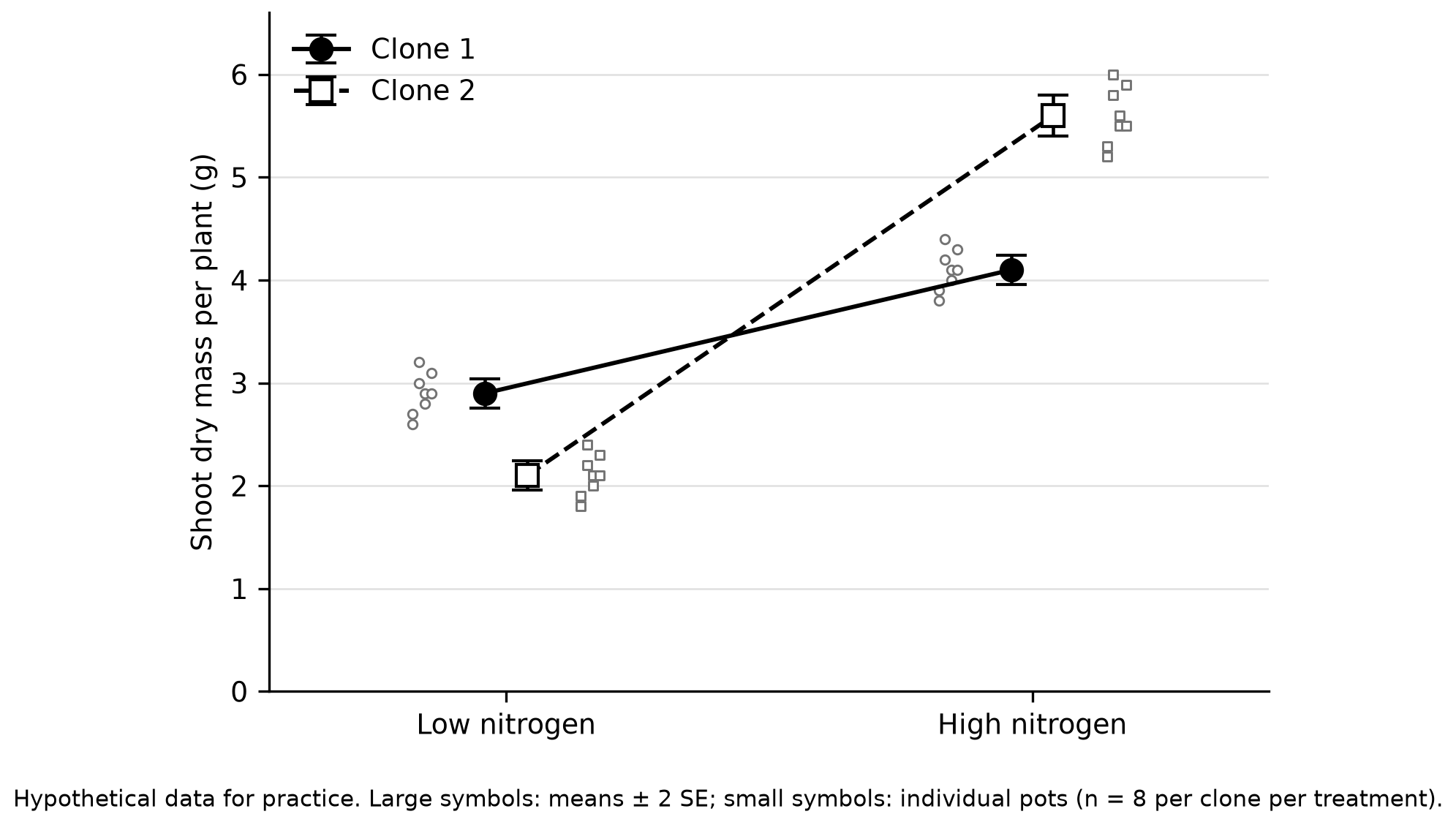
Figure 13.2. Hypothetical data for practice: reaction norms for two clones of a fictional grass. Pots were randomly assigned to treatments, and each pot held one plant (n = 8 per group).
Worked example: read crossing reaction norms
Question. Use Figure 13.2, treating means whose ±2 SE intervals do not overlap as different (Chapter 3). Does each clone show plasticity, and which clone grows more?
Solution. Both clones show plasticity: each genotype produced a different mean mass at the two nitrogen levels, with non-overlapping intervals. Neither clone grows more in general. Clone 1 is heavier at low nitrogen (2.9 versus 2.1 g) and Clone 2 at high nitrogen (5.6 versus 4.1 g). Crossing reaction norms mean that the effect of genotype depends on the environment, so any claim about which clone grows more must name the condition.
Try it
Try it 13.1. For the cross AaBbDd × aaBbDd, with the three genes on different chromosomes, find the probability of an aabbdd offspring.
Try it 13.2. A woman's father has an X-linked recessive condition; her mother is homozygous for the normal allele. She has children with an unaffected man. (a) What is the probability that a son is affected? (b) What is the probability that their first child is an affected son?
Try it 13.3. A plant from EEFF × eeff parents is testcrossed to eeff. Offspring classes, named by the alleles received from the heterozygote, are E F 186, e f 178, E f 19 and e F 17. How far apart are genes E and F?
Try it 13.4. Using the means in Figure 13.2, calculate each clone's percent increase from low to high nitrogen.
Check your try-it work
13.1. Aa × aa gives aa with probability 1/2; Bb × Bb gives bb with 1/4; Dd × Dd gives dd with 1/4. Product: 1/2 × 1/4 × 1/4 = 1/32.
13.2. She inherited her father's X, so she is a carrier. (a) Each son receives one of her two X chromosomes, so P(affected) = 1/2. (b) P(son) × P(affected, given a son) = 1/2 × 1/2 = 1/4.
13.3. The recombinants are E f and e F: (19 + 17) ÷ 400 = 0.09, so about 9 map units.
13.4. Clone 1: (4.1 − 2.9) ÷ 2.9 × 100 ≈ 41.4 percent. Clone 2: (5.6 − 2.1) ÷ 2.1 × 100 ≈ 166.7 percent. Clone 2 is more plastic for this trait.
Review and retrieval
Close the book, write the four pedigree rules from memory, then check them. In two sentences, explain how metaphase I produces independent assortment and how crossing over produces recombinant offspring. In three days, redo the moth chi-square without notes. Chapter 12 supplies the meiosis behind every ratio here, Chapter 3 reviews chi-square and error bars, and Chapter 18 applies allele frequencies to whole populations.
Practice
Chapter 13's printed practice is Questions 153–166, Written task 14 (a long free-response task with a graph) and Written task 15 (a short free-response task). Answers, explanations and scoring guides are under Chapter 13: answers and explanations in Answers, explanations and written responses at the back of the book.