What to practice
- connect transcription, processing and translation without reversing strands
What this chapter trains
This chapter covers topics 6.3 and 6.4 of the AP Biology Course and Exam Description: transcription, RNA processing and translation. The errors that cost points are rarely about vocabulary. Most come from reversing a strand, pairing with the wrong strand or starting in the wrong place. Each section below therefore ends with a check you can run on paper. Chapter 14's rule still applies: label 5′ and 3′ before you reason.
Three kinds of RNA
- Messenger RNA (mRNA) carries a gene's information from DNA to a ribosome.
- Transfer RNA (tRNA) binds one specific amino acid. Its three-base anticodon pairs with a matching mRNA codon.
- Ribosomal RNA (rRNA) is, together with proteins, the building material of ribosomes, and it catalyzes peptide bond formation.
Not every gene codes for a protein. Some genes encode RNAs, such as tRNA and rRNA, that function without being translated (NHGRI glossary, gene).
Transcription: DNA to RNA
RNA polymerase binds a promoter, a DNA sequence just upstream of the gene. It separates the strands and uses one of them, the template strand, to build RNA. Polymerase reads the template 3′ to 5′ and makes RNA 5′ to 3′, pairing U with A, A with T, G with C and C with G (OpenStax Biology 2e, prokaryotic transcription).
The other strand is the coding strand. The RNA has the same sequence as the coding strand, except that it has U wherever the coding strand has T.
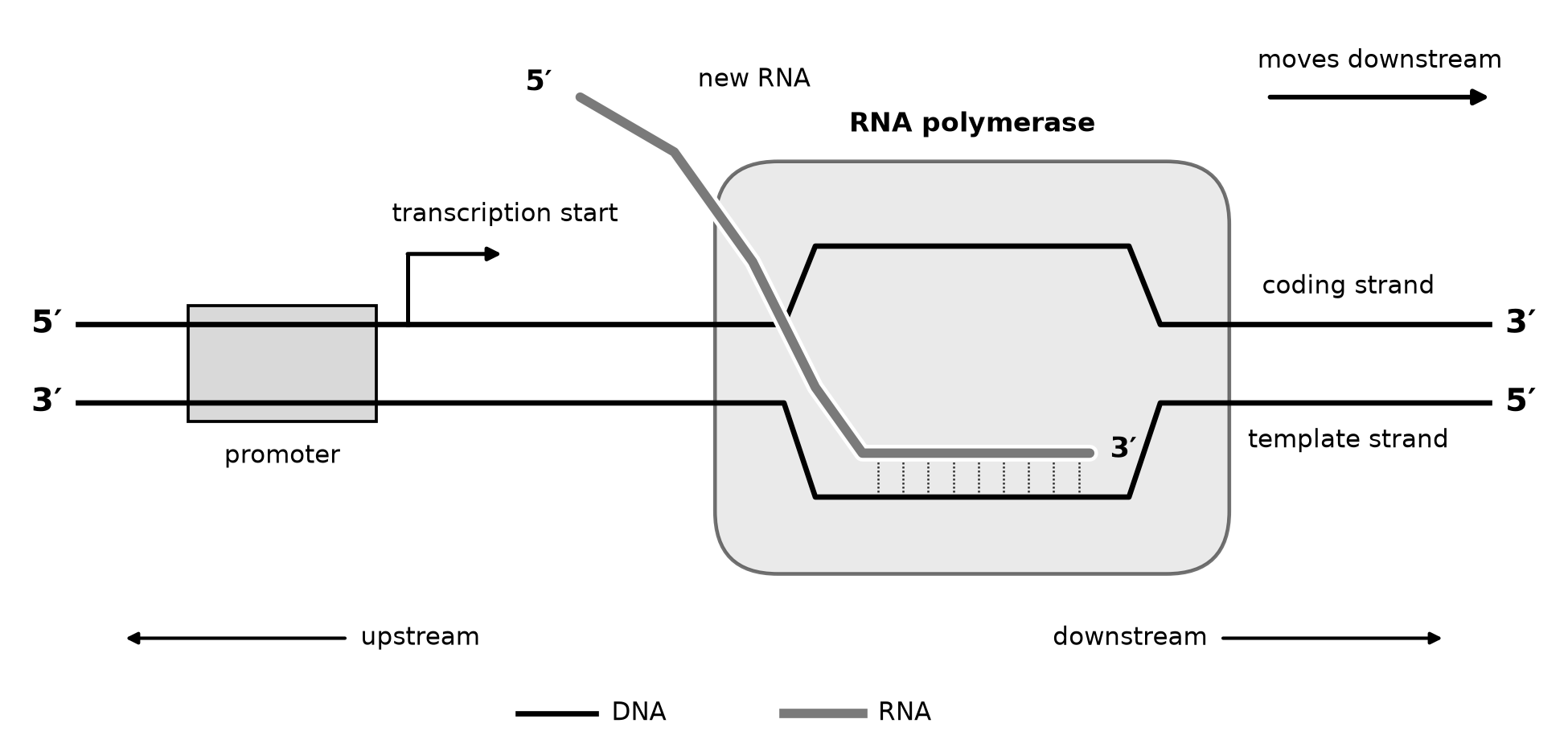
Figure 15.1. Transcription of one gene. Original schematic, not to scale.
Worked example: template strand to protein
A template strand reads 3′-TACAAGCCGATT-5′. Find the mRNA, the coding strand and the polypeptide.
- Pair each base. Opposite T write A, opposite A write U, opposite C write G, and opposite G write C. The mRNA is 5′-AUGUUCGGCUAA-3′. It is written 5′ to 3′ because it is antiparallel to the template.
- Check against the coding strand. The coding strand is 5′-ATGTTCGGCTAA-3′, which is the mRNA with T for U.
- Read codons from AUG. The codons are AUG UUC GGC UAA. In the codon table (Table 15.1, printed with this chapter's practice questions), these code for Met, Phe and Gly, followed by a stop codon. The polypeptide is Met-Phe-Gly.
RNA processing in eukaryotes
A eukaryotic gene's first transcript, the pre-mRNA, is modified in the nucleus before export (OpenStax Biology 2e, RNA processing).
- A 5′ cap, a modified guanine nucleotide, protects the mRNA from degradation and helps ribosomes recognize it.
- A poly-A tail, a string of about 200 adenine nucleotides, is added to the 3′ end and makes the mRNA more stable.
- Introns are removed and exons are joined. Spliceosomes, made of RNA and proteins, carry out this splicing.
Cells can join different combinations of exons from the same pre-mRNA. This alternative splicing lets one gene produce more than one protein.
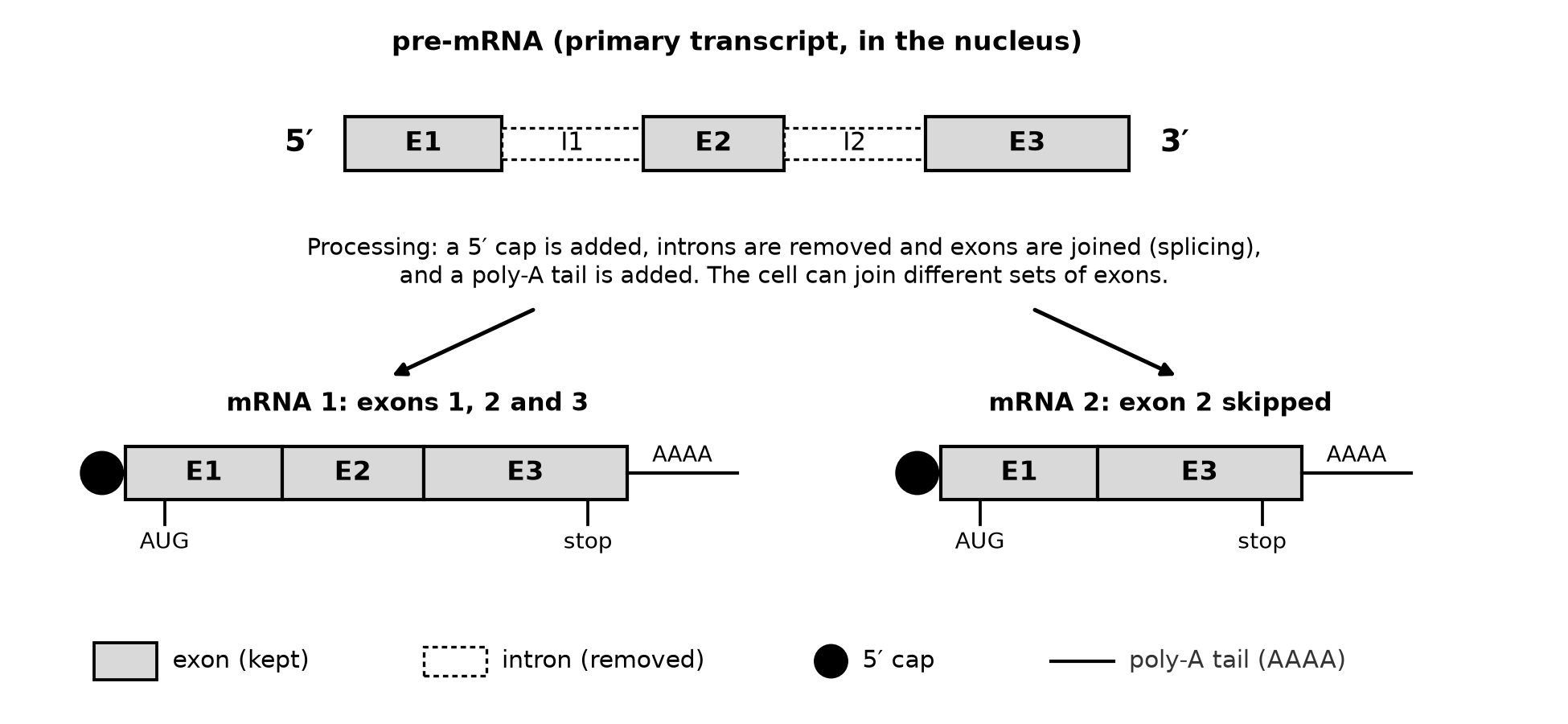
Figure 15.2. One pre-mRNA, two mature mRNAs. Original schematic, not to scale.
Worked example: does skipping an exon keep the frame?
Suppose exon 2 in Figure 15.2 is 87 nucleotides long. Because 87 ÷ 3 = 29, skipping it removes exactly 29 codons, so mRNA 2's protein lacks 29 amino acids, and every codon after the junction is still read in its original frame.
If exon 2 were 88 nucleotides long, skipping it would shift the reading frame. Every codon after the junction would change, and a stop codon would often appear early.
Translation: mRNA to polypeptide
Ribosomes sit free in the cytoplasm or on the rough endoplasmic reticulum (OpenStax Biology 2e, ribosomes and protein synthesis). Before translation can start, an enzyme uses energy from ATP to attach each amino acid to its own tRNA. Translation then has three stages:
- Initiation. rRNA in the small subunit interacts with the mRNA near the start codon, AUG. A tRNA carrying methionine pairs with AUG, and the large subunit joins.
- Elongation. A tRNA whose anticodon matches the next codon brings its amino acid. rRNA in the large subunit catalyzes a peptide bond between the growing chain and that amino acid, and the ribosome moves one codon toward the mRNA's 3′ end. The chain grows from its N-terminus to its C-terminus.
- Termination. At a stop codon (UAA, UAG or UGA), no tRNA pairs. The polypeptide is released and the ribosome separates.
Bacteria have no nucleus, so ribosomes can begin translating an mRNA while it is still being transcribed (OpenStax Biology 2e, prokaryotic transcription).
| Step | Bacteria | Eukaryotes |
|---|---|---|
| Where transcription happens | cytoplasm | nucleus |
| Processing of the transcript | little or none | cap, poly-A tail and splicing |
| Timing of translation | can begin during transcription | begins after processing and export |
| Where translation happens | ribosomes in the cytoplasm | ribosomes in the cytoplasm or on rough ER |
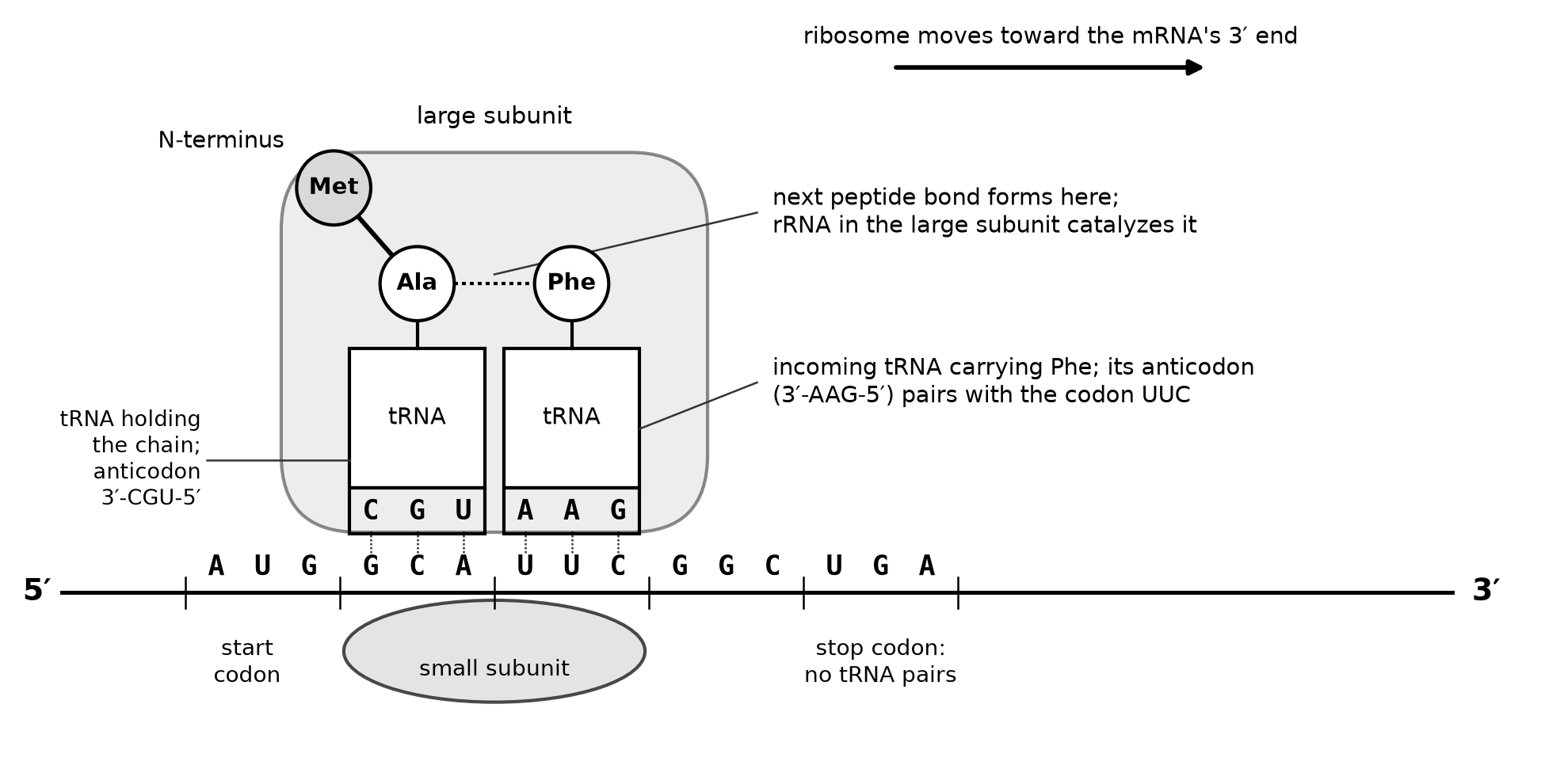
Figure 15.3. A ribosome adding the third amino acid. Original schematic, not to scale.
Worked example: anticodon to codon
What anticodon pairs with the codon 5′-GCA-3′? Pairing is antiparallel. Written 3′ to 5′, so that it lines up under the codon, the anticodon is CGU, as in Figure 15.3. Written in the standard 5′-to-3′ direction, it is 5′-UGC-3′. Going the other way, start from a 5′-to-3′ anticodon: reverse it, then complement each base to get the codon.
The genetic code
Codons are triplets. Of the 64 codons, 61 specify amino acids and 3 are stops (NHGRI glossary, codon).
Counting shows why the unit must be at least three bases. With four bases, one-base "words" give only 4 combinations and two-base words give 4 × 4 = 16, too few for 20 amino acids. Three-base words give 4 × 4 × 4 = 64, enough for every amino acid plus stop signals.
The code is redundant: several codons can specify the same amino acid. Leucine, for example, has six. It is also unambiguous: each codon specifies only one amino acid.
The code is nearly universal, which is strong evidence that living things share a common ancestor (OpenStax Biology 2e, the genetic code).
Experiments with synthetic RNA helped crack the code. Nirenberg and Matthaei found that a cell-free extract of E. coli would make protein when given RNA. An RNA made only of uracil produced a chain of phenylalanine, so UUU codes for phenylalanine (Nirenberg and Matthaei, PNAS, 1961).
Retroviruses reverse the first step
A retrovirus such as HIV stores its genome as RNA. Reverse transcriptase copies that RNA into DNA, which is inserted into a host chromosome. The host cell then transcribes the inserted DNA and translates the resulting mRNA into viral proteins (NHGRI glossary, retrovirus).
Common errors to repair
- Matching the template instead of pairing with it. mRNA is complementary to the template strand and matches the coding strand.
- Reading the template 5′ to 3′. Polymerase reads it 3′ to 5′.
- Translating from the first nucleotide. Start at AUG and stop at the first stop codon in that frame. A stop codon adds no amino acid.
- Forgetting to reverse an anticodon. Reverse a 5′-to-3′ anticodon before you complement it.
- Removing introns from DNA. Splicing edits the RNA. The gene keeps its introns.
Try it
Try it 15.1. A template strand reads 3′-TACCGGTTTACT-5′. Write the mRNA and the polypeptide.
Try it 15.2. A tRNA has the anticodon 5′-GAU-3′. Which codon does it pair with, and which amino acid does it carry?
Try it 15.3. A pre-mRNA has three exons of 150, 64 and 210 nucleotides. A splicing error skips the 64-nucleotide exon. Predict the effect on the protein.
Try it 15.4. A mutation changes the codon GAA to GAG. Using Table 15.1, predict the effect on the protein. Which property of the code does this show?
Try it 15.5. A cell cannot add poly-A tails to a particular mRNA. Predict the effect on (a) the sequence of codons in that mRNA and (b) the amount of protein made from it. Explain each prediction.
Check your try-it work
15.1. The mRNA is 5′-AUGGCCAAAUGA-3′. The codons are AUG GCC AAA UGA, so the polypeptide is Met-Ala-Lys, and UGA stops translation.
15.2. Reversed, the anticodon reads UAG, 3′ to 5′. Complemented, that gives the codon 5′-AUC-3′, so the tRNA carries Ile.
15.3. 64 is not a multiple of 3, so every codon after the junction is read in a shifted frame. The amino acids after exon 1 change, and an early stop codon is likely, which would give a shortened protein.
15.4. GAA and GAG both code for Glu, so the protein is unchanged. This is redundancy.
15.5. (a) The codons are unchanged, because the tail is added after the stop codon, outside the coding sequence. (b) Less protein is made. Without the tail, the mRNA is less stable and is broken down sooner, so each molecule is translated fewer times.
Review and retrieval
Without notes, draw Figure 15.1 and label the promoter, both strands' ends and the direction of RNA growth. Then list, in order, everything that happens to a eukaryotic transcript between the promoter and a finished polypeptide. Check your list against this chapter. Tomorrow, invent your own 12-base template, translate it and swap with a partner to check each other's work. Chapter 16 builds on these steps to explain regulation and mutation.
Practice
Questions 177–186 and the short Written task 17 follow this chapter's companion panel. They use Table 15.1, Figure 15.4, Table 15.2, and Figure 15.5 with Table 15.3. Work all of them before checking. The keys, explanations, scoring rubric and sample response are in Answers, explanations and written responses, under Chapter 15: answers and explanations. For each miss, name the strand, direction or reading-frame step you skipped.