What to practice
- distinguish RNA, protein and activity measurements in an experiment
A liver cell and a nerve cell in your body carry essentially the same DNA, yet they make very different sets of proteins. This chapter explains how cells decide which genes to express and how strongly, how changes in DNA alter those decisions or the products themselves, and how biologists copy, sort and read DNA. It covers topics 6.5 to 6.8. The skill to build is precise: in an experiment, tell measurements of mRNA, protein and activity apart, and say what each can and cannot show. All numerical data in this chapter are hypothetical data for practice.
Retrieve first. Without notes, recall Chapter 15. In one cell line, a gene's mRNA doubles but the amount of its protein does not change. Name two steps after transcription that could explain the mismatch. The answer is in Check your try-it work.
Regulatory sequences decide when a gene is read
A gene is more than its coding sequence. Regulatory sequences are stretches of DNA that proteins bind to control transcription. RNA polymerase binds the promoter, next to the transcription start site; in eukaryotes, general transcription factors help it attach. Enhancers can lie far upstream, far downstream or inside an intron. When specific transcription factors bind an enhancer, the DNA bends so that those proteins contact the machinery at the promoter (OpenStax Biology 2e, Eukaryotic Transcription Gene Regulation).
Regulatory proteins come in two kinds. Activators, or positive regulators, increase transcription. Repressors, or negative regulators, bind DNA and block it. Genes also differ in their default state. A constitutive gene is transcribed steadily in every condition. An inducible gene is transcribed only when a signal is present.
Operons: one switch for several genes
In bacteria, genes whose products work in one pathway are often grouped in an operon: one promoter, one operator (the repressor's binding site) and several coding sequences copied into a single mRNA. Because the genes share one mRNA, they are switched on and off together. That is coordinated regulation.
The lac operon of E. coli is inducible. Its enzymes let the cell use lactose. A repressor, made all the time from a separate gene, sits on the operator and blocks RNA polymerase. When lactose is present, a related sugar, allolactose, binds the repressor and changes its shape so it releases the operator. The activator CAP adds a second input: when glucose is scarce, CAP binds near the promoter and raises transcription. The operon is therefore most active when lactose is available and glucose is not.
The trp operon is repressible. Its enzymes make the amino acid tryptophan, and it is normally on. When tryptophan is plentiful, tryptophan binds the repressor and activates it; the repressor then binds the operator and transcription stops (OpenStax Biology 2e, Prokaryotic Gene Regulation). Remember the contrast: in an inducible operon the signal inactivates the repressor; in a repressible operon the signal activates it.
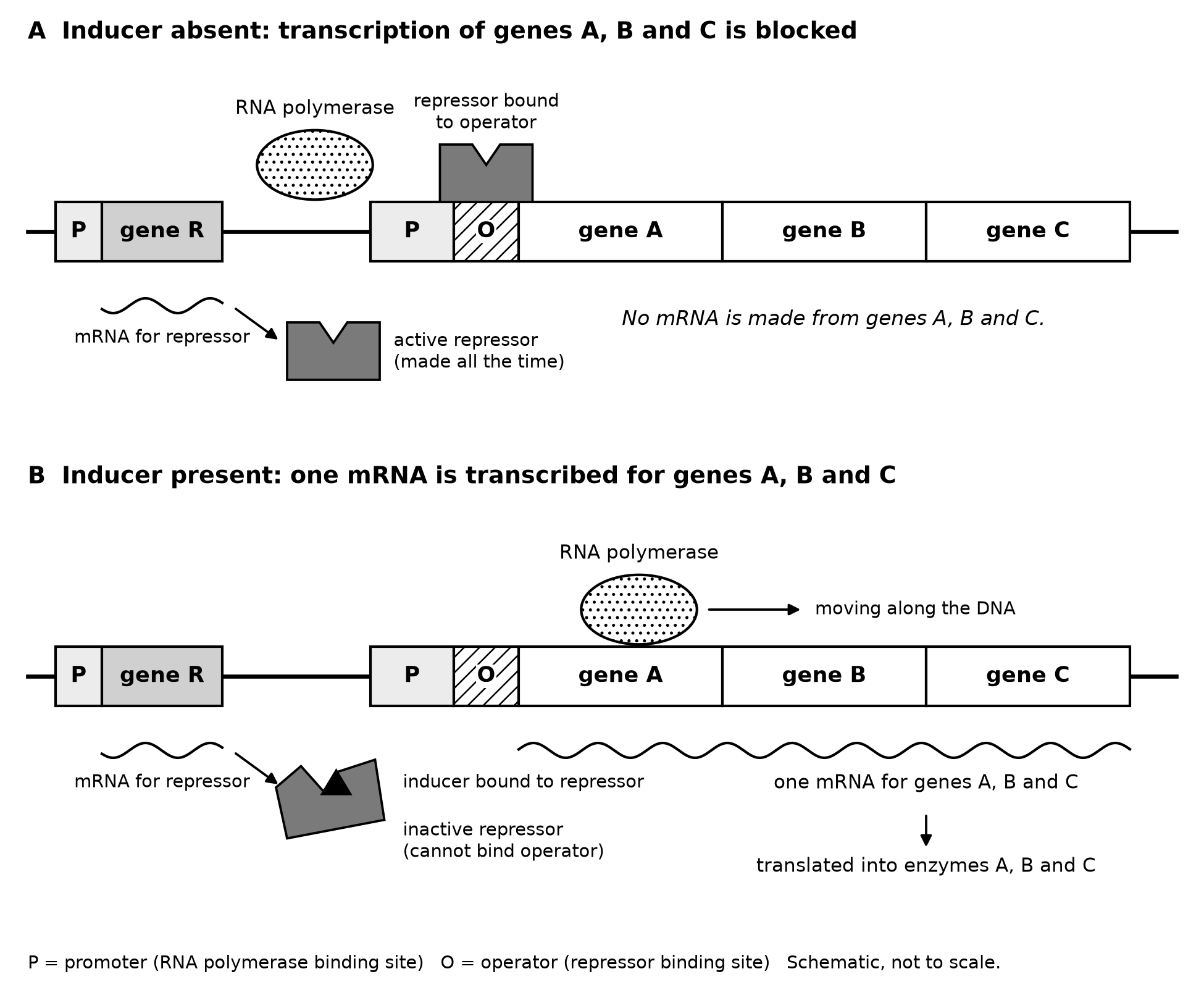
Figure 16.1. An inducible operon. One promoter and one operator control three genes, so their enzymes are made together or not at all. Schematic, not to scale.
Worked example 16.1: two mutants of an inducible operon
Use Figure 16.1. Mutant 1 has a changed operator that the repressor cannot bind. Mutant 2 makes a repressor that still binds the operator but can no longer bind the inducer. Predict enzyme levels with and without inducer.
Solution. In mutant 1, nothing blocks RNA polymerase, so enzymes A to C are made whether or not inducer is present. In mutant 2, the inducer cannot pull the repressor off the operator, so the enzymes stay off even with inducer. Common error: assuming every regulatory mutation turns genes off. Ask which molecule lost which binding ability, then trace whether RNA polymerase can get through.
Try it 16.1. In a trp operon mutant, the repressor cannot bind tryptophan. Predict whether the tryptophan-making enzymes are produced when tryptophan is abundant, and explain.
Epigenetic marks change access, not sequence
Eukaryotic DNA wraps around histone proteins, and how tightly it is packed controls whether transcription machinery can reach a promoter. Epigenetic changes are reversible chemical modifications of DNA or histones that alter gene expression without changing the base sequence. Histone acetylation adds acetyl groups to histone tails. That reduces their positive charge, loosens their hold on negatively charged DNA and usually increases transcription. DNA methylation, the addition of methyl groups to cytosines, often near promoters, usually silences genes; heavily methylated regions with deacetylated histones are tightly coiled and inactive (OpenStax Biology 2e, Eukaryotic Epigenetic Gene Regulation). Many marks are copied when a cell divides, which helps a liver cell's daughters remain liver cells. Because they are reversible, environmental factors can change them during a lifetime (NHGRI glossary: Epigenetics).
Common error: calling an epigenetic change a mutation. A mutation changes the base sequence; an epigenetic mark changes how accessible an unchanged sequence is.
Same genome, different cells
Cells of one organism specialize through differential gene expression: each cell type transcribes its own subset of genes. A eukaryotic gene is transcribed when the right combination of transcription factors is present, and that combination differs among cell types. During development, one transcription factor can switch on the gene for the next, a sequence of inductions that commits cells to a fate.
Regulation continues after transcription. MicroRNAs are RNA molecules of only 21 to 24 nucleotides. Joined to a protein complex, a microRNA base-pairs with a matching sequence in a target mRNA and then blocks its translation or causes the mRNA to be broken down (OpenStax Biology 2e, Post-transcriptional Gene Regulation). A phenotype therefore depends on which genes are expressed, how much product is made, and whether that product works.
Measure the right level
Every experiment in this topic measures one level of the path from DNA to trait. Know what each level can show.
| Level measured | A difference shows | It cannot show |
|---|---|---|
| DNA sequence | which alleles are present | whether the gene is expressed |
| mRNA amount | a change in transcription or mRNA stability | how much protein is made |
| Protein amount | how much product exists | whether the product works |
| Enzyme activity | how much working product exists | which step caused a change |
| Phenotype | the effect on the cell or organism | the molecular cause |
Table 16.1. What each measurement can and cannot tell you.
Compare adjacent levels. If mRNA and protein change together, look at or before transcription. If protein changes while mRNA does not, look at translation or protein breakdown. If activity changes while protein does not, look at the protein's function.
Worked example 16.2: one enzyme in three tissues
A fish makes enzyme T. Values are relative to gill tissue.
| Tissue | mRNA | Protein | Activity |
|---|---|---|---|
| Gill | 1.0 | 1.0 | 1.0 |
| Liver | 1.1 | 0.2 | 0.2 |
| Muscle | 0.9 | 1.0 | 0.1 |
Table 16.2. Enzyme T in three tissues. Hypothetical data for practice.
Solution. Liver mRNA matches gill, but protein is one-fifth as much, so the difference arises after transcription: less translation or faster protein breakdown. A microRNA is one possible cause. Activity follows protein. Muscle mRNA and protein match gill, but activity is one-tenth, so each protein molecule works less well: an inhibitor, a missing cofactor or a chemical modification could be responsible. Common error: concluding from low activity alone that muscle does not transcribe gene T.
Try it 16.2. In kidney, enzyme T's mRNA, protein and activity are 0.1, 0.1 and 0.1. At which level does the difference most likely arise, and what kind of mechanism could cause it?
Mutations change sequences and sometimes phenotypes
A mutation is a change in the DNA sequence (NHGRI glossary: Mutation). Table 16.3 changes one teaching mRNA, 5′-AUG UUC GAU CAG GGA UGA-3′, which codes for Met-Phe-Asp-Gln-Gly and then stops.
| Change | New reading frame | Protein | Type |
|---|---|---|---|
| GAU to GAC | AUG UUC GAC CAG GGA UGA | Met-Phe-Asp-Gln-Gly | silent: same amino acid |
| GAU to AAU | AUG UUC AAU CAG GGA UGA | Met-Phe-Asn-Gln-Gly | missense: one amino acid changes |
| CAG to UAG | AUG UUC GAU UAG | Met-Phe-Asp, then stop | nonsense: early stop codon |
| A inserted after AUG | AUG AUU CGA UCA GGG AUG A… | Met-Ile-Arg-Ser-Gly-Met… | frameshift: every later codon changes |
Table 16.3. Four point mutations in one teaching sequence.
Inserting or deleting three nucleotides adds or removes one codon without shifting the frame. Location matters too. A missense change in an enzyme's active site may destroy function; one on the protein's surface may do nothing. A mutation in a coding sequence changes the product itself, while a mutation in a promoter, enhancer or operator changes how much product is made, or when and where. Whether a mutation is harmful, neutral or beneficial depends on the environment, which Chapter 17 develops.
Mutations arise from replication errors that escape proofreading and repair, from radiation such as ultraviolet light, and from reactive chemicals (OpenStax Biology 2e, DNA Repair). They are random with respect to need: an environment does not produce the particular mutation that would help.
Larger changes alter whole chromosomes. Nondisjunction, the failure of chromosomes to separate in meiosis, gives gametes with an extra or missing chromosome, and the resulting zygote is aneuploid (Chapter 12). Whole extra chromosome sets, polyploidy, are common in plants. Deletions, duplications, inversions and translocations change gene number or arrangement.
Bacteria also gain variation by horizontal gene transfer: transformation (taking up DNA from the surroundings), transduction (a virus carries DNA between bacteria), conjugation (direct transfer, often of a plasmid, through a cell-to-cell connection) and transposition (a transposable element moves to a new site) (OpenStax Biology 2e, Structure of Prokaryotes). Related viruses infecting one cell can exchange genetic material, producing new combinations. Transposition matters in animals too: the black form of the British peppered moth arose when a transposable element inserted into an intron of the gene cortex, an event dated to around 1819 (van't Hof and colleagues, Nature, 2016).
Try it 16.3. Use the teaching mRNA. (a) UUC becomes UUU, which also codes for Phe. (b) The first G of GAU is deleted. Write each new amino acid sequence and classify the mutation. Codons you need: AUC is Ile, AGG is Arg, GAU is Asp.
Biotechnology copies, sorts and reads DNA
Gel electrophoresis separates DNA fragments by length. DNA's phosphate backbone is negatively charged, so fragments move toward the positive electrode, and the gel slows long fragments more than short ones. Short fragments travel farther. A size standard of known lengths lets you estimate each band's size.
The polymerase chain reaction (PCR) copies one chosen region. Each cycle heats the DNA to separate its strands, cools it so short primers bind on either side of the target, and lets a heat-stable DNA polymerase extend the primers (NHGRI glossary: PCR). Each cycle can double the target, so one copy can become 2ⁿ copies after n cycles: 1,024 after 10 cycles and 1,048,576 after 20. Real reactions fall short as reagents run low.
In bacterial transformation, biologists add a plasmid carrying a gene of interest plus an antibiotic-resistance gene, then grow the bacteria on that antibiotic so only cells that took up the plasmid form colonies. DNA sequencing finds the order of nucleotides. Sequences and band patterns, sometimes called DNA fingerprints, identify individuals, species and alleles. Applications include diagnosing genetic conditions, forensic identification, checking food labels and making human proteins such as insulin in bacteria (OpenStax Biology 2e, Biotechnology).
Worked example 16.3: genotypes from a gel
A gene's normal allele gives a 450-base-pair (bp) PCR product; a deletion allele gives 300 bp. Every reaction also copies a 200-bp piece of a reference gene that everyone carries, as a built-in check. Lane 2 is a no-template control with no DNA added.
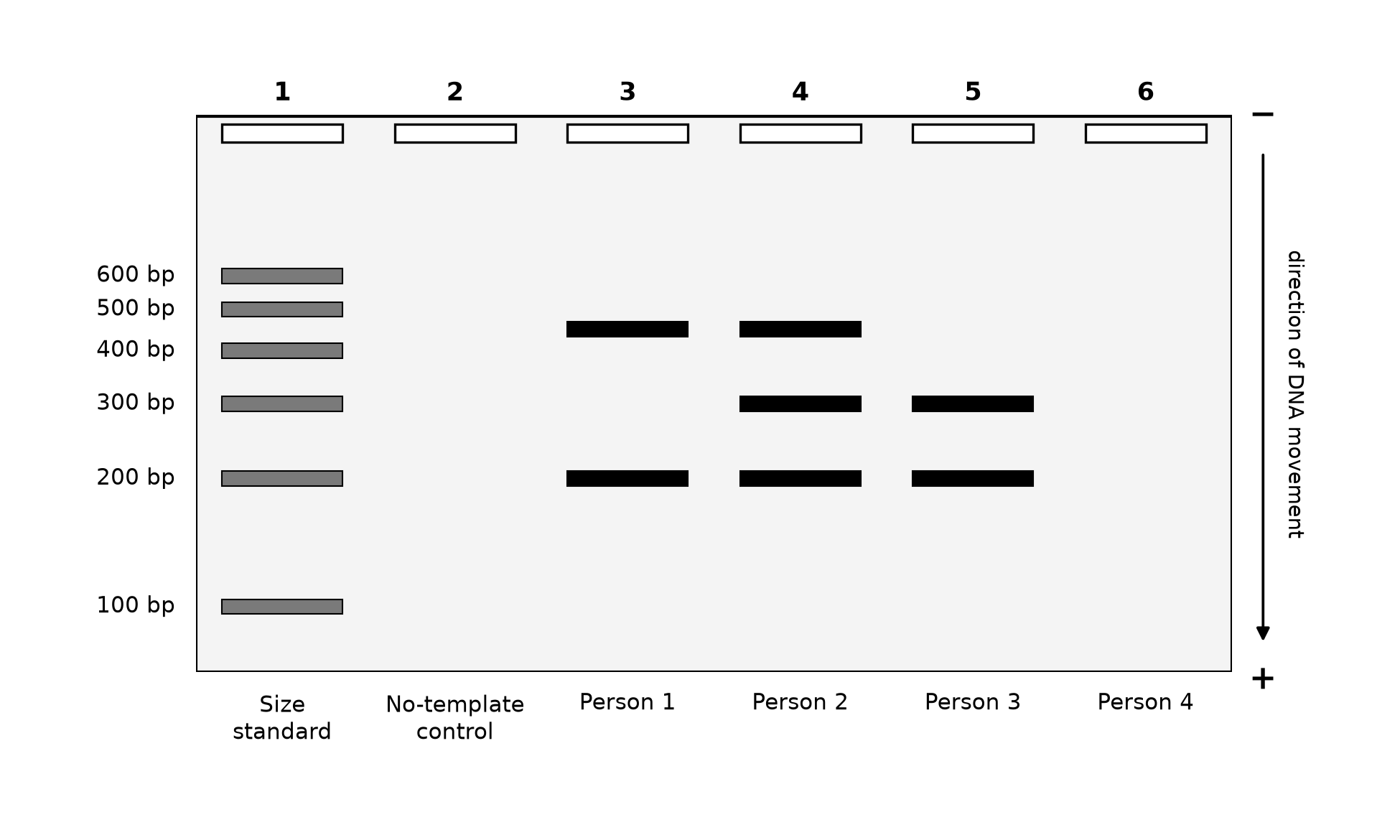
Figure 16.2. PCR products for four people. Hypothetical results for practice; band positions are schematic.
Solution. The empty control lane shows no contaminating DNA. Person 1 has only the 450-bp allele, so is homozygous normal. Person 2 has both alleles, so is heterozygous. Person 3 has only the 300-bp allele, so is homozygous for the deletion. Person 4 lacks even the 200-bp reference band, so the reaction failed and no genotype can be assigned. Common error: reading a band's brightness or position as dominance. A gel shows which DNA lengths are present, not which allele is dominant.
Try it 16.4. (a) A PCR starts with 50 copies of a target. Assuming perfect doubling, how many copies are present after 6 cycles? (b) Which control plate shows that ampicillin kills bacteria lacking the plasmid: bacteria with no plasmid on ampicillin agar, or plasmid-treated bacteria on plain agar?
Check your try-it work
Retrieve first. Translation could be slowed, for example by a microRNA, or the protein could be broken down faster. Differences in mRNA processing or export are also acceptable.
16.1. Yes, they are produced. Without tryptophan bound, the repressor never becomes active, so it cannot bind the operator, and transcription continues even when tryptophan is abundant.
16.2. All three fall by the same factor, so the difference most likely arises in the amount of mRNA: less transcription (fewer activators, a bound repressor or epigenetic silencing) or, less likely, faster mRNA breakdown. Protein and activity simply follow the mRNA.
16.3. (a) Met-Phe-Asp-Gln-Gly: silent. (b) AUG UUC AUC AGG GAU GA… gives Met-Phe-Ile-Arg-Asp…: a frameshift that also removes the original stop codon from the frame.
16.4. (a) 50 × 2⁶ = 3,200 copies. (b) The no-plasmid bacteria on ampicillin. If no colonies grow there, colonies on the experimental ampicillin plate must carry the plasmid.
Review and retrieve
Close the book and draw an inducible and a repressible operon, labeling what the signal does to the repressor. Then rebuild Table 16.1 from memory. In two days, redo Worked example 16.2 and Try it 16.3 on blank paper. In a week, explain to someone why a gel lane with no reference band cannot be genotyped.
Practice
Do Questions 187–198 and Written task 18, the long free-response task, printed after this chapter. Questions 187–190 share an enhancer experiment, 191 and 192 an operon model, 193 and 194 a sequence table, 195 and 196 a species-identification gel, and 197 and 198 stand alone. Allow about 22 minutes for the written task and use its printed response pages. Explanations for every answer choice, and the task's rubric with a complete sample response and an annotated partial response, appear under "Chapter 16: answers and explanations" in the answers section.