What to practice
- compare trees, shared ancestry and alternative explanations
How do biologists know that species share ancestors, and how do they decide which species are most closely related? This chapter covers the evidence for common ancestry, how to read and build evolutionary trees, how new species form, and the evidence behind models of how life began. Taxa in the figures are hypothetical unless they are named organisms.
Evidence that species share ancestors
Evidence for evolution comes from many disciplines, including geology, anatomy, biochemistry and mathematics (AP Biology Course and Exam Description, topics 7.6–7.7).
Fossils and their ages
Fossils show that organisms have changed over time, and their ages put those changes in order. A fossil can be dated by the age of the rock layer in which it is found, by the decay of radioactive isotopes such as carbon-14, and by geographic data, such as matching fossils on continents that were once joined.
A radioactive isotope decays at a constant rate, described by its half-life, the time for half of its atoms to decay. Carbon-14 has a half-life of 5,730 years. A living organism keeps taking in carbon, so its carbon-14 level matches the atmosphere's; after death, its carbon-14 decays and is not replaced.
Worked example 19.1: radiocarbon dating
A bone contains 1/8 of the carbon-14, relative to carbon-12, found in living tissue. How old is it?
Each half-life halves the amount: 1 → 1/2 → 1/4 → 1/8 is three half-lives, so the age is 3 × 5,730 = 17,190 years.
Carbon-14 gives reasonably accurate dates only up to about 50,000 years, because by then less than 1 percent of the original carbon-14 remains (OpenStax Chemistry 2e, Radioactive Decay). Older fossils are dated with isotopes that decay far more slowly, such as uranium-238, which decays to lead-206, measured in volcanic ash layers above and below the fossil. A fossil lying between ash layers dated at 68 and 66 million years old is between 66 and 68 million years old.
Try it 19.1. (a) A wooden tool has 25 percent of the carbon-14 found in living wood. Estimate its age. (b) Explain why carbon-14 cannot date a 70-million-year-old dinosaur bone, and name a better approach.
Homologous, analogous and vestigial structures
Homologous structures share an underlying plan inherited from a common ancestor, even when they now do different jobs: the forelimbs of humans, dogs, birds and whales are built from the same set of bones. Analogous structures do similar jobs but evolved independently, from different starting structures. Bat wings and insect wings both serve flight, yet they arose separately, so similar function alone is not evidence of close relationship. Bird and bat wings show both ideas: their bones are homologous, inherited from a common ancestor, but wings evolved separately in each lineage. Vestigial structures are reduced remnants with little or no function, such as the hind leg bones of whales and the wings of flightless birds. They make sense as inheritances from ancestors in which the structures worked (OpenStax Biology 2e, Understanding Evolution).
Molecules and shared cell features
DNA and protein sequences give the most detailed evidence. Mutations accumulate over time, so two species that split recently differ at fewer positions than species that split long ago. Counting differences between aligned sequences, position by position, estimates relatedness; calibrated with dated fossils, the count estimates time, a molecular clock. Molecular data typically provide more reliable evidence than anatomy, because thousands of characters can be compared and similar body forms can evolve independently.
Shared cell features point to common ancestry, too. All eukaryotes, from protists and fungi to plants and animals, have membrane-bound organelles, linear chromosomes and genes containing introns. Features this specific are unlikely to have arisen separately in each group, so they indicate that all eukaryotes descend from a common ancestor.
Read a phylogenetic tree
Phylogenetic trees and cladograms are hypotheses about evolutionary relationships that can be tested with new evidence (OpenStax Biology 2e, Organizing Life on Earth).
- Each tip is a lineage. Each node, or branch point, represents the most recent common ancestor of all the lineages that branch from it.
- Relatedness comes from nodes, not from which tips sit next to each other. Two lineages are more closely related when they share a more recent common ancestor, a node farther from the root.
- Branches can rotate around any node, like parts of a hanging mobile, without changing the relationships.
- The out-group is the lineage least closely related to the rest; it branches from the root.
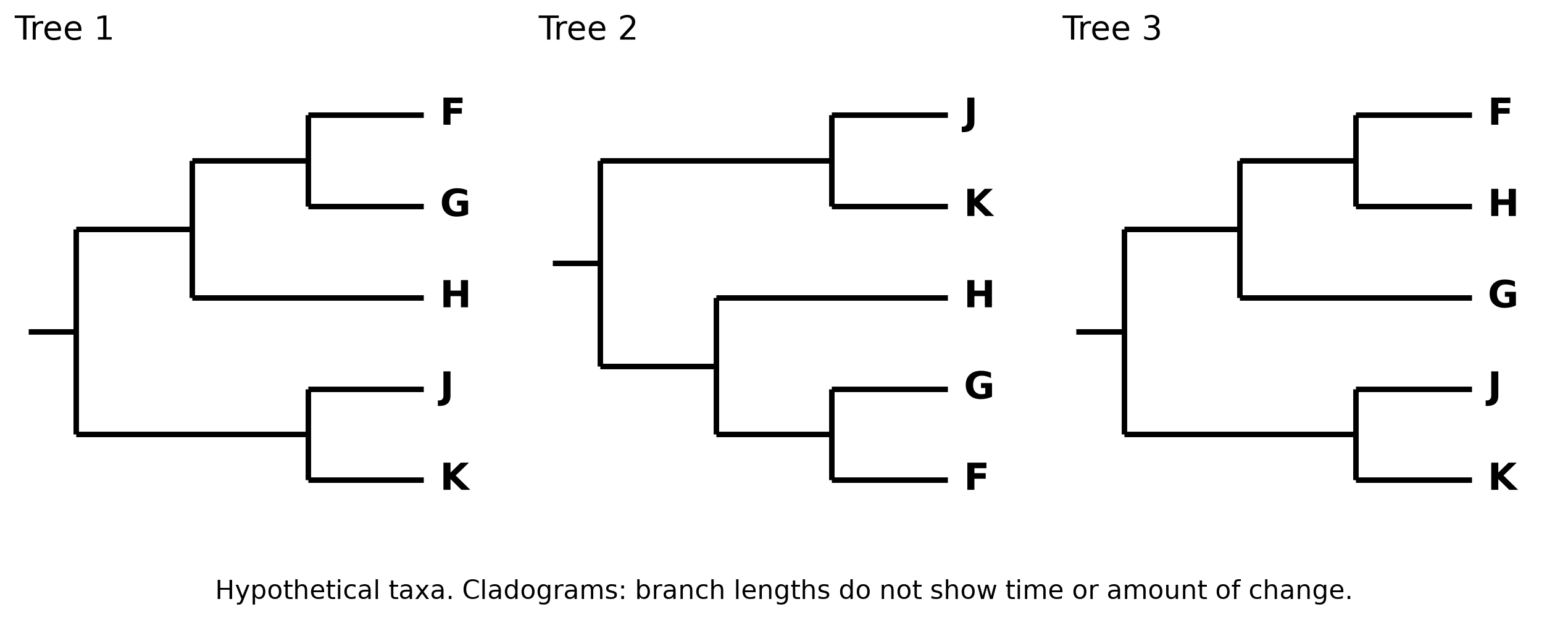
Figure 19.1. Three drawings of relationships among five hypothetical taxa. Branch lengths do not show time.
Worked example 19.2: same hypothesis or different?
List the groups each node defines. Tree 1 has {F, G}, {F, G, H} and {J, K}. Tree 2 has {J, K}, {G, F} and {H, G, F}, the same three groups, so it states the same hypothesis; its branches are only rotated. Tree 3 has {F, H}, {F, H, G} and {J, K}. It is a different hypothesis, claiming that F is more closely related to H than to G.
Avoid two common misreadings. First, tip order is not relationship: in Tree 1, H is drawn next to J, yet H shares a more recent ancestor with F and G. Second, a tree is not a ladder of progress. Every tip has been evolving for the same length of time since the root, so no living tip is "more evolved" than another or the ancestor of another (Understanding Evolution, Misconceptions about evolution).
Try it 19.2. In Tree 1, is H more closely related to G or to K? Name the node that justifies your answer. Then explain why the out-group is not "the oldest species."
Build a cladogram from shared derived characters
A shared derived character is a trait, gained or lost, that first appeared in the most recent common ancestor of a group and is shared by its descendants. A trait present in the out-group and in all the other organisms cannot separate them into groups.
Worked example 19.3: a plant cladogram
| Organism | Embryo protected by parent tissue | Vascular tissue | Seeds | Flowers |
|---|---|---|---|---|
| Green alga | no | no | no | no |
| Moss | yes | no | no | no |
| Fern | yes | yes | no | no |
| Pine | yes | yes | yes | no |
| Lily | yes | yes | yes | yes |
Step 1. Choose the out-group: the green alga lacks every derived character. Step 2. Nest groups: the character shared by the most organisms belongs nearest the root, because it arose earliest. Protected embryos unite four plants, vascular tissue three, seeds two and flowers one. Step 3. Mark each character on the branch where it first appears, then check that each set of organisms sharing a character forms a single group (Figure 19.2) (OpenStax Biology 2e, Early Plant Life; OpenStax Biology 2e, Evolution of Seed Plants).
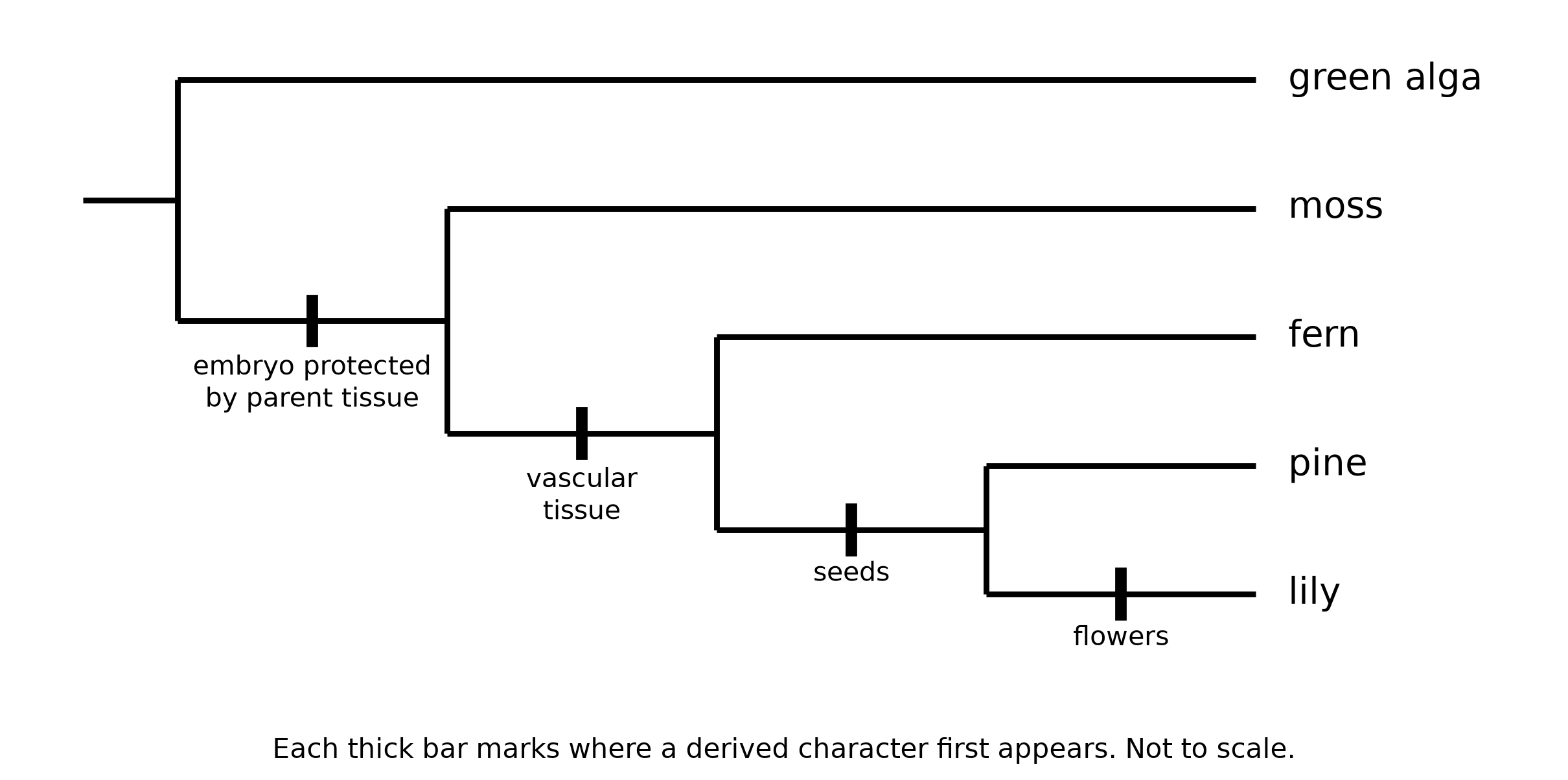
Figure 19.2. Cladogram built from the character table. Each bar marks where a derived character first appears.
Try it 19.3. Using Figure 19.2, list the derived characters of a fern. Then explain why "embryo protected by parent tissue" cannot help decide whether pine is more closely related to lily or to fern.
Trees, cladograms and evidence
A cladogram shows only the order of branching; its branch lengths mean nothing. A phylogenetic tree also shows time or the amount of change, calibrated with fossils or a molecular clock. Trees are revised as evidence grows: a new fossil or sequence can move a branch, and where anatomy and molecules disagree, molecular data usually carry more weight.
Worked example 19.4: place a newly described organism
A newly found single-celled organism has a nucleus, mitochondria, linear chromosomes and introns. Where does it belong?
Solution. This full set of eukaryotic features is unlikely to have evolved more than once, so place it among the eukaryotes. Test the placement: its DNA should resemble other eukaryotes' more than any prokaryote's; if not, revise the tree.
How new species form
Under the biological species concept, a species is a group whose members can interbreed and produce viable, fertile offspring. Speciation occurs when populations become reproductively isolated, so gene flow between them stops (AP Biology Course and Exam Description, topic 7.10). Barriers that act before fertilization are prezygotic; barriers that act after a zygote forms are postzygotic (OpenStax Biology 2e, Formation of New Species).
| Barrier | When it acts | Example |
|---|---|---|
| Habitat isolation | Prezygotic | Two related species live in one area, one in ponds and one on land |
| Temporal isolation | Prezygotic | Two frog species breed in different months |
| Behavioral isolation | Prezygotic | Females respond only to their own species' courtship song |
| Mechanical isolation | Prezygotic | Reproductive structures do not fit together |
| Gametic isolation | Prezygotic | Sperm cannot fuse with the other species' eggs |
| Reduced hybrid viability | Postzygotic | Hybrid embryos die early in development |
| Reduced hybrid fertility | Postzygotic | Hybrids survive but are sterile, as mules usually are |
Allopatric speciation happens when a geographic barrier, such as a mountain range, river or stretch of sea, separates populations. Gene flow stops, and mutation, drift and different selection pressures make the populations diverge until they can no longer interbreed. Sympatric speciation happens without geographic separation. In plants, a common route is polyploidy: an error in cell division produces offspring with extra chromosome sets that cannot form fertile offspring with the parent population but can reproduce with each other or by self-pollinating.
Speciation proceeds at different rates. Gradualism is slow change over hundreds of thousands or millions of years. Punctuated equilibrium is rapid change after a long period of stasis, seen in fossils as sudden shifts between long unchanging intervals (OpenStax Biology 2e, Reconnection and Speciation Rates). Isolation can arise very fast. On the Galápagos island of Daphne Major, an immigrant finch of another species bred with a resident medium ground finch, and from the second generation on, its descendants bred only among themselves: reproductive isolation in three generations rather than the hundreds that are typical (Lamichhaney and colleagues, Science, 2018).
Divergent evolution occurs when adaptation to new habitats diversifies descendants of one ancestor. Speciation can be especially rapid during adaptive radiation, when many new habitats become available, as on newly formed islands. Convergent evolution occurs when similar selective pressures produce similar adaptations in different lineages, producing analogous structures.
Worked example 19.5: how far has isolation gone?
Two populations of a meadow flower live on opposite sides of a mountain range. In one shared garden, one flowers in April and the other in June, yet hand-pollinated hybrids set fertile seed. Hypothetical data for practice.
Solution. The mountains block gene flow, the setting for allopatric speciation. The shared garden rules out climate, so the timing difference is inherited: temporal isolation, a prezygotic barrier. Fertile hybrids mean no postzygotic barrier has formed; if flowering times came to overlap, the populations could interbreed again.
Try it 19.4. Name the barrier and whether it is prezygotic or postzygotic: (a) two pine species release pollen in different months; (b) sea urchin sperm cannot bind the eggs of a related species; (c) two species' hybrids grow to adulthood but produce no offspring. Then (d) state whether speciation by polyploidy within one field is allopatric or sympatric.
Models of the origin of life
Earth formed about 4.6 billion years ago, its environment was too hostile for life until about 3.9 billion years ago, and the earliest fossil evidence of life dates to about 3.5 billion years ago. Together, these dates give a plausible window for the origin of life (AP Biology Course and Exam Description, topic 7.12).
Worked example 19.6: test a claim against the dates
A student claims that life began about 4.3 billion years ago. Solution. Earth was too hostile for life until about 3.9 billion years ago, and the oldest fossils date to about 3.5 billion years ago, so the evidence supports a window of about 3.9 to 3.5 billion years ago, not 4.3. A claim outside that window needs new evidence, such as older fossils.
The RNA world hypothesis proposes that RNA could have been the earliest genetic material. It makes three assumptions: genetic continuity was once assured by RNA replication, base pairing is necessary for that replication, and genetically encoded proteins were not involved as catalysts. RNA fits these roles because it stores information in its base sequence, like DNA, and some RNA molecules, called ribozymes, catalyze reactions. In the ribosome, the site that forms peptide bonds is made entirely of RNA, with no protein near the bond being formed (Nissen and colleagues, Science, 2000). The hypothesis is still debated; laboratory work suggests that DNA might have appeared alongside RNA rather than after it (Bhowmik and Krishnamurthy, Nature Chemistry, 2019).
Try it 19.5. Explain how the ribosome finding supports one assumption of the RNA world hypothesis, and state one thing it does not show.
Check your try-it work
19.1. (a) 25 percent is two half-lives: 2 × 5,730 = 11,460 years. (b) After 70 million years, about 12,000 half-lives, no measurable carbon-14 remains. Date volcanic ash layers above and below the bone with a slowly decaying isotope such as uranium-238.
19.2. G. H, F and G share a node that K does not; K joins them only at the root. The out-group branched off first, but its lineage has evolved for as long as every other; the living species is not the ancestor.
19.3. Protected embryo and vascular tissue. Fern, pine and lily all have protected embryos, so that character cannot separate them. Seeds, shared by pine and lily but absent from fern, is the character that places pine closer to lily.
19.4. (a) Temporal, prezygotic. (b) Gametic, prezygotic. (c) Reduced hybrid fertility, postzygotic. (d) Sympatric: the populations share one field.
19.5. RNA in the ribosome catalyzes peptide-bond formation, showing that RNA can act as a catalyst, consistent with the assumption that early catalysts were not encoded proteins. It does not show that RNA came before DNA and proteins or that life began this way.
Practice
Under "Printed practice" after this chapter are Questions 225–238 and Written task 21, a short free-response task. Questions 225–228 share a cladogram, 229–231 a sequence alignment and 232–234 a cricket study. The written task asks you to read, explain and revise a dated tree of island beetles. Explanations for every choice, and the task's rubric and sample response, appear under "Chapter 19: answers and explanations."
Before you move on
Without notes, redraw Figure 19.2 from its table, then rotate two branches and confirm that the groups are unchanged. In one week, classify each barrier in the table as prezygotic or postzygotic from memory, and redo Worked example 19.1. Chapter 20 turns from species to ecology.