What to practice
- support a qualified ecological claim from limited evidence
This chapter finishes Unit 8 with topics 8.5 to 8.7 of the AP Biology Course and Exam Description. Chapter 20 followed single populations and the energy that supports them. Here the unit of study is the community, the populations of different species that live and interact in one area. You will measure diversity, classify interactions, predict what happens when a species is removed or added, and judge evidence about disruptions.
Describe a community: composition and diversity
Two numbers describe a community's composition: species richness, the number of species, and relative abundance, how individuals are divided among those species. Diversity combines both. The AP Biology equations and formulas sheet gives Simpson's diversity index:
Here n is the number of individuals of one species and N is the total number of individuals of all species. The index runs from 0, when one species makes up the whole sample, toward 1 as individuals spread evenly over many species.
Worked example: same richness, different diversity
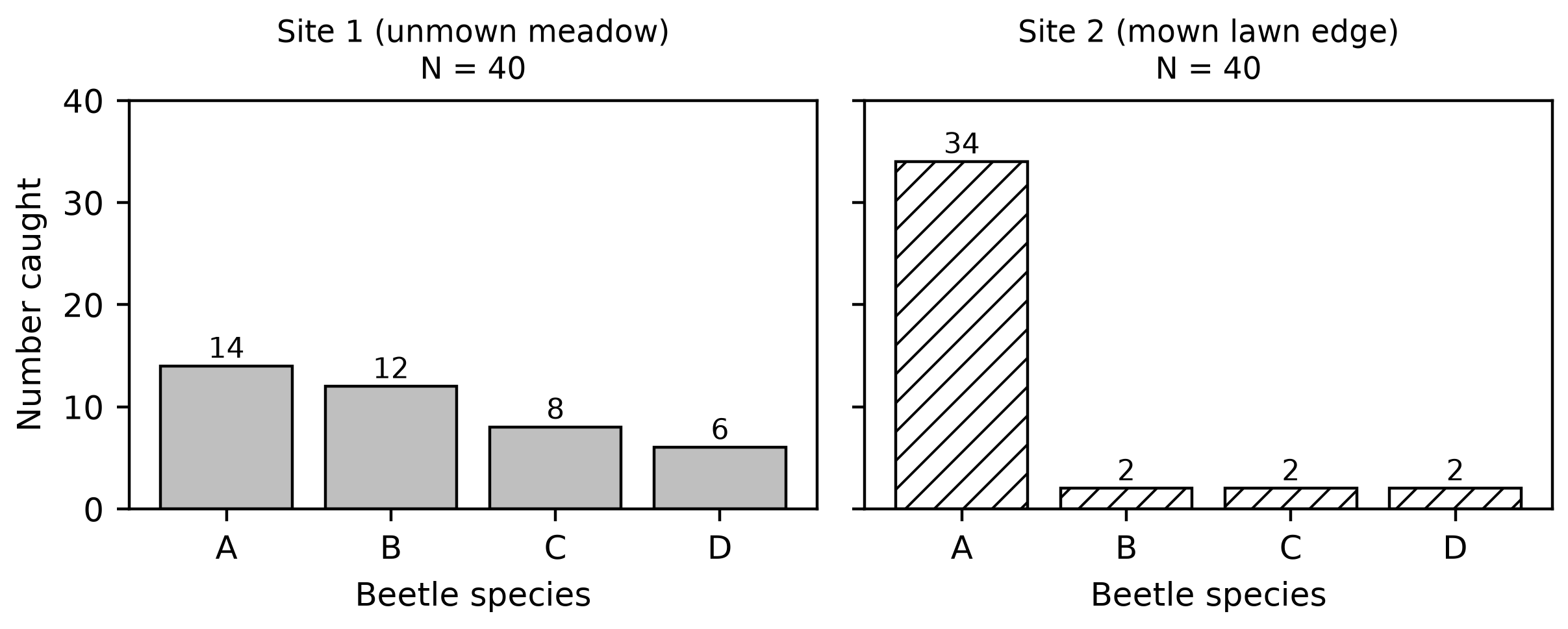
Figure 21.1. Hypothetical counts of ground beetles from ten pitfall traps at each of two sites.
Both sites have four species and 40 beetles. Convert each count to a proportion, square it, add the squares and subtract from 1.
| Site | Proportions (n/N) | Sum of squares | Index |
|---|---|---|---|
| 1 | 0.35, 0.30, 0.20, 0.15 | 0.1225 + 0.0900 + 0.0400 + 0.0225 = 0.275 | 1 − 0.275 = 0.725 |
| 2 | 0.85, 0.05, 0.05, 0.05 | 0.7225 + 0.0025 + 0.0025 + 0.0025 = 0.730 | 1 − 0.730 = 0.270 |
Site 1 is more diverse because its individuals are spread more evenly. Comparisons like this are fair only when sampling effort is the same: equal numbers of traps, set for the same time. Small samples also miss rare species, so richness tends to rise as more traps are set.
Common error. Stopping at the sum of squares. That sum is the probability that two randomly chosen individuals belong to the same species, so a larger sum means lower diversity.
Try it 21.1. Pond A yields 10 individuals of each of five snail species. Pond B yields 46 individuals of one species and 1 each of four others. Calculate the index for each pond.
Interactions shape community structure
Classify an interaction by its effect on each species: positive (+), negative (−) or no effect (0).
| Interaction | Effects | Example |
|---|---|---|
| Competition | − / − | Two plant species shading each other |
| Predation or herbivory | + / − | Lynx eating snowshoe hares |
| Parasitism | + / − | Tapeworm in a host's intestine |
| Mutualism | + / + | Rhizobium in legume root nodules |
| Commensalism | + / 0 | Bird nesting in a tree |
Competition can exclude a species. On a Scottish rocky shore, one barnacle species crowded another out of the lower intertidal zone; the excluded species persisted only higher up, where its competitor could not survive (Connell, 1961). Species that use resources in different ways, at different times or in different places can coexist; this is resource partitioning (OpenStax Biology 2e, section 45.6). Cooperation also structures communities. Members of one species may hunt or defend territory together, and mutualists such as pollinators and flowering plants each gain resources they could not obtain alone. Predator and prey populations can cycle together: lynx and snowshoe hare numbers rise and fall over about 10 years, with the predator lagging 1–2 years behind its prey (OpenStax Biology 2e, section 45.6). The lag arises because predator numbers rise only after plentiful prey has fed a generation of young predators, and fall only after prey have become scarce.
Effects also travel indirectly through food webs. Around islands with sea otters, sea urchins were scarce and kelp was dense; where otters were absent, urchins were abundant and kelp was sparse (Estes and Palmisano, 1974). A predator that changes the abundance of organisms two or more feeding links away is causing a trophic cascade.
Worked example: direct and indirect effects
Otters eat urchins: a direct negative effect on urchins. Urchins eat kelp: a direct negative effect on kelp. Therefore otters have an indirect positive effect on kelp. Predict a removal by following the links in order: remove the otters, urchins increase, kelp declines.
Common error. Calling any interaction with a benefit "mutualism." Mutualism requires that both species benefit. If one benefits and the other is unaffected, it is commensalism.
Try it 21.2. Classify each relationship: (a) a remora rides on a shark and eats scraps from its meals, without affecting the shark; (b) a tapeworm absorbs nutrients in a dog's intestine; (c) two warbler species feed in different parts of the same trees.
Try it 21.3. Spiders eat grasshoppers, and grasshoppers eat grass. Predict the effect of removing the spiders on grass biomass and name the kind of effect spiders have on grass.
Biodiversity and resilience
A resilient ecosystem resists change during a disturbance and recovers afterward. Ecosystems with greater diversity, including genetic diversity within populations, tend to be more resilient; one with little diversity can fail all at once. A diverse community holds more species that use resources in different ways, so if one species fails, others can take over part of its role. The Irish potato famine occurred when the single potato variety grown widely in Ireland proved susceptible to blight (OpenStax Biology 2e, section 47.2).
Some species matter far more than their numbers suggest. A keystone species has an effect on community structure that is large relative to its abundance. When the sea star Pisaster was removed from rocky-shore plots, mussels spread over the rock and the number of species fell (Paine, 1966). Producers also shape structure, because they determine how much energy enters. Abiotic factors such as water, temperature and nutrients set which species can live in a place at all.
Worked example: predict the effect of a removal
A beetle kills most trees of one species that forms 70 percent of a forest's canopy. Work in three steps. First, name the lost species' roles: it is a producer, a food source for insects that eat only its leaves, and a nest site. Second, follow each role outward: less energy enters the food web; the specialist insects, and birds that feed on them, decline; more light reaches the forest floor. Third, state directions and limits: specialists decrease, while shade-intolerant understory plants increase. Whether total diversity falls depends on how many species depended on that tree. A forest with many canopy species would lose less.
Common error. Defining a keystone species as the most abundant species or the top predator. The defining feature is a disproportionately large effect, shown when its removal changes the community.
Disruptions: variation, invaders, humans and Earth processes
Variation. A population with more genetic variation is more likely to include individuals that survive a new disease or climate. Selection acts on variation that already exists; mutations arise at random and are not produced because an organism needs them. Some variation persists through heterozygote advantage: carriers of one sickle-cell allele are partly protected against malaria, so the allele stays common where malaria is common (Allison, 1954).
Try it 21.4. Rewrite this sentence so it is correct: "The insects developed resistance because they needed to survive the pesticide."
Invasive species. A species introduced to a new area may escape the predators, parasites and competitors that limited it at home. Its population can then grow rapidly and displace native species. Kudzu, introduced to the United States in 1876, now covers more than 7 million acres in the Southeast (OpenStax Biology 2e, section 47.3). Zebra mussels, native to the Black and Caspian Sea region, were found in the Great Lakes in 1988. Each filters about a liter of water per day, and diatom abundance in Lake Erie fell 82–91 percent during the first years of the invasion (USGS zebra mussel fact sheet).
Human activity. Logging, urbanization and monocropping remove habitat and diversity. Persistent toxins are concentrated up food chains by biomagnification: in one estuary, DDT residues rose from about 0.04 ppm in plankton to about 75 ppm in fish-eating gulls (Woodwell and colleagues, 1967). Nutrient runoff causes eutrophication: algae bloom, then decomposers break down the dead algae and use up dissolved oxygen, killing fish and shellfish (OpenStax Biology 2e, section 46.3). Introduced pathogens, such as those causing Dutch elm disease and potato blight, can sweep through hosts that never evolved defenses.
Common error. Explaining biomagnification with energy. Energy decreases at each trophic level. A persistent toxin increases because it is stored in tissues rather than broken down or excreted, and each consumer eats many contaminated prey over its lifetime.
Try it 21.5. Using the DDT values above, by roughly what factor did the concentration increase from plankton to gulls?
Earth processes. Geological and weather events also change ecosystems. During El Niño, upwelling of cold, nutrient-rich water off South America weakens, phytoplankton decline, and the change spreads to fish and to everything that eats fish (NOAA). Climate change shifts temperature and rainfall faster than many populations can move or adapt. Continental drift has rearranged habitats over millions of years, and an asteroid impact is linked to the mass extinction at the end of the Cretaceous (Alvarez and colleagues, 1980).
Worked example: before-after-control-impact evidence
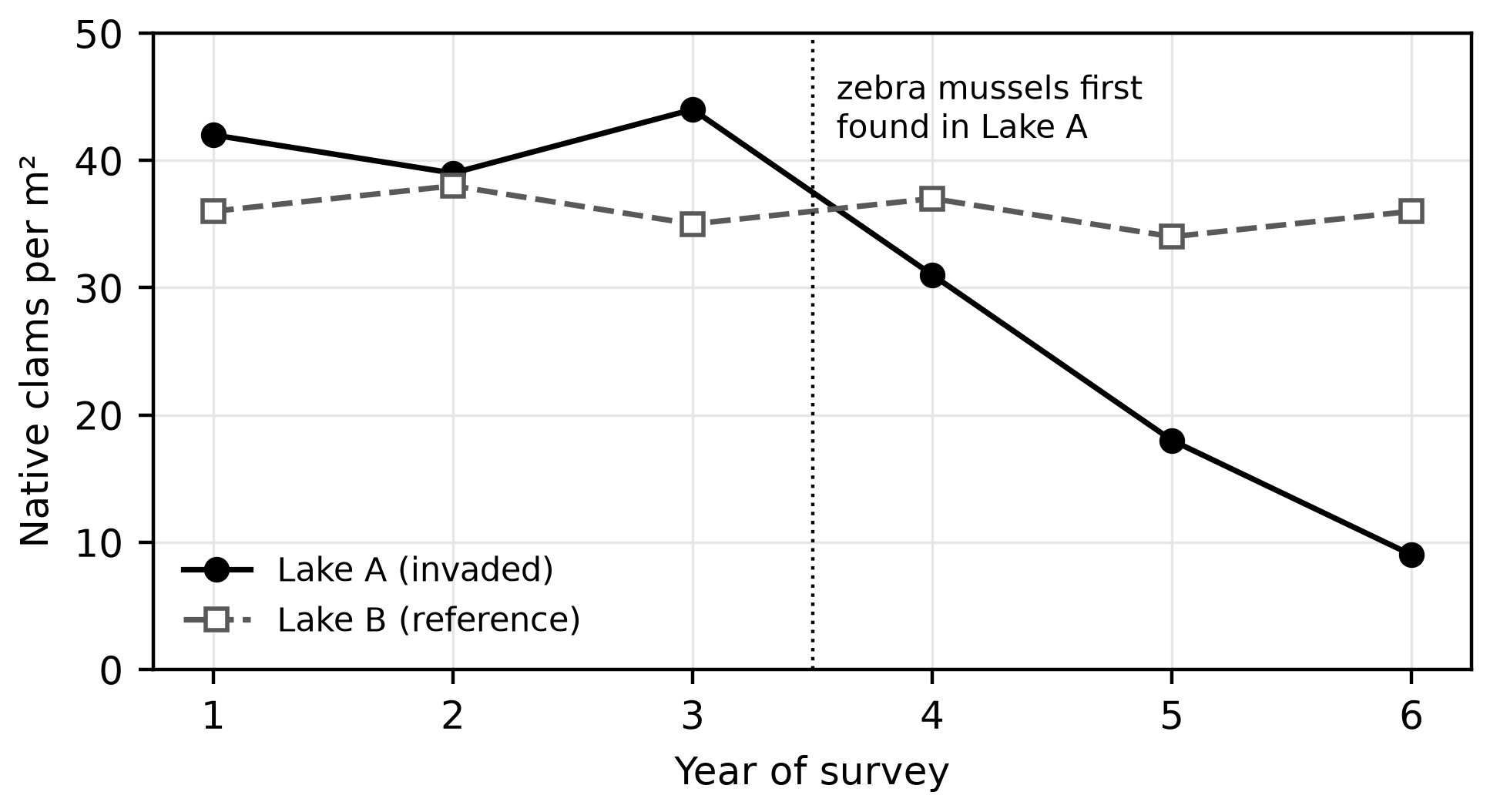
Figure 21.2. Hypothetical native clam densities (mean of 20 quadrats per lake per year) before and after zebra mussels appeared in Lake A.
Average each lake before and after the invasion. Lake A fell from 41.7 to 19.3 clams per m², a change of −22.3. Reference Lake B went from 36.3 to 35.7, a change of −0.7. Because the reference lake shows almost no change, a regionwide cause such as an unusually cold winter is unlikely. The design still has limits: one invaded lake is a single replicate, and the graph does not show how the mussels affected the clams. Zebra mussels attach to native clams, so smothering is one hypothesis to test.
Try it 21.6. A student concludes from Figure 21.2 that zebra mussels caused native clams to decline in every lake in the region. Write a more defensible conclusion and name one additional data set that would strengthen it.
Check your try-it work
21.1. Pond A: each proportion is 0.2, and 5 × 0.04 = 0.20, so the index is 0.80. Pond B: 0.92² + 4 × 0.02² = 0.8464 + 0.0016 = 0.848, so the index is 0.152. Same richness; Pond A is far more diverse.
21.2. (a) Commensalism (+/0). (b) Parasitism (+/−). (c) Resource partitioning, which reduces competition and allows coexistence.
21.3. Without spiders, grasshoppers increase and eat more grass, so grass biomass falls. Spiders have an indirect positive effect on grass, a trophic cascade.
21.4. "Some insects already carried alleles that made them resistant. They survived the pesticide and reproduced, so resistance alleles became more common." Mutations are not caused by need.
21.5. 75 ÷ 0.04 ≈ 1,900, so the concentration rose nearly two-thousandfold from plankton to gulls.
21.6. "In Lake A, native clam density fell after zebra mussels arrived, while the reference lake did not change, which is consistent with an effect of the mussels." Stronger evidence: before-and-after surveys of several invaded and several uninvaded lakes, or counts of mussels attached to clams.
Practice
Complete the printed practice after this chapter's companion panel: Questions 255–270 and Written task 24, a short free-response question about an investigation (4 points). Give the multiple-choice set about 24 minutes and the free-response question about 10 minutes. A four-function or scientific calculator is allowed. Check your work in "Answers, explanations and written responses" at the back of the book, under "Chapter 21: answers and explanations." Each item names the section to reread if you miss it.
Two days later, redo every missed item without notes; one week later, redo Try it 21.1, 21.3 and 21.6. Chapter 20 reviews energy flow and population growth, and Chapter 22 practices complete written responses that draw on every unit.