What to practice
- Connect secants, tangent slopes, derivative values and units
Predict before you read. A cart's position is meters after seconds, and its average velocity over the first three seconds is 6 meters per second. Is its velocity at the instant greater than 6, less than 6 or equal to 6? Decide now; Example 5.2 answers it.
Chapter 4 made limits exact. This chapter uses one limit, the limit of a difference quotient, to turn an average rate into an instantaneous rate: the derivative. It then estimates derivatives from data and finds where a derivative fails to exist.
Average rate of change is a secant slope
The average rate of change of on is
It is the slope of the secant line through and , and its units are output units per input unit. The numerator alone, , is the total change. Dividing by the length of the interval turns a change into a rate.
Example 5.1: average velocity
For the cart, and , so on
meters per second. Interpretation: from to seconds, the cart's position increased by an average of 7 meters per second. The sentence names the interval, the direction and the units. It does not claim that the cart moved at 7 meters per second at any particular moment.
Common error. Reporting 14, the change in position, as the rate. Fourteen meters says how far the cart moved; 7 meters per second says how fast, on average.
From secant slopes to the derivative
To find the velocity at the instant , shrink the interval. On ,
for . With , 1 and 0.5 the secant slopes are 7, 6 and 5.5 (Figure 5.1). As they approach 5.
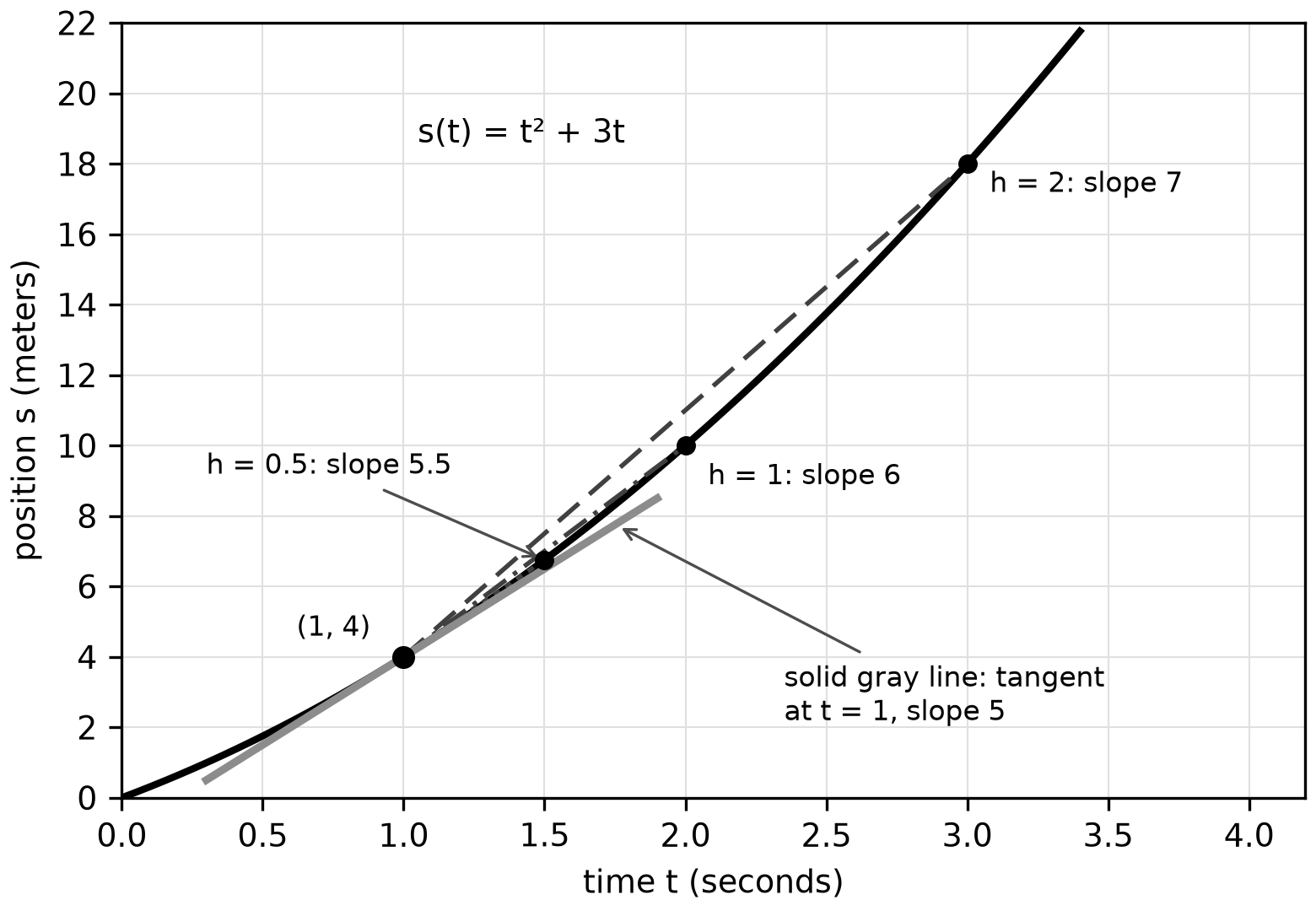
Figure 5.1. Secant slopes from approach the tangent slope 5 as the second point slides toward the first.
Definition. The derivative of at is
provided this limit exists. An equivalent form lets the second input be :
If exists, is differentiable at . Geometrically, is the slope of the tangent line at , the line . As a rate, is the instantaneous rate of change of at , with the same units as an average rate.
Example 5.2: velocity at an instant, and a tangent line
Find the cart's velocity at .
At the cart moves at 9 meters per second. Cancel only while ; then take the limit.
The same algebra at gave , so the tangent line at is . That answers the opening prediction: the velocity at is 5 meters per second, less than the average of 6 over , because the cart is speeding up.
A tangent line need not touch a graph only once. The tangent to at the origin is the line , and it crosses the curve there. The limit of secant slopes defines the tangent; a picture of "touching" does not.
Read a limit as a derivative
The definition works in both directions. A limit of a difference quotient is a derivative in disguise, and naming it can be faster than evaluating it.
Example 5.3: change the representation
Evaluate and say what it represents.
Since , the limit has the form with and . So it equals : the slope of the tangent to at , or the instantaneous rate of change of at .
Algebraically, for , so the limit is . A short secant agrees: .
The same number has an form, . More than one pair can fit a limit: with also works. What must match is the whole quotient, including the value subtracted.
The derivative as a function
Letting the input vary produces a new function,
defined wherever the limit exists. Its value at each input is the slope of there. Common notations include , and .
Example 5.4: the derivative of a square root
Let . Multiply the quotient by the conjugate (Chapter 4):
for . As this approaches for every . So and . A secant check: .
At the quotient is for , which grows without bound. The graph has a vertical tangent there, and does not exist. The domain of , , is smaller than the domain of .
Estimate a derivative from data
With only a table, you cannot take a limit. Estimate by the slope of a secant through nearby data, and say that it is an estimate: a finite table cannot show what the function does between its entries.
| (minutes) | 0 | 4 | 6 | 10 | 15 |
|---|---|---|---|---|---|
| (degrees Fahrenheit) | 70 | 190 | 238 | 310 | 350 |
Example 5.5: choose the interval
The table gives an oven's temperature (constructed practice data). Estimate and interpret it.
Several secants are available:
- :
- :
- :
Choose . It is the narrowest interval in the table that contains 8, so its secant is likely closest to the tangent at 8. A slope from , which is 24, describes earlier times and does not contain 8 at all.
So : at minutes the oven's temperature is increasing at about 18 degrees Fahrenheit per minute.
Common error. Averaging two table values, , estimates , a temperature, not , a rate.
When the derivative fails to exist
Differentiability implies continuity. If exists, then for
and as the right side approaches . So , and is continuous at . Read in reverse, the statement says that a function is not differentiable where it is not continuous.
The converse is false. A continuous function can still fail to have a derivative (Figure 5.2):
- at a corner, where the one-sided limits of the difference quotient are different numbers;
- at a cusp, where the one-sided quotients grow without bound in opposite directions;
- at a vertical tangent, where the quotients grow without bound in the same direction.
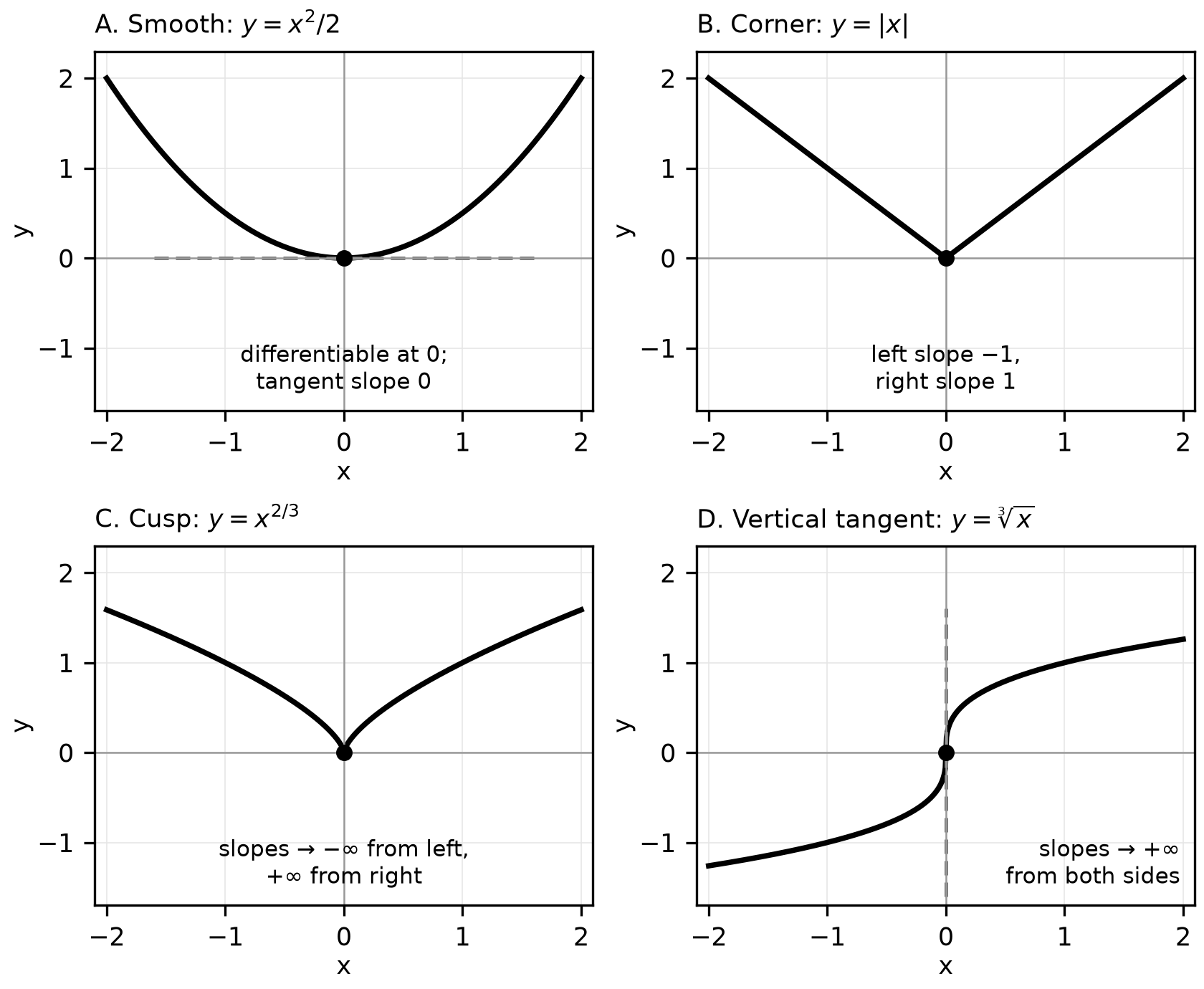
Figure 5.2. Four graphs that are continuous at . Only A is differentiable there.
To test a point, compute the one-sided limits of the difference quotient. The derivative exists only when both are the same finite number.
Example 5.6: join two pieces smoothly
Let for and for . Find and so that is differentiable at 2.
Continuity first. and the right-hand limit is , so .
Then equal one-sided slopes. For , the quotient is , which approaches 2. For it is , once . So , and then .
Why continuity first? Matching slopes alone is not enough: and give equal slopes but a jump from 3 to 4. Continuity alone is not enough either: and join the pieces at , but the slopes are 2 on the left and 0 on the right, a corner. Comparing the derivative formulas and at is a valid shortcut only after continuity holds.
Diagnose a flawed difference quotient
Task: use the definition to find for .
Student work. ", so , and ."
Diagnosis. The error is in distributing: , not . With that repaired, the quotient is , so .
A check that would have caught it. and , so a short secant has slope , close to 1 and far from 5. Before reporting a derivative, compare it with one short secant slope.
Try it
Try it 5.1. A tank holds liters of water at time minutes, for . (a) Find the average rate of change of on . (b) Use the definition to find , and interpret it with units.
Try it 5.2. Write as a derivative , then evaluate it.
Try it 5.3. The temperature of a cup of tea, degrees Celsius, was recorded at times minutes (constructed practice data). Estimate and interpret it.
| (minutes) | 0 | 5 | 8 | 12 |
|---|---|---|---|---|
| (degrees Celsius) | 60 | 47 | 41 | 35 |
Try it 5.4. Let for and for . Find so that is continuous at 1. With that , is differentiable at 1?
Check your work
5.1. (a) liter per minute. (b) and , so , which approaches 4. At minute the amount of water is increasing at 4 liters per minute.
5.2. With and , the limit is . The pair and also fits.
5.3. Use , the narrowest interval in the table containing 10: . At 10 minutes the tea's temperature is decreasing at about 1.5 degrees Celsius per minute.
5.4. Continuity requires , so . For , , which approaches 4. For , . The one-sided limits differ, so is not differentiable at 1: its graph has a corner there.
Practice
Chapter 5 practice is items APCAL-C05-M01 to APCAL-C05-M13 and the written task APCAL-C05-F01. They are printed after this chapter's companion panel as Questions 66–78 and Written task 4. Questions 69, 74, 75 and 78 and Written task 4 require a graphing calculator in radian mode; the others do not. Answers, full reasoning, the error behind each wrong choice, a Repair and retry line and the scoring rubric are in Answers, explanations and written responses at the back of the book, under Chapter 5: answers and explanations.
Before you move on
From memory, write both forms of the definition of the derivative, the tangent-line equation and the three ways a continuous function can fail to be differentiable. Then explain in one sentence why differentiability forces continuity. In two or three days, without notes, rework Example 5.6 with for and for , and redo Example 5.4 for at .