What to practice
- Distinguish power, product, quotient and elementary-function rules
Predict before you read. Let and . Is the derivative of the product equal to ? Decide now; Example 6.4 answers it.
Chapter 5 built each derivative from a limit. That always works, but slowly. This chapter develops rules that differentiate powers, sums, products and quotients, and the sine, cosine, tangent, exponential and logarithm functions, without a new limit each time. Chapter 7 adds the chain rule for compositions such as .
Powers, constants and sums
Four rules handle every polynomial and every power of :
- Constant: . A constant's graph is horizontal.
- Power: for every real , wherever both powers are defined.
- Constant multiple: .
- Sum and difference: .
Why the power rule holds for a positive integer : expanding gives plus terms that each contain . Subtract , divide by , and every term except still contains , so it vanishes in the limit.
Rewrite roots and reciprocals as powers before differentiating. For example, gives , the result Example 5.4 needed a conjugate to find. The derivative can have a smaller domain than the function: is defined at 0, but is not, because the graph has a vertical tangent there.
Example 6.1: rewrite, then differentiate
Differentiate .
Rewrite: . Then
for . The term is a constant, so its derivative is 0, not .
Common error. Differentiating as . A power in a denominator must be rewritten with a negative exponent first.
Sine, cosine, exponential and logarithm
| Function | Derivative | Condition |
|---|---|---|
| in radians | ||
| in radians | ||
| all | ||
The sine rule comes from the definition and two limits from Chapter 4. Since ,
which approaches . The cosine rule follows the same way from , and the minus sign in that identity becomes the minus sign in . Those two limits hold only when angles are measured in radians. In degrees, the slope of sine at 0 would be , not 1. Figure 6.1A shows the rule: at each marked input, the slope of the sine graph equals the height of the cosine graph.
The number is the base whose exponential has slope 1 at : . Then , which approaches . Each output of is also its slope. The logarithm undoes , and its slope at is (Figure 6.1B); Chapter 7's inverse-function reasoning explains why.
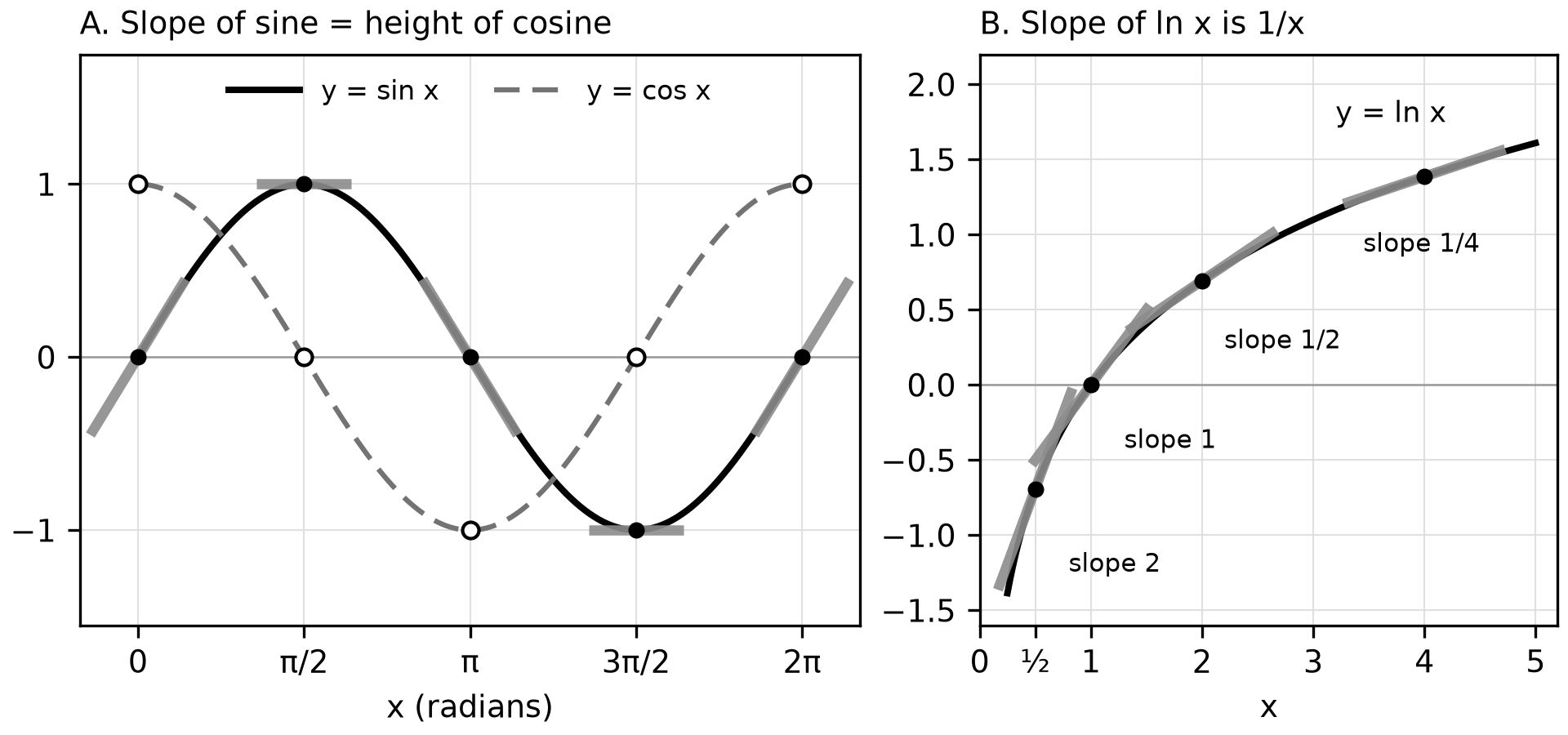
Figure 6.1. The tangent slopes of sine match the values of cosine (A); the tangent slopes of equal (B).
Example 6.2: a limit that is a derivative
Evaluate .
Since , this is the difference quotient of at (Chapter 5's representation change). So it equals . No trigonometric identity is needed.
Example 6.3: a tangent line
Find the tangent line to at .
The point: . The slope: , so . The tangent line is . Leave exact unless a decimal is requested.
The product rule
The derivative of a product is not the product of the derivatives. Figure 6.2 shows why. Picture as the area of a rectangle with width and height . When changes by , the width grows by and the height by , and the area grows by
Divide by . As , the first two pieces approach and . The corner piece, , approaches , because a differentiable is continuous.
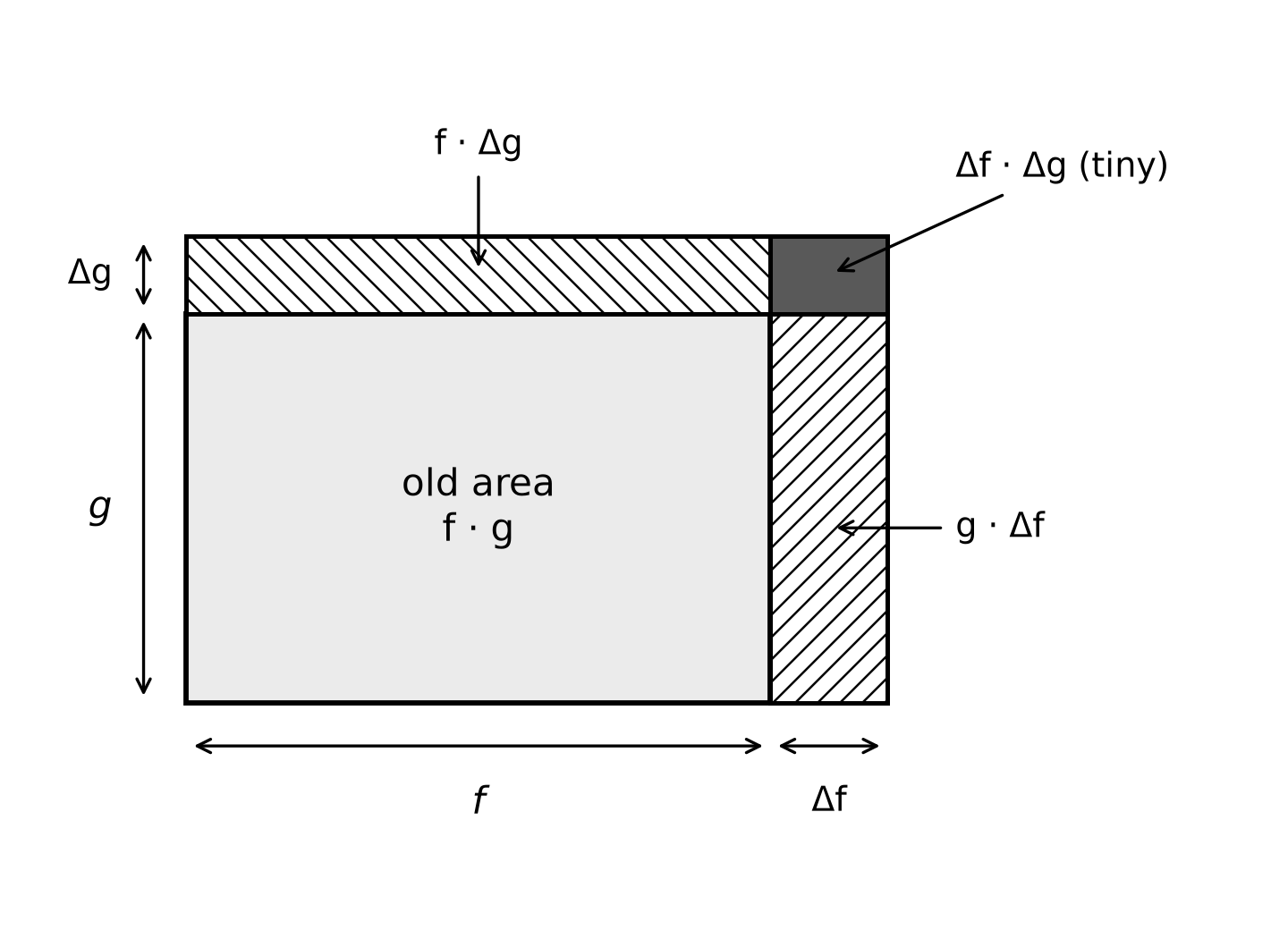
Figure 6.2. The change in a product has two main parts; the corner piece vanishes in the limit.
Example 6.4: check the rule by expanding
Differentiate .
By the product rule,
Check by expanding first: , so . The answers agree. The product of the derivatives, , does not.
This settles the prediction: has derivative , while .
The quotient rule
Order matters: the numerator starts with the derivative of the top. Reversing the order reverses the sign. The denominator is squared.
Example 6.5: two routes to the same derivative
Differentiate .
Quotient rule. .
Divide first. , so .
Both routes give the same answer for . When the denominator is a single power of , dividing first is shorter and has fewer places to slip. Save the quotient rule for denominators with more than one term.
Tangent, cotangent, secant and cosecant
Write each of these functions in terms of sine and cosine, then use the quotient rule.
Example 6.6: derive the secant rule
Since ,
wherever . The same method gives the other three rules:
| Function | Derivative |
|---|---|
For , the numerator becomes , so the derivative is . Each "co" function's derivative carries a negative sign. Every rule holds only where the original function is defined.
Choose a rule before you differentiate
Example 6.7: name the structure first
Differentiate each function.
(a) . The denominator is a single power, so simplify: for , and there.
(b) . A product of a power and an exponential: .
(c) . The denominator has two terms, so use the quotient rule:
wherever , using .
The structure chooses the method: simplify a quotient over a single power, use the product rule for a product of different kinds of function, and use the quotient rule for a denominator with several terms.
Example 6.8: rules with only values
The table gives values of differentiable functions and at .
| 3 | 2 | 4 | 5 |
Find the derivatives of and of at .
No formulas are needed. The rules use only values and slopes at the one input.
Example 6.9: a product with units
Fresh water flows into a tank of salt water faster than the mixture drains out. At time minutes the volume is liters and the salt concentration is grams per liter, so the tank holds grams of salt. At , , , and (constructed practice data). Is the amount of salt increasing or decreasing at ?
Check the units of each term. Grams per liter per minute times liters gives grams per minute, and grams per liter times liters per minute also gives grams per minute. So at the amount of salt is decreasing at 18 grams per minute, even though the volume is increasing. Neither rate decides the sign alone: the product rule weighs each factor's rate by the other factor's value.
Diagnose a flawed quotient
Task: find the slope of at .
Student work. ", so the slope at 0 is ."
Diagnosis. The numerator is in the wrong order. It must be the top's derivative times the bottom, minus the top times the bottom's derivative: . So , and the slope at 0 is 1.
A check that would have caught it. Near 0 the denominator is close to 1, so is close to and the slope should be close to 1. Also, is negative for and positive for , so the graph rises through the origin; a slope of is impossible.
Try it
Try it 6.1. Differentiate , and state where your result is valid.
Try it 6.2. Let . Find .
Try it 6.3. Let . Find and every where the graph of has a horizontal tangent.
Try it 6.4. Use the quotient rule to show that .
Try it 6.5. Differentiable functions and satisfy , , and . Find and .
Check your work
6.1. , so . It is valid for : is undefined at 0, and the cube-root term has a vertical tangent there.
6.2. , so .
6.3. for . Since , only at .
6.4. , wherever .
6.5. , and .
Practice
Chapter 6 practice is items APCAL-C06-M01 to APCAL-C06-M15 and the written tasks APCAL-C06-F01 and APCAL-C06-F02. They are printed after this chapter's companion panel as Questions 79–93 and Written tasks 5 and 6. Questions 88, 91 and 93 require a graphing calculator in radian mode; the other questions and both written tasks do not. Answers, full reasoning, the error behind each wrong choice, a Repair and retry line and both scoring rubrics are in Answers, explanations and written responses at the back of the book, under Chapter 6: answers and explanations.
Before you move on
From memory, write the power, product and quotient rules and the derivatives of the six trigonometric functions, and . Then explain in one sentence why the sine rule needs radians. In two or three days, without notes, derive the cosecant rule as in Example 6.6, and redo Example 6.8 with .