What to practice
- Identify inner functions, implicit dependencies and inverse inputs
Chapter 6's rules work when a function is built by adding, multiplying or dividing simpler pieces. This chapter covers four structures in which the input of one function is itself changing: compositions (topic 3.1), relations that are not solved for (topic 3.2), inverse functions (topic 3.3) and inverse trigonometric functions (topic 3.4). One rule connects all four: the chain rule. The official framework treats these as one unit of the course (AP Calculus AB course page).
Predict first. Suppose changes 3 units for every unit of , and changes 2 units for every unit of . How many units does change for every unit of ? Write a number before reading on.
The chain rule: rates multiply through a changing input (topic 3.1)
Your prediction should be 6. Each unit of produces 2 units of , and each of those produces 3 units of . Rates along a chain multiply:
In function notation, if is differentiable at and is differentiable at , then
Read the right side carefully. The outer derivative is evaluated at the inner value , because is the input that actually receives. Then multiply by the inner derivative .
Why the factors multiply. Over a small change , the inner function changes by about . The outer function responds to that change in its own input at the rate , so the output changes by about . Dividing by and letting it shrink gives the rule. The outer rate depends on where its input currently is, which is why it is read at .
Use four steps on every composition:
- Name the layers from the inside out.
- Differentiate each layer with respect to its own input.
- Multiply all the factors.
- Substitute back so the answer uses only .
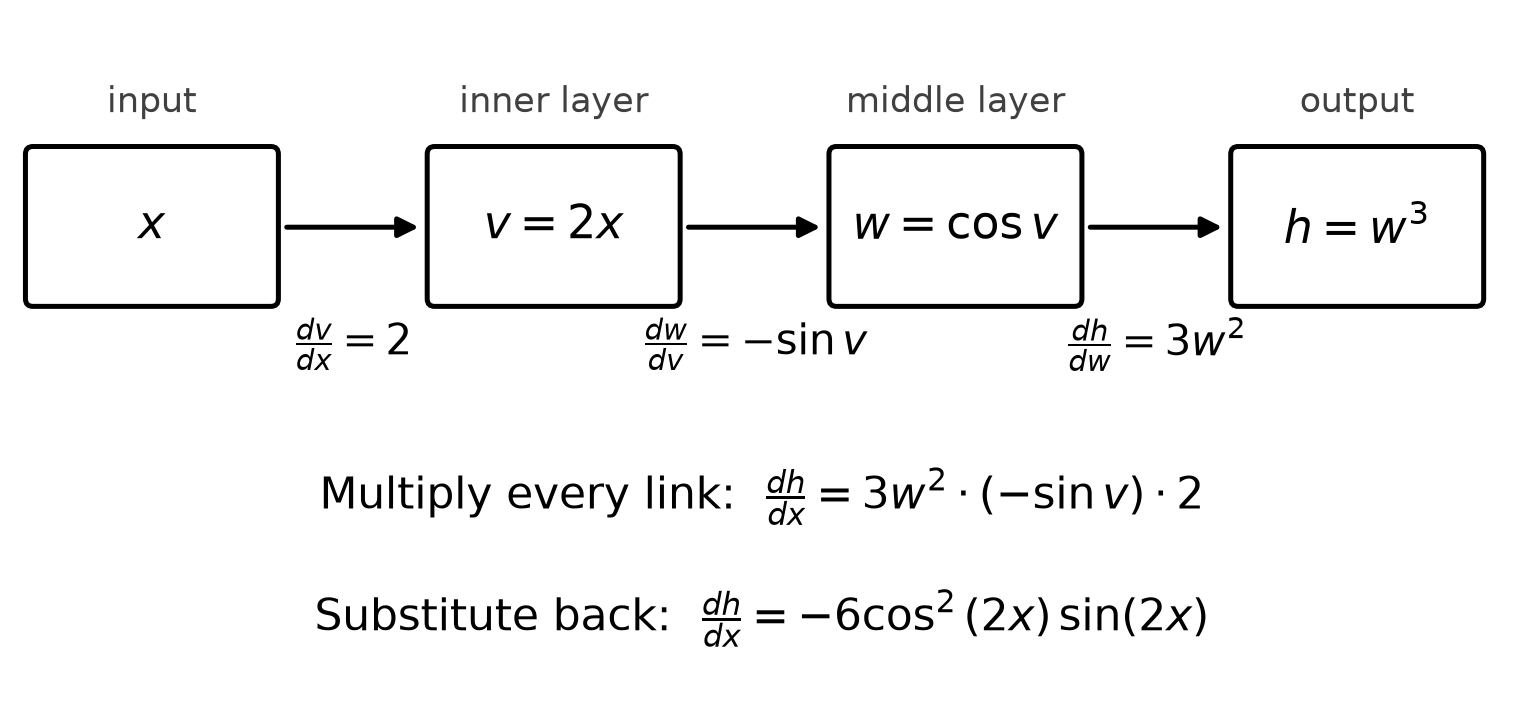
Figure 7.1. Each arrow carries one derivative; the chain rule multiplies all of them.
Worked example 7.1: a three-layer nest
Differentiate .
Read the notation. means . The last operation is cubing, so cubing is the outer layer.
Layers. , , , as in Figure 7.1. The three link derivatives are , and .
Multiply and substitute.
At , , so .
Check by meaning. For , is positive and decreasing, so its cube decreases too. A negative derivative agrees.
Worked example 7.2: units travel through the chain
A weather balloon rises. The air temperature is degrees Celsius at altitude meters, and the balloon's altitude is meters after minutes. At , and , and the temperature model gives . How fast is the temperature around the balloon changing at ?
Translate the words. The temperature the balloon experiences is the composition . Its rate is
Units. (degrees per meter) times (meters per minute) gives degrees per minute. At the temperature is falling about 0.26 °C per minute.
A common wrong setup uses . That is the temperature rate at an altitude of 5 meters, not at time 5 minutes, so it answers a different question.
Worked example 7.3: the chain rule from a table
| 1 | 3 | −2 | 2 | 5 |
| 2 | 1 | 4 | 3 | −1 |
| 3 | 2 | 6 | 1 | 0.5 |
Table 7.1. Values of , , and (constructed practice data).
Let . Find .
Locate the inner value first. , so the outer derivative is read at 2: . Reading instead gives , the most common table error.
Now reverse the order: for , . The table row you need depends on the composition's order.
Common errors.
- Dropping the inner derivative: is , not .
- Evaluating the outer derivative at instead of at .
- Misreading as or as .
Try it 7.1
(a) Find at .
(b) Use Table 7.1 to find the derivative of at .
(c) is a volume in cubic centimeters when the radius is centimeters, and is the radius after seconds. What are the units of ?
Solutions. (a) The derivative is ; at 3 it is . (b) . (c) Cubic centimeters per second: the product is the rate of change of volume with respect to time.
Implicit differentiation: y keeps depending on x (topic 3.2)
The relation describes a curve, but it does not define one function: Figure 7.2 shows two points with . Near most points, though, a small piece of the curve is the graph of a differentiable function . Implicit differentiation finds that function's slope without solving for .
Differentiate both sides of the equation with respect to , treating as :
- , by the chain rule;
- , by the product rule;
- .
Then solve for . The resulting formula usually contains both and , so you need both coordinates of the point.
Two habits prevent most errors. Differentiate the whole equation, both sides, before rearranging anything. And attach to a term the moment you differentiate a inside it, rather than planning to add it later.
Worked example 7.4: slope at a point
Find the slope of at .
Check the point. , so is on the curve.
Differentiate every term.
Collect and solve. , so .
Evaluate. At , .
Change representation. The same input also gives the point , where the formula gives . Figure 7.2 shows both tangent lines. One input, two points, two slopes: that is why the formula needs .
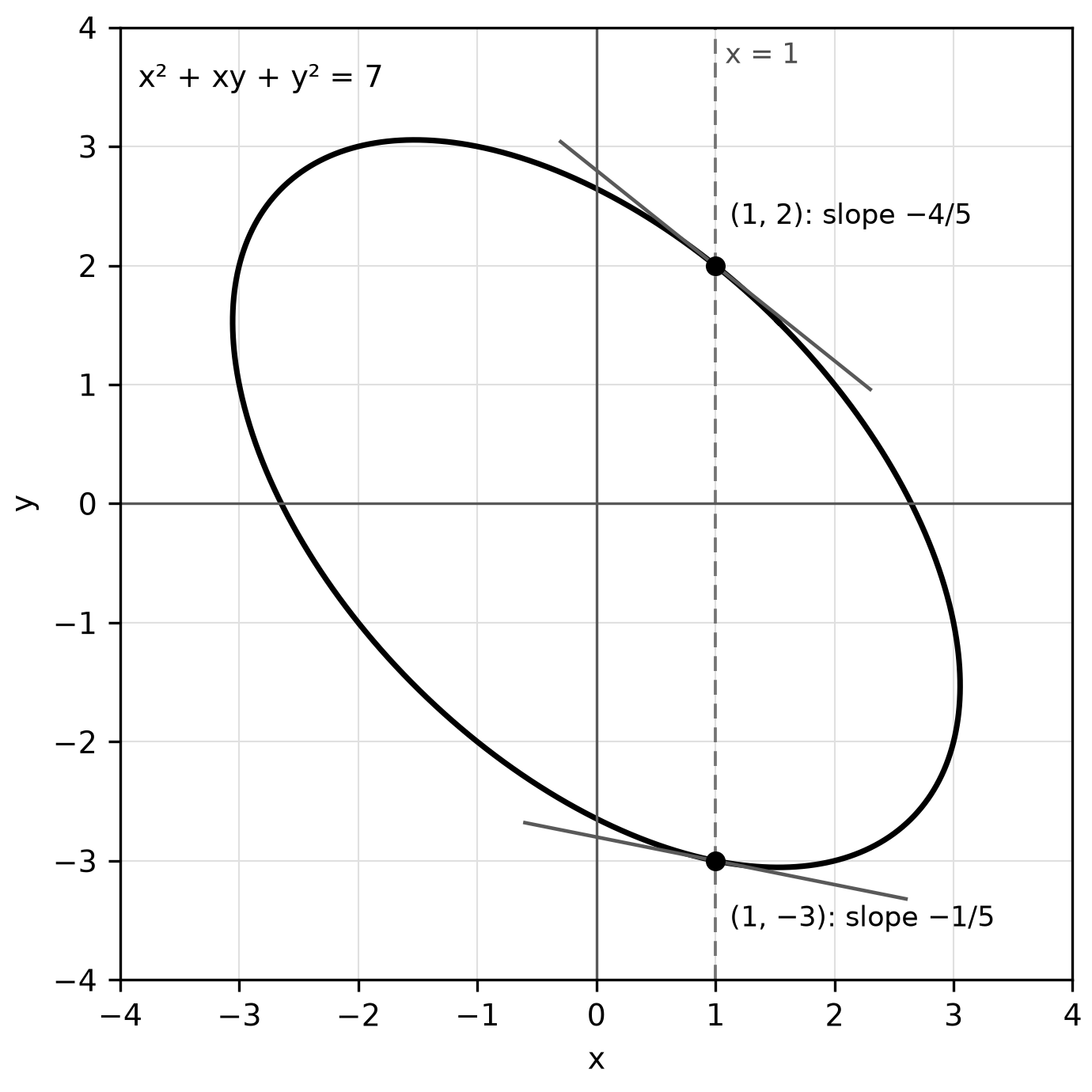
Figure 7.2. The vertical line meets the curve twice, and the slopes differ.
If at a point of the curve, the formula has no finite value there. Do not divide by zero; Chapter 13 analyzes such points.
Worked example 7.5: choose implicit or explicit
Find the slope of the circle at .
Explicit route. Solving for forces a choice of branch. The point is on the lower half, , so at .
Implicit route. , so .
Method choice. Both routes agree, but the implicit route needed no branch decision and less algebra. Implicit differentiation becomes the only practical route when cannot be isolated: gives , so . Use the explicit route when is already isolated.
Worked example 7.6: diagnose an incorrect solution
A student's work on at :
, so .
Diagnosis. Two terms are wrong. The derivative of needs the product rule, , not . The derivative of needs the chain-rule factor, , not . A slope of also contradicts Figure 7.2, where the tangent at falls gently.
Repair. gives , as in Worked example 7.4.
Try it 7.2
Verify that lies on , then find there.
Solution. . Differentiating, , so .
Inverse functions: evaluate at the matching input (topic 3.3)
Let be one-to-one with inverse , so . Differentiate both sides with the chain rule: . Therefore
provided is differentiable at and .
Units invert too. If converts minutes into liters, its inverse converts liters into minutes, and is measured in minutes per liter: the reciprocal of liters per minute.
Geometrically, reflecting a graph across swaps rise and run. If the tangent to at has slope , the tangent to at has slope (Figure 7.3). Note the swapped coordinates: the inverse's slope at comes from at , the preimage.
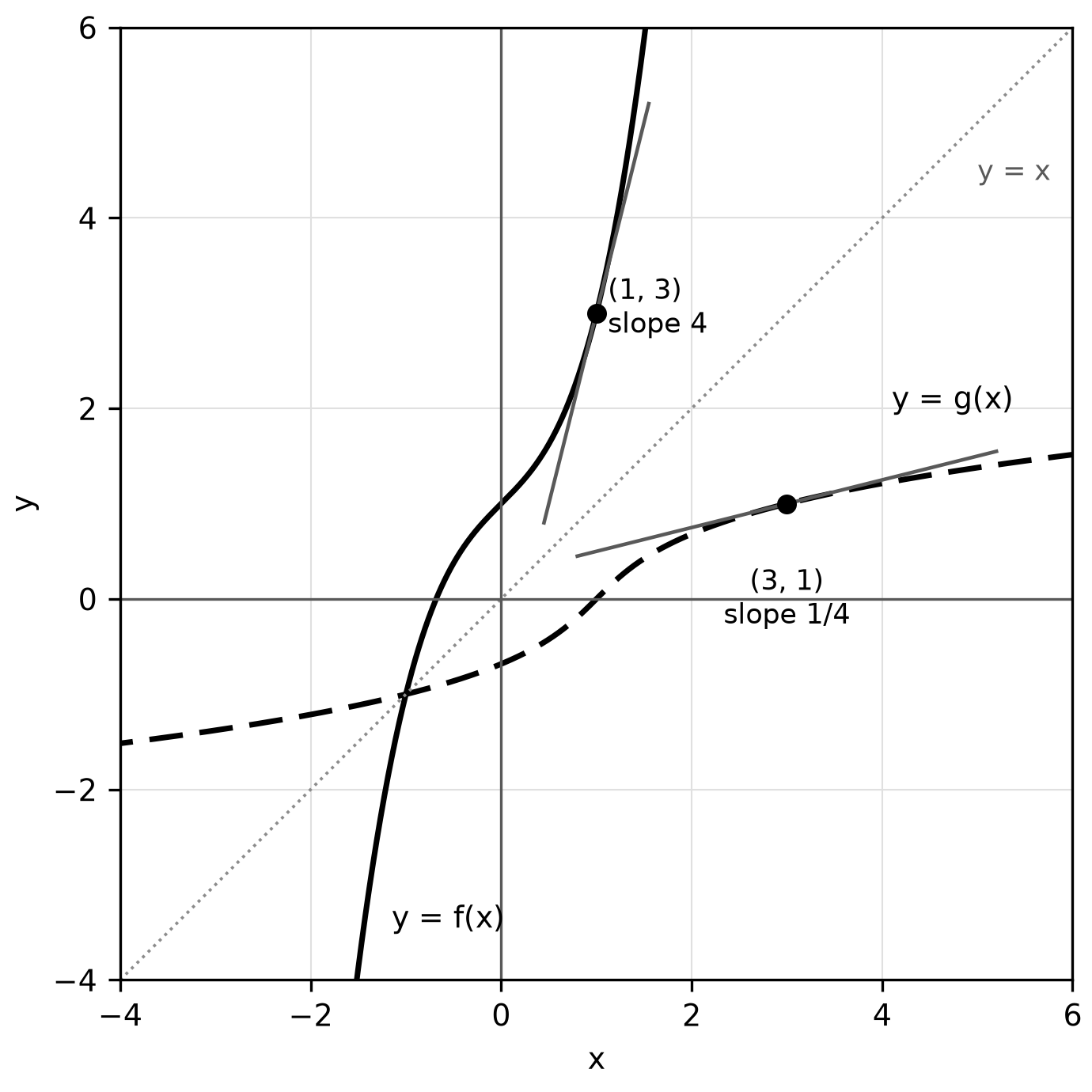
Figure 7.3. Corresponding points on and its inverse have reciprocal tangent slopes.
Worked example 7.7: find the preimage first
Let and let be its inverse. Find .
Condition. , so is increasing, hence one-to-one, and is never zero.
Preimage. Solve : works, since . So .
Reciprocal. .
Diagnose the tempting error. Writing treats 3 as an input of . But 3 is an output of ; the matching input is 1.
Worked example 7.8: when the reciprocal fails
is one-to-one, with inverse . Since , the formula would require at . The difference quotient confirms that no derivative exists: grows without bound as , and the graph of has a vertical tangent at the origin. Always check before using the formula.
Try it 7.3
is differentiable and increasing, and is its inverse.
| 1 | 2 | 5 | |
|---|---|---|---|
| 2 | 5 | 9 | |
| 3 | 4 | 10 |
Table 7.2. Values of and (constructed practice data).
Find and , and explain why is wrong.
Solution. , so and . The value reads the row where 5 is an input; you need the row where 5 is an output.
Inverse trigonometric functions: restricted outputs (topic 3.4)
, also written , is the angle in whose sine is . It is not , which is . The restricted output intervals make each inverse a function: takes values in and in .
Worked example 7.9: derive, then apply the chain rule
Let for . Then . Differentiate implicitly: , so .
Choose the sign. Because lies in , , so . Therefore
The same method gives and .
Check the signs and domains. Arcsine and arctangent are increasing, so their derivatives are positive; arccosine is decreasing, so its derivative is negative. The arcsine and arccosine derivatives exist only for ; at their graphs have vertical tangents. The arctangent derivative exists for every real .
Apply the chain rule. ; at the slope is 1. Similarly, for , the inputs where lies strictly between and 1.
Common errors. Treating as ; dropping the inner derivative; writing where belongs; ignoring the domain of the original function.
Try it 7.4
(a) Find for .
(b) Evaluate and .
(c) Find the slope of at .
Solutions. (a) . (b) , an angle; and 2, a reciprocal. (c) at 1 equals .
Retrieve and review
- Today. Without notes, write the chain rule in both notations and the inverse-derivative formula with its condition.
- In about two days. Differentiate and , then name the outer layer of each. (Answers: and .)
- In about a week. Mix one problem from each of topics 3.1–3.4 with one Chapter 6 product or quotient, without labels, and choose each method before computing.
- Log each miss with an error code: OBJECT for evaluating at the wrong input, CONDITION for dividing by a zero derivative, ALGEBRA for lost terms.
Chapter 10 reuses implicit differentiation with respect to time for related rates; Chapter 13 studies horizontal and vertical tangents on implicit curves.
Practice
Work items APCAL-C07-M01 to APCAL-C07-M10, printed after this chapter's companion panel as Questions 94–103. Questions 96 and 100 require a graphing calculator in radian mode; round final answers to three decimal places only at the end. The remaining eight questions are to be done without a calculator.
Then complete the two written tasks, APCAL-C07-F01 (Written task 7, no calculator) and APCAL-C07-F02 (Written task 8, graphing calculator required), using the two response pages printed for each.
Full solutions, an explanation of every wrong choice, nine-point rubrics and complete sample responses are in Answers, explanations and written responses at the back of the book, under Chapter 7: answers and explanations. Each explanation ends with a Repair and retry line pointing to the section above.