What to practice
- Select a differentiation route and interpret higher-order notation
Chapters 6 and 7 supplied the rules. This chapter is about using them well: choosing an efficient, valid route through an unfamiliar expression (topic 3.5), and differentiating more than once (topic 3.6). On the exam no question announces which rule it needs, so the choice itself is a skill to practice.
Predict first. Which rule would you apply first to ? Write your choice; Worked example 8.1 compares two routes.
Read the structure before you choose (topic 3.5)
Ask four questions, in order, before writing any derivative.
- What is the last operation? If you evaluated the function at a number, the final step (a sum, product, quotient or composition) names the outermost rule.
- Would a rewrite help? Roots and single-term denominators become powers, logarithm properties split products and quotients, and short products can be expanded. Rewrite only where the new form agrees with the original on its domain.
- Is hidden? For a relation or an inverse, use Chapter 7's implicit or inverse methods.
- Is any input exceptional? At a piecewise join, an absolute value or a point where your formula breaks, check the derivative separately with its definition.
Worked example 8.1: two valid routes
Differentiate for .
Route A, the quotient rule. . Multiplying the top and bottom by gives .
Route B, rewrite first. Since , , so .
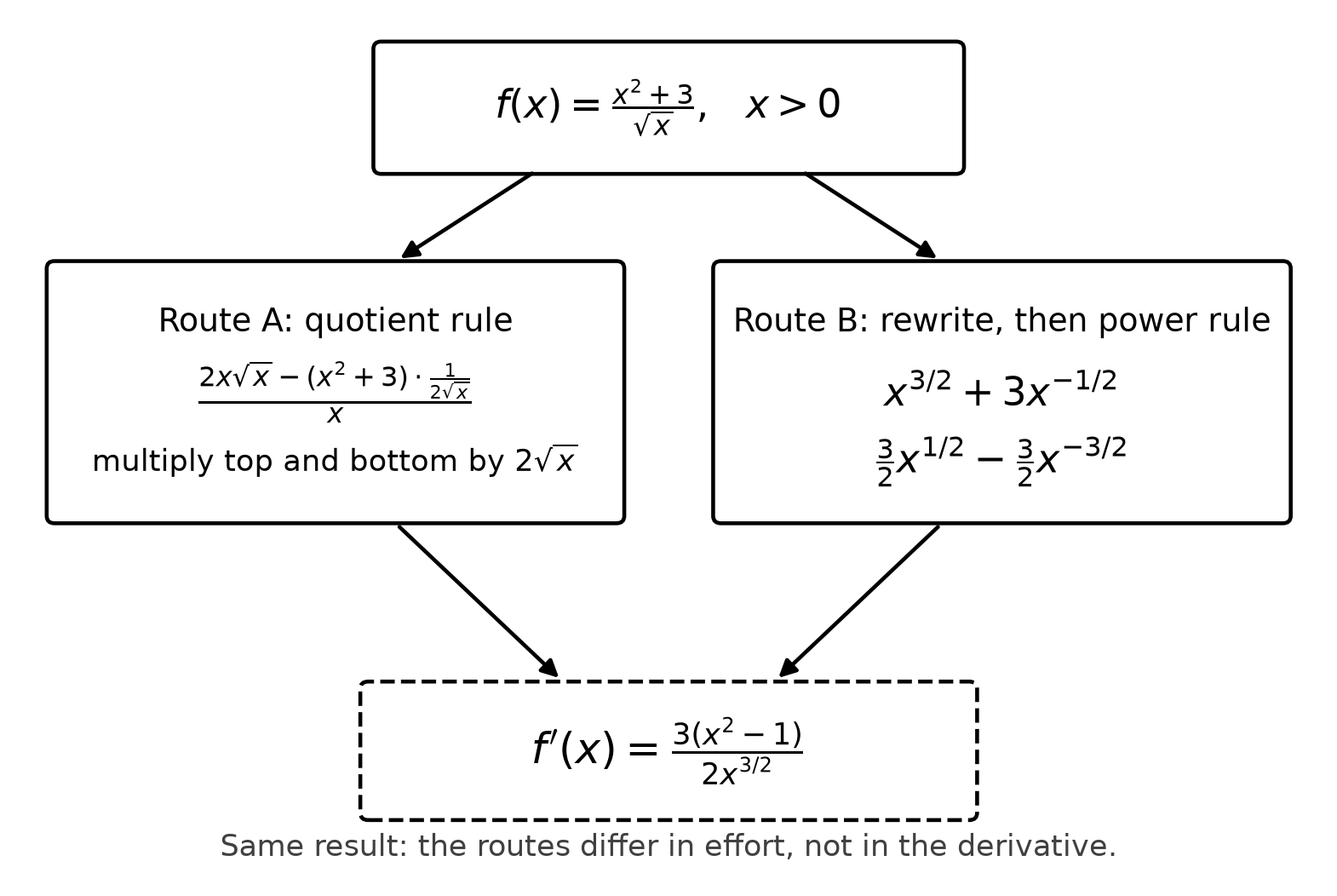
Figure 8.1. Two valid routes reach the same derivative; Route B is shorter.
Method choice. Both routes are correct, and from either one. Route B is shorter and has fewer places for a sign error, so it is the better choice here. The quotient rule becomes necessary when the denominator has more than one term, as in , because no power rewrite splits that fraction into simple terms.
Worked example 8.2: rewrite a logarithm first
Differentiate for .
Check the rewrite's domain. For , both and are positive, so the logarithm properties apply: .
Differentiate term by term. .
Differentiating the original form directly needs the chain rule wrapped around the quotient rule; it reaches the same result with far more algebra.
Worked example 8.3: a formula that breaks at one input
A student differentiates . For , the derivative of is , so the product rule gives
The student concludes that does not exist because this formula is undefined at 0.
Diagnosis. The formula was derived only for , where is differentiable. Its failure at 0 is a signal to check, not a verdict. Use the definition:
Both one-sided limits are 0, so . For the formula also simplifies to , which approaches 0.
Contrast. For alone, the quotient is unbounded near 0, so no derivative exists there. The definition, not the appearance of a formula, decides.
Try it 8.1
Choose a route, then differentiate. (a) (b)
Solutions. (a) Rewrite as ; then . (b) Rewrite as ; then , valid for every real because .
Higher-order derivatives: differentiate the derivative (topic 3.6)
The second derivative is the derivative of . It measures how fast the rate of change is itself changing. Repeating gives , then , and so on. For , the second derivative is also written or , and the $n$th derivative (CED, topic 3.6).
Read the notation as an instruction. means "differentiate twice"; it is not . For , the first is and the second is .
Units divide once per derivative. If is in meters and in seconds, then is in meters per second and in meters per second per second.
A second derivative can fail to exist where the first exists. If , the graph of has a corner at 0, so does not exist. When is given as a graph, is the slope of that graph at , and it exists only where the graph has a single tangent line. In a calculator section, a numerical derivative applied to a formula for estimates ; write down which function you differentiated.
Worked example 8.4: keep every product and chain term
Find for .
First derivative. .
Second derivative. Apply the product rule again to times :
So . A common first-step error multiplies the two derivatives, ; that gives 0 at , although .
Worked example 8.5: read a second derivative from a graph
Figure 8.2 aligns with and .
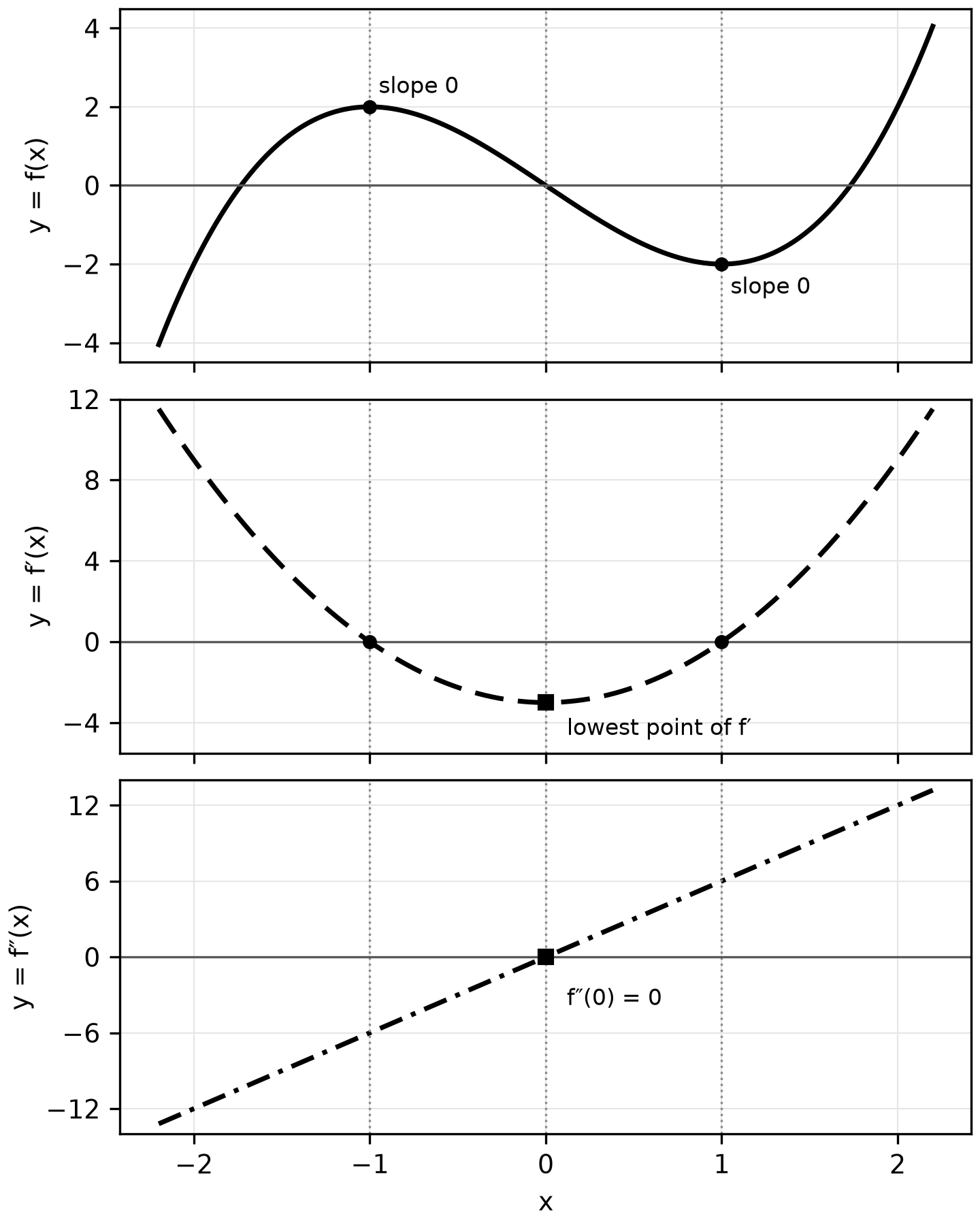
Figure 8.2. Each panel shows the slope of the panel above it.
Translate between panels. is the slope of the graph. The graph falls for and rises for , so on the left and on the right. At , reaches its lowest value , and . Notice that says nothing about the height of ; it describes how changes.
Worked example 8.6: an implicit second derivative
On , Worked example 7.4 found at . Find there.
Differentiate the differentiated equation. Start from . Every and still depends on :
Substitute only now. With , and : , so and .
Independent check. Differentiating the quotient and substituting gives the same value. Treating as a constant during the second differentiation, a common error, loses the terms and gives a different number.
Worked example 8.7: patterns in repeated derivatives
Each derivative of multiplies by , so . Derivatives of cycle every four steps: , , , . Since , the 27th derivative of is .
Try it 8.2
(a) For , find and .
(b) On , the slope at is . Find there.
(c) Find .
Solutions. (a) and , so . (b) Here , so , giving . (c) ; each pair of derivatives multiplies by .
Retrieve and review
- Today. Write the four structure questions from memory.
- In about two days. Compute and , then explain in one sentence why they differ. (Answers: and .)
- In about a week. Choose three unlabeled problems from Chapters 6–8, name the route before you start, and record any case where a rewrite would have been shorter.
- Log misses with an OBJECT code when a first derivative was used where a second was required.
Chapter 9 interprets the second derivative of position as acceleration, and Chapter 12 uses its sign to describe concavity.
Practice
Work items APCAL-C08-M01 to APCAL-C08-M06, printed after this chapter's companion panel as Questions 104–109. Question 109 requires a graphing calculator in radian mode; the other five are to be done without a calculator.
Then complete written task APCAL-C08-F01 (Written task 9, no calculator) on its two response pages.
Full solutions, an explanation of every wrong choice, the nine-point rubric and a complete sample response are in Answers, explanations and written responses at the back of the book, under Chapter 8: answers and explanations. Each explanation ends with a Repair and retry line pointing to the section above.