What to practice
- Explain position, velocity, acceleration and non-motion rates
A derivative is a rate, and every rate has a context: what changes, with respect to what, and in which units. This chapter covers topics 4.1 to 4.3 of the course framework: derivatives in context, motion along a line, and rates in other settings. Two habits return in every later unit: state units, and keep direction separate from speed.
Predict before you read
Answer quickly; the chapter settles each one.
- At one instant a particle has velocity and acceleration . Is it speeding up?
- counts people and is measured in hours. What are the units of ?
- Can an object with negative acceleration be speeding up?
Read a derivative as a sentence
If , then is the instantaneous rate of change of with respect to at . Its units are always output units per input unit, so in the second prediction is in people per hour. A complete interpretation answers four questions: at what input, which quantity, increasing or decreasing, and how fast, in which units. One template:
At [input value with units], [output quantity] is [increasing or decreasing] at a rate of [size of the derivative] [output units] per [input unit].
The sign carries the direction, so write "decreasing at 0.08", not "increasing at ". It also approximates change: one more input unit changes the output by about units, not exactly, because the rate may vary.
The second derivative has units of output per input per input; its sign tells whether the rate, not the quantity, is rising.
Example 9.1: a rate whose input is not time
A car's tank holds liters of fuel after the car has driven kilometers on a trip. Interpret and .
Solution. The input is distance, so the rate is per kilometer, not per hour. After 120 kilometers, the fuel in the tank is decreasing at 0.08 liter per kilometer driven; the next kilometer uses about 0.08 liter.
The units of are liters per kilometer per kilometer. Because it is positive, is increasing toward 0, so each kilometer uses slightly less fuel than the one before. The fuel itself is still decreasing.
Common error. Writing "liters per hour" because many rates involve time. Read the input variable before you write units.
Position, velocity and acceleration
For a particle moving along a line with position :
- velocity is , and acceleration is ;
- means motion in the positive direction, and means motion in the negative direction;
- speed is , which is never negative;
- the particle changes direction where changes sign. A zero of without a sign change is only a momentary stop.
Displacement over is . Total distance traveled adds the length of every leg, so split the interval wherever the direction changes.
Example 9.2: a complete motion analysis
A particle's position is meters for seconds. Describe its motion, and find its displacement and total distance traveled.
Solution. Differentiate twice:
The velocity is zero at and , and its sign changes at each:
| Interval | |||
|---|---|---|---|
| Sign of | |||
| Direction | positive | negative | positive |
The positions at the endpoints and turning points are , , and .
- Displacement: meters.
- Total distance: meters.
Figure 9.1 shows the same analysis in three linked graphs. The direction reverses where the position graph has a horizontal tangent, which is where the velocity graph crosses the axis.
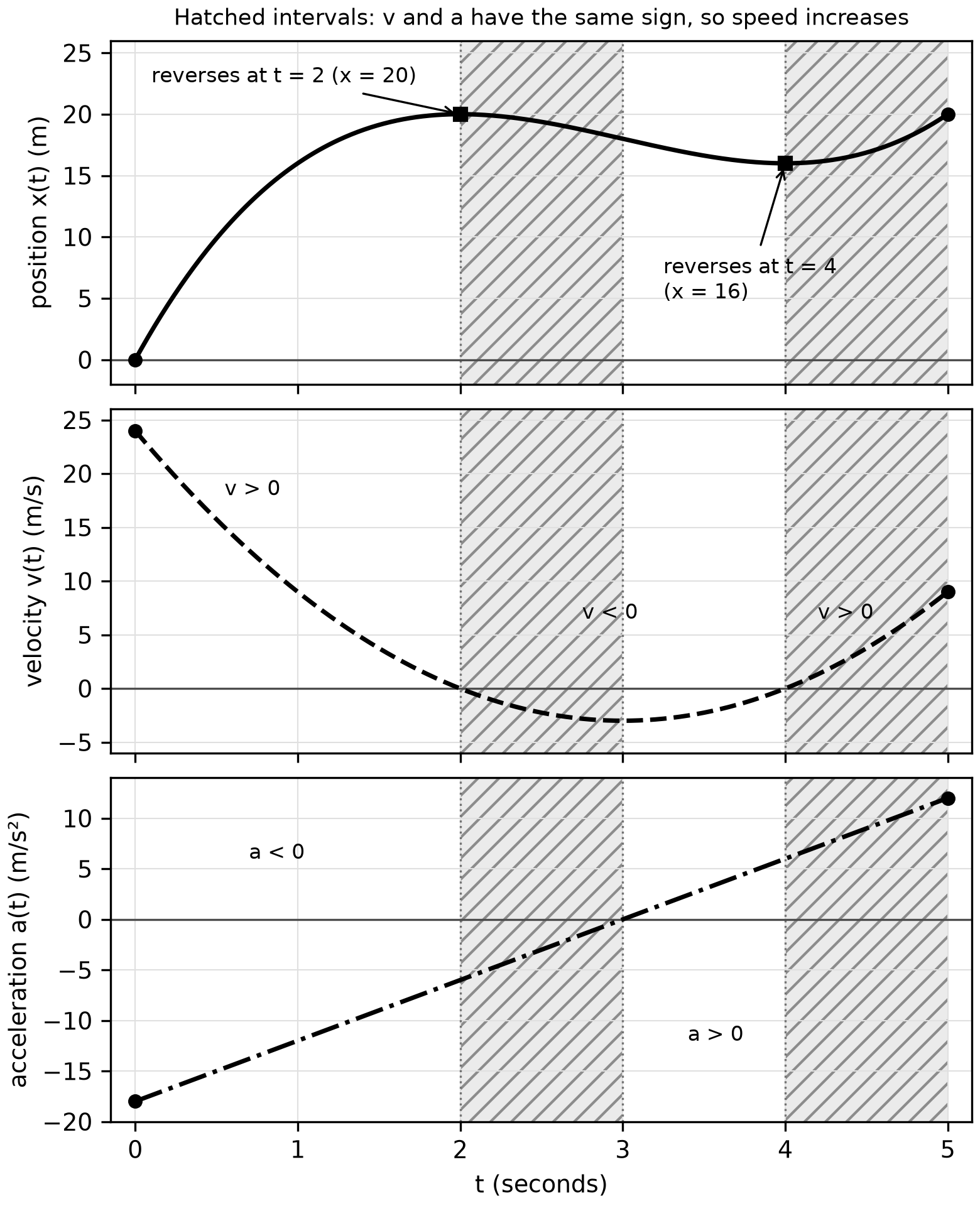
Figure 9.1. Position, velocity and acceleration for Example 9.2 on one time axis. The hatched intervals are where velocity and acceleration have the same sign.
Common error. Reporting as the total distance. That is the displacement; it ignores the 4-meter backward leg and the 4-meter return.
Speeding up and slowing down
Three signs answer three different questions.
| Sign to check | Question it answers |
|---|---|
| Sign of | Which way is the particle moving? |
| Sign of | Is the velocity increasing or decreasing? |
| Signs of and together | Is the speed increasing or decreasing? |
Speed increases when and have the same sign and decreases when they have opposite signs. To see why, suppose and . The velocity is decreasing, so it becomes more negative, and its distance from zero, the speed, grows. So negative acceleration does not mean slowing down, which settles the third prediction. In the first prediction, and have opposite signs, so that particle is slowing down.
In Example 9.2, on and on . Combining signs, the particle slows down on and and speeds up on and , the hatched intervals in Figure 9.1.
Example 9.3: from a velocity graph to a sign table
Figure 9.2 shows a velocity , in meters per second, for (solid) and the speed (dashed). Without a formula, find where the particle speeds up.
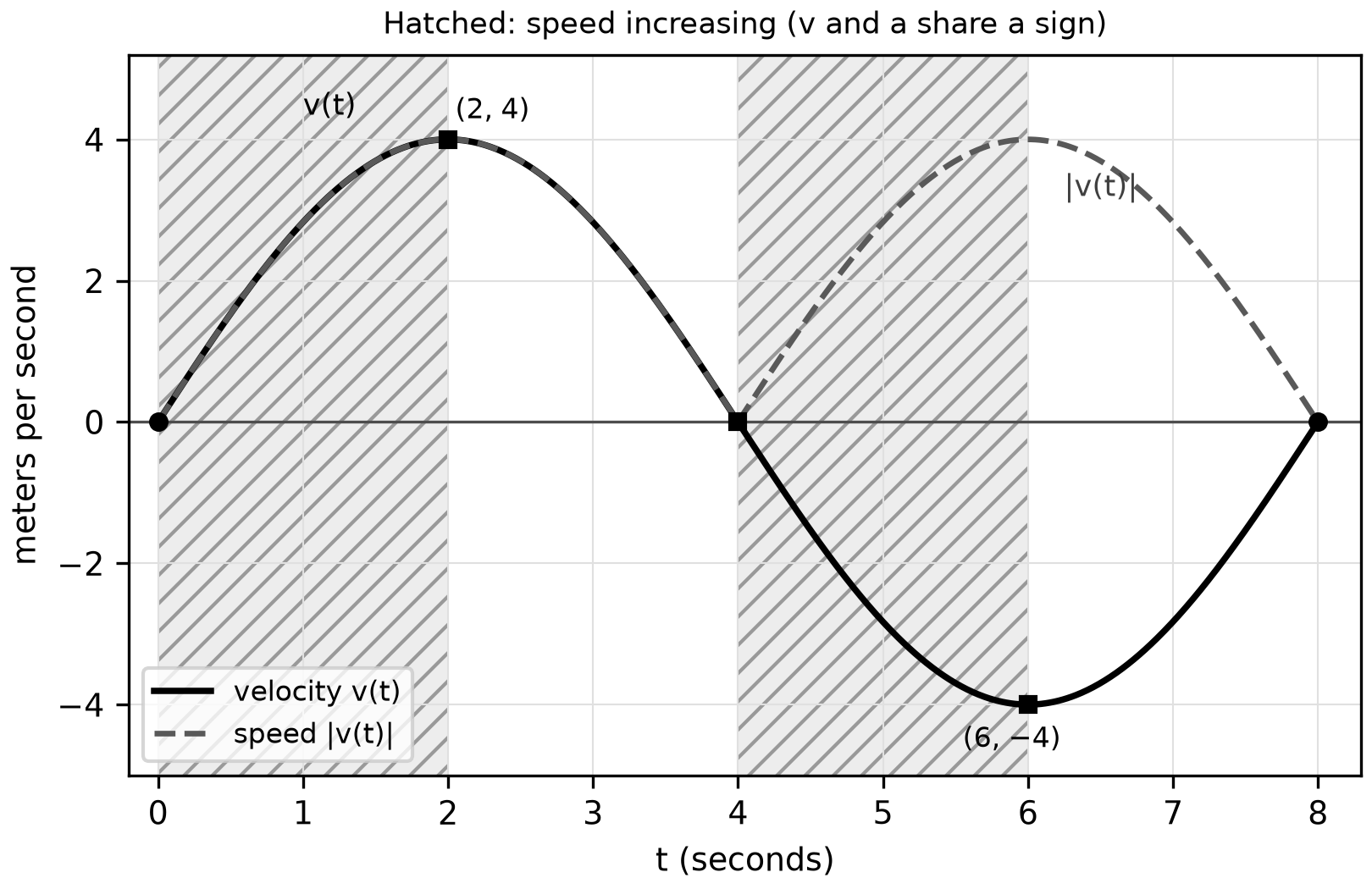
Figure 9.2. Velocity (solid) and speed (dashed) for Example 9.3.
Solution. Read the sign of from the side of the axis, and the sign of from the slope of the velocity graph.
| Interval | ||||
|---|---|---|---|---|
| (slope of ) | ||||
| Speed | increasing | decreasing | increasing | decreasing |
The particle speeds up on and : speed increases where a velocity graph moves away from the horizontal axis. On the graph falls, yet the speed rises, because the graph is moving away from the axis below it.
Example 9.4: diagnose a right answer with a wrong reason
For the particle in Example 9.2, a student writes: "At the particle is slowing down because ."
Diagnosis. Check the facts: and . The signs are opposite, so the particle is slowing down. The conclusion is right, but the reason would earn no credit, because the sign of gives only the direction. Test the same reason at : is also negative, but , so the particle is speeding up there.
Repair. "Slowing down, because and have opposite signs."
When a calculator is required
If a velocity formula needs a calculator, work in radian mode: evaluate , compute numerically, write both values with their signs, and only then conclude. Report three decimal places.
Rates in other contexts
Every rule above carries over when the input is not time, as with temperature against depth or cost against items produced. Name the input and its unit first; the rate is "per" that unit.
When a function is known only from a table, estimate its derivative with a difference quotient. For an input between two table inputs , use
and choose the closest table inputs on either side of . This is only an estimate of .
Example 9.5: choose the estimate a table supports
The table gives the water temperature , in degrees Celsius, at depth meters in a lake (constructed practice data). is differentiable. Estimate and interpret it.
| (meters) | 0 | 2 | 5 | 8 | 10 |
|---|---|---|---|---|---|
| (°C) | 24 | 22 | 15 | 10 | 9 |
Solution. The table has no entry for 6. The closest depths on either side are 5 and 8:
At a depth of 6 meters, the temperature is decreasing by about 1.667 °C per meter of additional depth.
Why not use the whole table? The quotient is the average rate over the whole lake, mixing slow change near the surface with fast change in the middle layer. The narrowest interval around 6 is the best-supported estimate.
Example 9.6: connect two rates with units
A diver descends at 0.5 meter per second and passes a depth of 6 meters. Using Example 9.5, about how fast is the water temperature around the diver changing with respect to time?
Solution. Temperature depends on depth, and depth depends on time, so the chain rule links the rates:
Check the units: degrees per meter times meters per second gives degrees per second. The water around the diver is cooling at about 0.833 °C per second.
Try it
Try it 9.1. The monthly rent for an apartment with square feet of floor space is dollars. (a) Interpret with units. (b) If , estimate the rent for an 810-square-foot apartment.
Try it 9.2. A particle's position is meters for seconds. (a) When does it change direction? (b) On which intervals is it speeding up? (c) Find its total distance traveled.
Try it 9.3. A tank holds liters of water at time minutes, with and . A student writes: "At the water is draining more and more slowly, because . Also, the tank holds exactly 3 liters less at than at ." Evaluate both claims.
Check your work
9.1. (a) When the floor space is 800 square feet, the rent increases by about 1.90 dollars per additional square foot. (b) dollars. It is approximate, because the rate may vary.
9.2. and . (a) On , before and after, so the particle changes direction only at ; the zero at is outside the interval. (b) It speeds up on , where both signs are negative, and on , where both are positive. It slows down on . (c) , and , so the distance is meters.
9.3. The first conclusion is right, but its reason is incomplete. Draining means , and means is increasing toward 0, so the draining rate of 3 liters per minute is shrinking. Both signs are needed. The second claim is wrong: is an instantaneous rate, so the change over the minute before is only approximately 3 liters.
Review and retrieve
- A derivative's units are output units per input unit.
- The sign of gives direction; speed increases exactly when and share a sign.
- Direction changes need a sign change of , not just a zero.
- Total distance splits at turning points; displacement does not.
- From a table, use the closest inputs on either side, and say "approximately".
Retrieve. In two days, without notes, rebuild Example 9.2's sign tables and speeding-up intervals. A week later, redo Try it 9.2(c) for . Check: , so the distance is meters.
Practice
Work items APCAL-C09-M01 to APCAL-C09-M12, printed after this chapter's companion panel as Questions 110–121. Do Questions 110–116 without a calculator. Questions 117–121 require a graphing calculator in radian mode; report three decimal places unless a question says otherwise.
Then complete the two written tasks, APCAL-C09-F01 (Written task 10, graphing calculator required) and APCAL-C09-F02 (Written task 11, no calculator), using the two response pages printed for each.
Full solutions, an explanation of every wrong choice, nine-point rubrics and complete sample responses are in Answers, explanations and written responses at the back of the book, under Chapter 9: answers and explanations. Each explanation ends with a Repair and retry line pointing to a section of this chapter.