What to practice
- Build variable relationships and check approximation or limit conditions
This chapter covers topics 4.4 to 4.7 of the course framework: rates linked by an equation, approximating a function by its tangent line, and L'Hospital's rule for limits of the forms and . One habit joins them: check the conditions before you compute. Related rates need an equation that holds at every instant. A tangent-line estimate needs a stated center and a concavity check. L'Hospital's rule needs an eligible form.
Predict before you read
- A runner's distance from a pole is changing. If you substitute today's value of before differentiating, what derivative will you get for ?
- Does a concave-up graph lie above or below its tangent lines?
- Does L'Hospital's rule apply to ?
Related rates: relate first, then differentiate
When quantities that change with time are linked by an equation, their rates are linked by the derivative of that equation. Work in this order.
- Draw a diagram. Name each changing quantity as a function of time, and mark what stays constant.
- Write an equation that holds at every instant.
- Differentiate both sides with respect to . By the chain rule, each changing quantity brings its own rate.
- Only now substitute the values at the instant in question, and solve for the unknown rate.
- Give the answer with units, and say what its sign means.
Example 10.1: name what changes
A camera on top of a 12-meter pole tracks a runner who moves in a straight line away from the base of the pole at 5 meters per second. How fast is the distance from the camera to the runner increasing when the runner is 16 meters from the base?
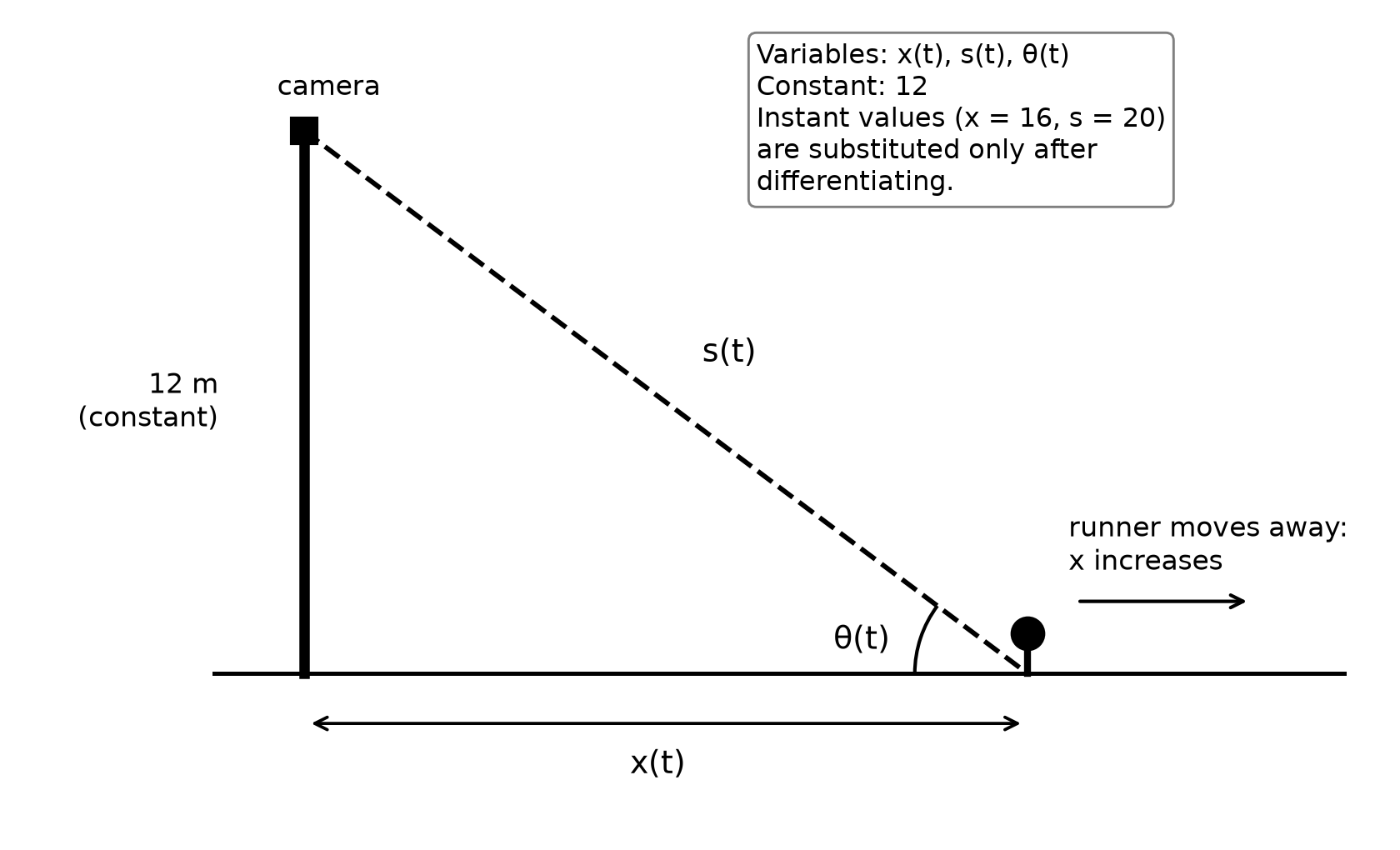
Figure 10.1. The camera problem with its changing quantities named. Only the pole's height is constant.
Solution. Let be the runner's distance from the base and the distance from the camera to the runner. We know and want when . At every instant, the Pythagorean theorem gives
Differentiate with respect to : , so . At the instant, , so
The distance is increasing at 4 meters per second.
Example 10.2: diagnose an early substitution
A student writes , so , and then: "The derivative of 20 is 0, so ."
Diagnosis. Substituting first froze a changing quantity. The equation is true at one instant only, and its derivative says nothing about how changes. That is the trap in the first prediction: substitute first and every derivative becomes 0. The answer also fails a reasonableness check, because a runner moving away must be getting farther from the camera.
Repair. Differentiate the relation that holds for all , , and substitute afterward, as in Example 10.1.
Example 10.3: choose the relation that uses known quantities
In the same setting, let be the angle at the runner between the ground and the line of sight. How fast is changing when ?
Method choice. Three relations connect to Figure 10.1: , and . The tangent relation involves only and , whose rate is given. The sine relation needs , which took a separate computation, and the cosine relation has two other changing quantities. Choose the tangent.
Solution. Differentiate with respect to :
At , , so . Then
The angle is decreasing at 0.15 radian per second, as expected when the runner moves away. As a check, the sine relation gives , so and again.
Common errors. Differentiating as instead of ; giving a shrinking quantity a positive rate; and treating a changing quantity as a constant, as in Example 10.2.
Example 10.4: eliminate a variable before differentiating
Water drains from a conical tank, vertex down, that is 6 meters tall with a top radius of 3 meters. Water leaves at 2 cubic meters per minute. How fast is the water level falling when the water is 4 meters deep?
Solution. The volume, depth and surface radius all change; the 6 and the 3 are constant. The volume formula has two changing dimensions, but similar triangles give , so at every instant. Because that relation holds at every instant, you may substitute it before differentiating:
Differentiate: . At the instant, and , so and . The level is falling at about 0.159 meter per minute.
Compare Example 10.2. Substituting a relation that is true at every instant, such as , is safe. Substituting a value that is true at one instant, such as , is not.
Local linearity
Near a point where is differentiable, the graph of looks almost straight, so its tangent line approximates . The tangent line at the center is
and for near . Always state the center and the estimate. To decide whether the estimate is too high or too low, check concavity on the whole interval between the center and the input.
- If there, the graph is concave up and lies above the tangent line, so is an underestimate. This answers the second prediction.
- If there, the graph is concave down and lies below the tangent line, so is an overestimate.
The sign of plays no part: an increasing function can be overestimated, and a decreasing one underestimated.
Often you are given rather than , as a graph or a table. Read the slope at the center from it, and read concavity from the behavior of : if is increasing between the center and the input, is concave up there; if is decreasing, is concave down. Watch the sign of when the input is to the left of the center.
Example 10.5: an estimate and its direction from a table
A function is twice differentiable, and for . Use the table to estimate and , and decide whether each estimate is too high or too low.
| 4 | 2.5 |
Solution. The center is , so . Then and . Because on both intervals, the graph lies above its tangent line there, and both estimates are underestimates. Concavity, not the side of the center, decides the direction.
Example 10.6: see the error, and where the estimate breaks down
Let . Since and , the tangent line at is , and . Since for , this is an underestimate. In fact (Figure 10.2).
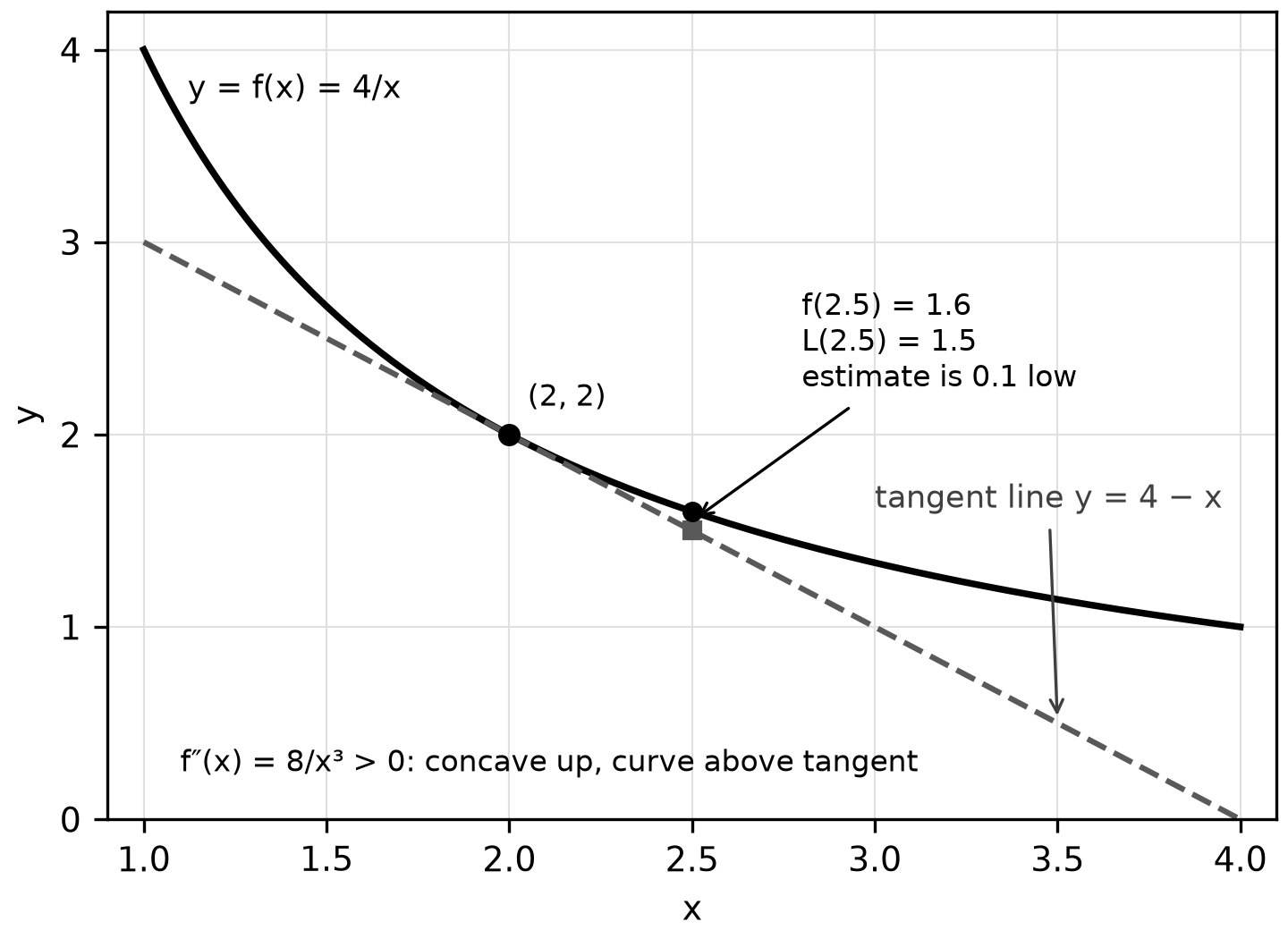
Figure 10.2. A concave-up graph lies above its tangent line, so tangent-line estimates are too low.
Farther from the center, the estimate degrades quickly: , but . A tangent line is a local tool; trust it only near its center.
L'Hospital's rule
Check the form first
L'Hospital's rule (also spelled L'Hôpital) evaluates a limit of a quotient whose numerator and denominator both approach 0, or both approach . Suppose and are differentiable near , except possibly at , that near for , and that has the form or as . If exists, then
The same holds for one-sided limits and for . The course assesses only the forms and .
- Differentiate the numerator and the denominator separately. This is not the quotient rule.
- Write the check, for example " and , so the form is ." On a free-response question, the check is part of the justification.
- If the new limit is again or , check again before applying the rule a second time.
Example 10.7: reject an ineligible limit
Evaluate .
Solution. Check the form first. The numerator approaches 8 and the denominator approaches 4, so this is not an indeterminate form, and the answer to the third prediction is no. The quotient is continuous at 2, so the limit is . Applying the rule anyway gives , which is wrong: the rule's conclusion cannot be used when its hypothesis fails.
Example 10.8: apply the rule and see why it works
Evaluate .
Solution. As , the numerator approaches and the denominator approaches , so the form is . Both functions are differentiable, and the denominator's derivative, , is not 0 near 0. So
Figure 10.3 shows why the rule works. Near 0, each function stays close to its tangent line: the numerator behaves like and the denominator like . Their ratio is close to , the ratio of the derivatives at 0. L'Hospital's rule is local linearity applied to a quotient.
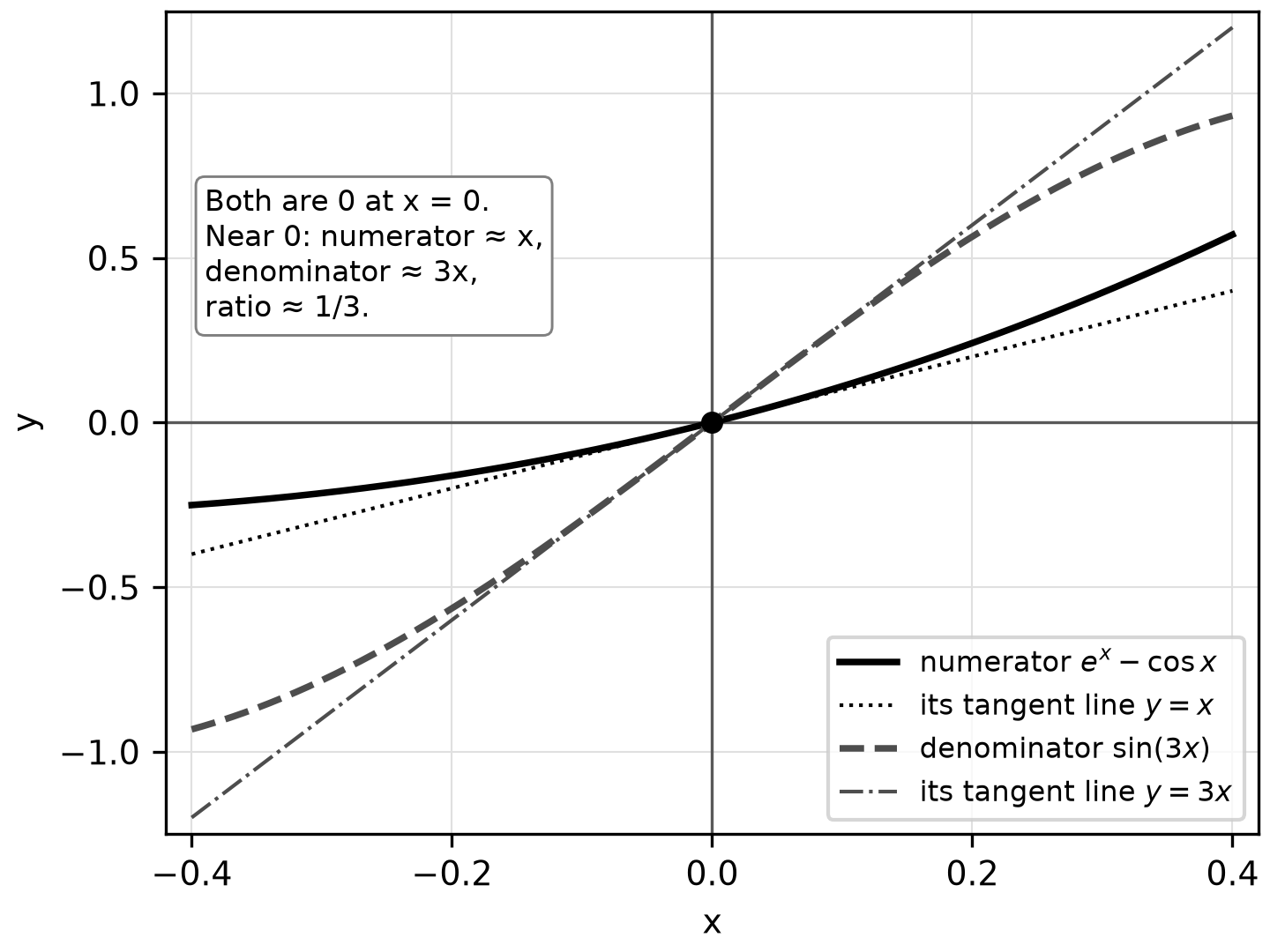
Figure 10.3. Near , each function hugs its tangent line, so their ratio approaches the ratio of the tangent slopes.
When the values come from a table
Suppose , both functions have continuous derivatives, and . The form is , and continuity of the derivatives lets you evaluate the new limit by substitution, so the limit of as is . If instead , the new limit is again ; with continuous second derivatives and , one more application gives . Read only the rows the limit needs, and state each check.
The rule works in one direction only
If the limit of does not exist, the rule says nothing. For example, has the form , but the derivative ratio oscillates between 0 and 2 without a limit. Yet , and , so the original limit is 1. When the rule stalls, use algebra or another method.
Try it
Try it 10.1. A circular ink spot spreads so that its area increases at 6 square centimeters per second. How fast is the radius increasing when the radius is 4 centimeters?
Try it 10.2. Use the tangent line to at to estimate . Is the estimate too high or too low? Explain.
Try it 10.3. For each limit, first decide whether L'Hospital's rule applies, then evaluate. (a) (b) (c)
Try it 10.4. The functions and have continuous derivatives, with , and . Find , and state why the rule applies.
Check your work
10.1. , so . At , , so centimeter per second.
10.2. The center is , where and the slope is . So and . The second derivative of is , so the graph is concave down and lies below its tangent line: is too high. The true value is about .
10.3. (a) The form is . The rule gives , again ; applying it again gives . (b) The quotient approaches , which is not indeterminate, so the rule does not apply; the limit is 1 by substitution. (c) The form is . Two applications give and then , so the limit is 0.
10.4. Both functions are continuous because they are differentiable, so and : the form is . Since and is continuous, near 5. The limit is .
Review and retrieve
- Related rates: name the changing quantities, write a relation true at every instant, differentiate with respect to , and only then substitute.
- Choose the relation whose variables have known rates.
- Tangent-line estimate: state the center and . Concave up between the center and the input gives an underestimate; concave down gives an overestimate.
- L'Hospital's rule: confirm or and the hypotheses before differentiating, and differentiate top and bottom separately.
Retrieve. In two days, without notes, redo Example 10.1 with the runner 9 meters from the base. Check: and meters per second. A week later, list the checks you make before using L'Hospital's rule, and redo Example 10.5 assuming instead.
Practice
Work items APCAL-C10-M01 to APCAL-C10-M17, printed after this chapter's companion panel as Questions 122–138. Do Questions 122–132 without a calculator. Questions 133–138 require a graphing calculator in radian mode; report three decimal places unless a question says otherwise.
Then complete the two written tasks, APCAL-C10-F01 (Written task 12, graphing calculator required) and APCAL-C10-F02 (Written task 13, no calculator), using the two response pages printed for each.
Full solutions, an explanation of every wrong choice, nine-point rubrics and complete sample responses are in Answers, explanations and written responses at the back of the book, under Chapter 10: answers and explanations. Each explanation ends with a Repair and retry line pointing to a section of this chapter.