What to practice
- Match hypotheses, candidates and conclusions in extrema arguments
An argument about a maximum or minimum has three separate jobs. An existence theorem promises that something happens. Critical numbers and endpoints list where it could happen. A test decides what actually happens at each candidate. This chapter keeps the jobs apart, because most lost points come from merging two of them, such as calling every critical number an extremum or invoking a theorem whose conditions were never checked.
Predict first. If , must have a maximum or a minimum at ? Write your answer down; Worked example 11.5 settles it.
What an existence theorem promises
The Mean Value Theorem (topic 5.1)
If is continuous on the closed interval and differentiable on the open interval , then there is at least one number in such that
Somewhere strictly between the endpoints, the instantaneous rate of change equals the average rate of change over the whole interval. In a graph, some tangent line is parallel to the secant line through the endpoints. When , the secant is horizontal and the conclusion becomes ; this special case is called Rolle's Theorem.
The theorem promises existence only. It does not say where is, and several numbers may qualify.
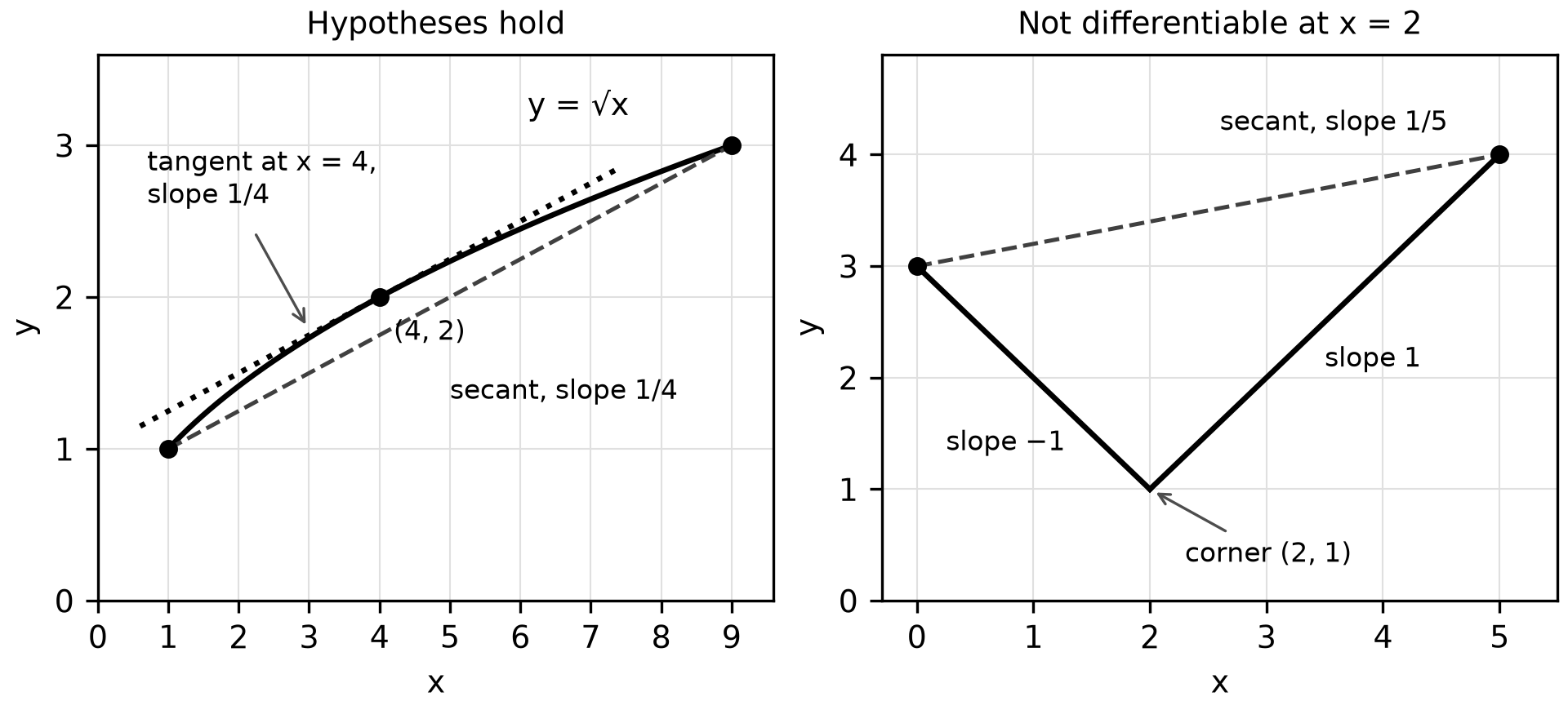
Figure 11.1. Left: the Mean Value Theorem's hypotheses hold, and the tangent at is parallel to the secant. Right: a corner breaks differentiability, and no tangent matches the secant slope.
The right panel is the warning. The function is continuous on but not differentiable at . Its secant slope is , yet every slope of is or . When a hypothesis fails, the theorem makes no promise.
Worked example 11.1: find the promised value. Apply the Mean Value Theorem to on .
- Check the hypotheses first. is continuous for and differentiable for , so it is continuous on and differentiable on .
- Average rate: .
- Solve , so and .
- Check: 4 lies in the open interval . Reject any solution at an endpoint or outside it.
The hypothesis check comes first because without it, the equation in step 3 may have no solution at all.
Worked example 11.2: from a table to a guarantee. A cyclist's odometer reads kilometers hours after 9:00 a.m. Assume is differentiable on .
| (hours) | 0 | 0.5 | 2 |
|---|---|---|---|
| (km) | 0 | 14 | 54 |
Must the cyclist's speed have been exactly 27 km/h at some moment? Translate the table into a rate statement: the average rate over is km/h. Differentiability on gives continuity on and differentiability on , so the Mean Value Theorem guarantees some in with . Because an odometer never decreases, is the speed. So yes, although the table cannot say when. Over the average rate is 28 km/h, which guarantees a moment at 28 km/h in that subinterval, not 27.
Common error. Citing the Intermediate Value Theorem. That theorem concerns values of itself, such as reaching 30 km between and , and needs only continuity. The Mean Value Theorem concerns values of .
The Extreme Value Theorem (topic 5.2)
If is continuous on the closed interval , then has at least one maximum value and at least one minimum value on . This wording follows the Fall 2026 clarification of the course framework. The guarantee is about values, not a unique location: a constant function attains its maximum at every input.
Both conditions matter. On , is continuous, but the interval is not closed and the function grows without bound, so it has no maximum. A jump can also leave a top value unattained. A failed hypothesis does not prove that the conclusion fails, however. A discontinuous function may still attain both extremes; the theorem is simply silent.
Try it 11.1. Decide whether the Mean Value Theorem applies, and whether the Extreme Value Theorem applies. (a) on (b) on (c) on
Solution. (a) Continuous on , so the EVT applies. The vertical tangent at 0 means no derivative there, so the MVT does not. (b) The only problem input, 3, lies outside , so both apply. (c) is undefined at , so neither applies.
Critical numbers are candidates (topic 5.2)
A critical number of is a number in the domain of where or does not exist. Every relative extremum at an interior point occurs at a critical number, but not every critical number is an extremum: has derivative 0 at and keeps increasing through it.
Worked example 11.3: respect the domain. Find the critical numbers of . By the quotient rule,
at and , both in the domain, so both are critical numbers. is undefined at , but so is , so 1 is not a critical number. It still belongs on the sign chart, because can change behavior across a break in its domain.
Increasing, decreasing, and the First Derivative Test (topics 5.3 and 5.4)
If for every in an open interval, is increasing there; if , decreasing. The sign of decides, not whether itself rises. To build a sign chart, mark every critical number and excluded input on a number line, then test one input in each piece.
First Derivative Test. Let be a critical number where is continuous. If changes from positive to negative at , has a relative maximum there; from negative to positive, a relative minimum. If keeps its sign, there is no relative extremum at .
Worked example 11.4: a sign chart with a gap. Continue with .
| Interval | Test input | Sign of | Behavior of |
|---|---|---|---|
| increasing | |||
| decreasing | |||
| decreasing | |||
| increasing |
changes from positive to negative at 0, so is a relative maximum. It changes from negative to positive at 2, so is a relative minimum. Write "decreasing on and on ," not "on ": 1 is not in the domain. Notice that the relative maximum value, 0, is smaller than the relative minimum value, 4. "Relative" compares only nearby inputs.
Worked example 11.5: diagnose an incorrect solution. A student is asked for the relative extrema of and writes: " at and , so has relative extrema at and ."
The zeros are correct candidates; the conclusion skipped the test. Factor: . The factor is positive except at 0, so has the sign of : negative on both sides of 0 and positive for . Repair: " is negative on both sides of , so has no extremum there. changes from negative to positive at , so has a relative minimum at , where ."
Try it 11.2. For , find every critical number, the intervals where increases or decreases, and each relative extremum.
Solution. . Critical numbers: and , where , and , where is undefined but is defined. The denominator is positive for , so on and and on and . Relative maximum ; relative minimum ; no extremum at 0, where stays negative.
Absolute extrema: the Candidates Test (topic 5.5)
For continuous on a closed interval :
- Confirm continuity on , so the Extreme Value Theorem guarantees both extremes exist.
- List the candidates: both endpoints and every critical number in .
- Evaluate , not , at every candidate.
- The largest value is the absolute maximum and the smallest is the absolute minimum. Report each value and every input where it occurs, including ties.
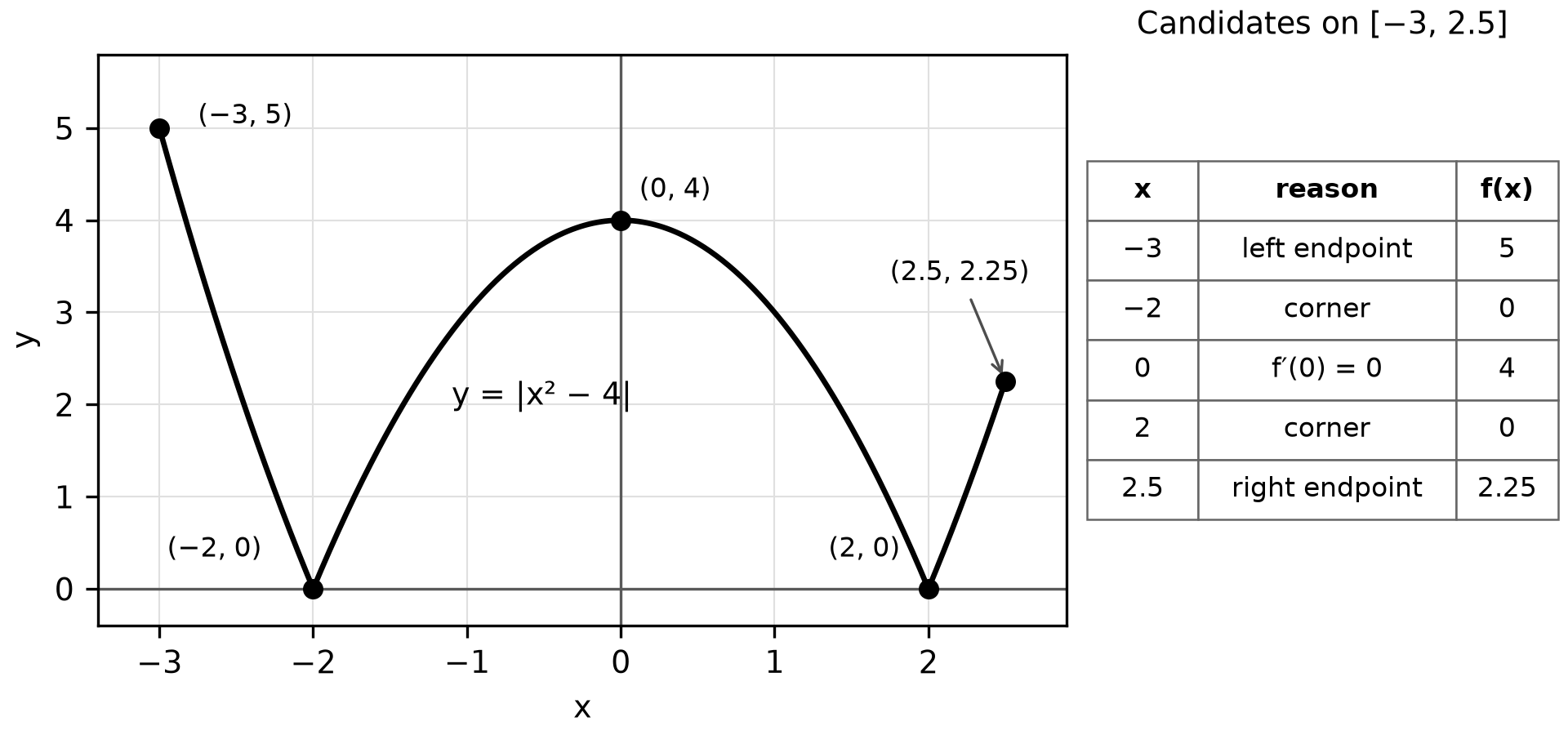
Figure 11.2. Every kind of candidate on : endpoints, corners where does not exist, and a stationary point. The local maximum at loses the global comparison, and the minimum value is a tie.
Read the figure the way the test works. The corners at are candidates because the derivative does not exist there, the peak at because the derivative is 0, and the endpoints because the interval stops there. Only the comparison of function values decides: the maximum, 5, occurs at the endpoint , and the minimum, 0, occurs at two inputs.
Worked example 11.6: choose the method. Find the absolute extrema of (a) on and (b) on .
(a) The interval is closed and is continuous, so use the Candidates Test. , which is 0 only at because . The values are , and . The absolute maximum is at ; the absolute minimum is 0 at .
(b) With no right endpoint, the Candidates Test cannot list every candidate. Use the sign of instead: on and on , so rises to and falls afterward. The absolute maximum is again . Since for and , the absolute minimum is 0 at . A sign argument about a single critical number works on any interval; the Candidates Test needs a closed one.
In calculator-required work, a critical number may come from a numerical solver. Store its full value and still evaluate every endpoint (Chapter 23).
Try it 11.3. Find the absolute maximum and minimum of on .
Solution. at , both inside. Values: , , , . The absolute maximum is 65 at the endpoint ; the absolute minimum is at . The relative maximum at is not absolute.
Write the justification
Name the function and the derivative fact, give the reason, then state the conclusion.
| Incomplete | Complete |
|---|---|
| ", so the maximum is at 3." | " changes from positive to negative at , so has a relative maximum at ." |
| "The graph goes up, then down." | " on and on , so ..." |
| "The MVT gives ." | " is continuous on and differentiable on , so by the MVT some in has ; ." |
| "The largest critical value is the maximum." | " is continuous on ; comparing at both endpoints and every critical number, the largest value is ..." |
Practice
This chapter's bank items are APCAL-C11-M01 to APCAL-C11-M15, printed after the companion panel as Questions 139–153, and the nine-point written tasks APCAL-C11-F01 and APCAL-C11-F02, printed as Written tasks 14 and 15. Questions 150–153 and Written task 15 require a graphing calculator in radian mode; the rest are without a calculator. Answers, the error behind each wrong choice, rubrics and complete responses are in Answers, explanations and written responses, under Chapter 11: answers and explanations.
For retrieval, wait two days. Then, without notes, write the hypotheses of both theorems and redo Worked example 11.5 from its prompt. About a week later, rework Try it 11.3 on instead; the answer changes to a maximum of 16 at and a minimum of at the endpoint .