What to practice
- Define feasible domains and justify an optimal or implicit-function conclusion
Chapters 11 and 12 found and classified extrema of functions that were given to you. This chapter adds two tasks where you supply more of the setup. In an applied problem you build the function and its domain before any calculus starts (topics 5.10 and 5.11). For a curve given by an equation in and , you locate horizontal and vertical tangents and read a second derivative that contains (topic 5.12). In both settings the derivative produces candidates. The conclusion still needs a reason that covers every allowed input.
Predict first. An open box is folded from a 48 cm by 30 cm sheet after equal squares are cut from its corners. Is the best cut nearer 1 cm, 6 cm or 12 cm? Keep your guess for Worked example 13.1.
Build the model before you differentiate (topic 5.10)
Applied optimization fails more often in the setup than in the derivative. Work in this order.
- Name the quantity to optimize and the variable you control, with units.
- Write the quantity as a function of one variable, using the constraint to remove any other variable.
- State the feasible domain: the inputs that describe a real object or situation.
- Find the critical numbers inside that domain and justify the absolute extremum on the whole domain.
- Answer the question asked, in context and with units.
Worked example 13.1: an open box from a sheet
A box with no lid is made from a 48 cm by 30 cm sheet by cutting a square of side cm from each corner and folding up the sides. Find the cut that gives the greatest volume.
The base measures by and the height is , so
Every length must be positive, so the feasible domain is ; the short side limits the cut. Differentiate and factor: . The critical number lies outside the domain. It belongs to the formula, not to any box, so discard it. On the factor is negative, so has the sign of : positive on and negative on . increases up to 6 and decreases afterward, so is the absolute maximum on the feasible domain. Cut 6 cm squares. The box measures 36 cm by 18 cm by 6 cm and holds 3888 cubic centimeters.
Figure 13.1 shows the problem in two representations. The sheet explains where each factor of the formula comes from. The graph shows why the domain matters: the formula keeps producing values past , including at the rejected critical number, but no box exists there.
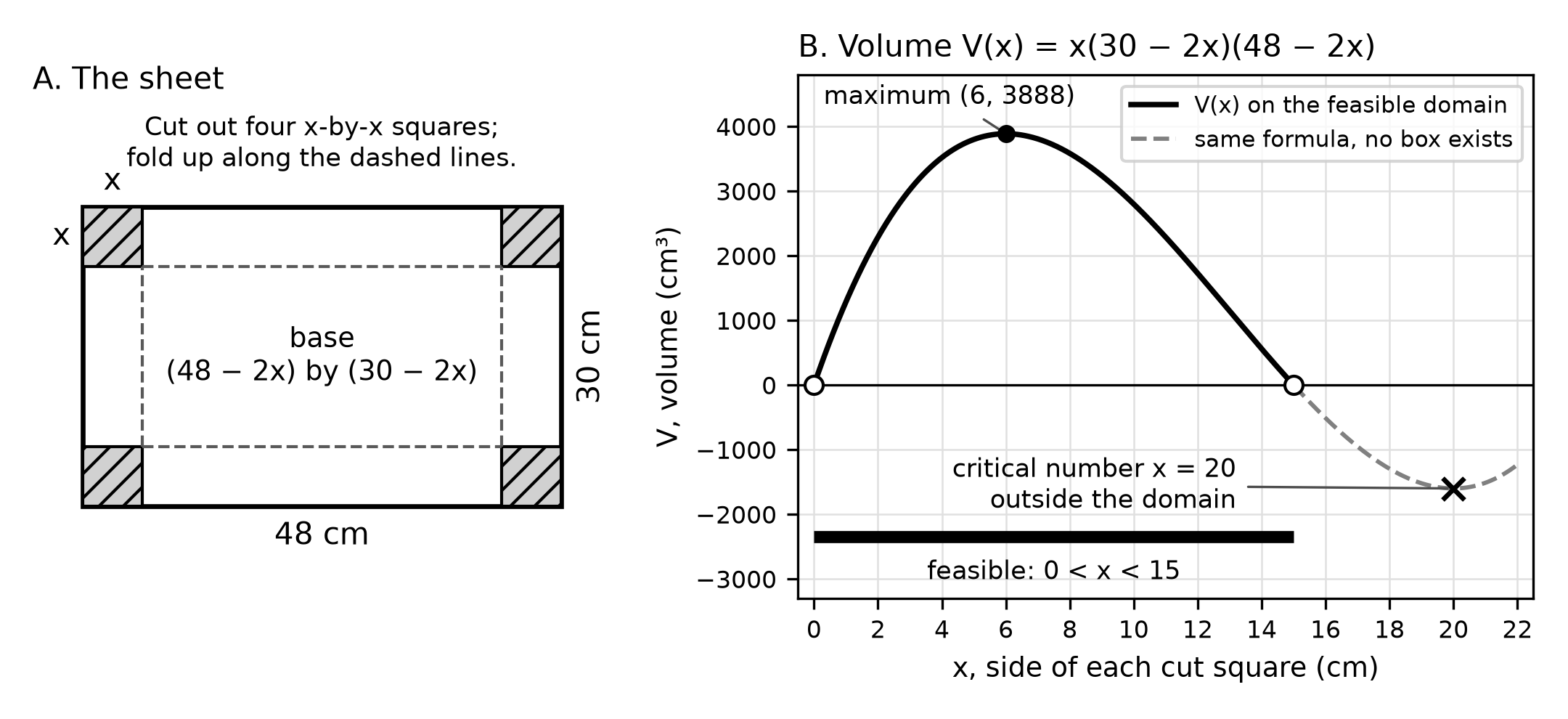
Figure 13.1. Build the formula from the picture, then keep only the inputs that describe a real box.
Justify a global answer on the feasible domain (topic 5.11)
A critical number is a candidate, not an answer. The exam asks for an absolute extremum, and the justification must cover every feasible input. Choose one of two arguments.
- Closed interval: the Candidates Test. If the function is continuous on , the Extreme Value Theorem guarantees at least one maximum value and at least one minimum value, as stated in the Fall 2026 clarification of the course framework. Compare the function's values at both endpoints and at every critical number inside (Chapter 11).
- Any interval: a sign argument. If the derivative is positive to the left of and negative to the right of throughout the domain, the function rises to and falls after it, so gives the absolute maximum. This works on open and unbounded domains, where the Candidates Test has no endpoints to check.
Two shortcuts fail. "" alone does not show a maximum. Checking two nearby inputs only shows a local comparison.
Worked example 13.2: minimize the square of a distance
Find the point on the curve closest to .
Method choice. A point on the curve is with . Its distance to is . Because the square root is increasing, and are smallest at the same input. Minimize to avoid differentiating a root.
, which is 0 at . The domain has no right endpoint, so use the sign argument: on and on . So is least at , where . The closest point is and the least distance is . The endpoint gives , a distance of 5, which agrees. Report , not , when the question asks for a distance.
Worked example 13.3: when the critical number is not allowed
A theater has 300 seats. At a ticket price of dollars, people want tickets, for . Find the price that maximizes ticket revenue.
Treat as revenue and solve to get . At that price 450 people want seats, but only 300 exist. The model has to respect the seat limit. When , that is , the show sells out and revenue is , which increases with . So the best price is at least 20 dollars. On , , so decreases. The maximum is at : revenue dollars, with every seat sold. The unconstrained critical number answered a question about a larger theater.
Find where an implicit curve is horizontal or vertical (topic 5.12)
Chapter 7 differentiated implicitly: differentiate both sides with respect to , treat as a function of , and solve for . Write the result as a fraction in and . Then:
- Horizontal tangent: and at a point on the curve.
- Vertical tangent: and at a point on the curve.
- Both zero: decides nothing. Examine the curve near the point.
Every candidate must satisfy the original equation. Setting gives a relation between and ; substitute it into the curve's equation to find actual points.
Worked example 13.4: tangents on a tilted ellipse
For , differentiate: , so
Horizontal: . Substitute into the curve: , so . The points are and , where the denominator is . Vertical: . Substitute: , so . The points are and , where the numerator is . Figure 13.2A shows all four.
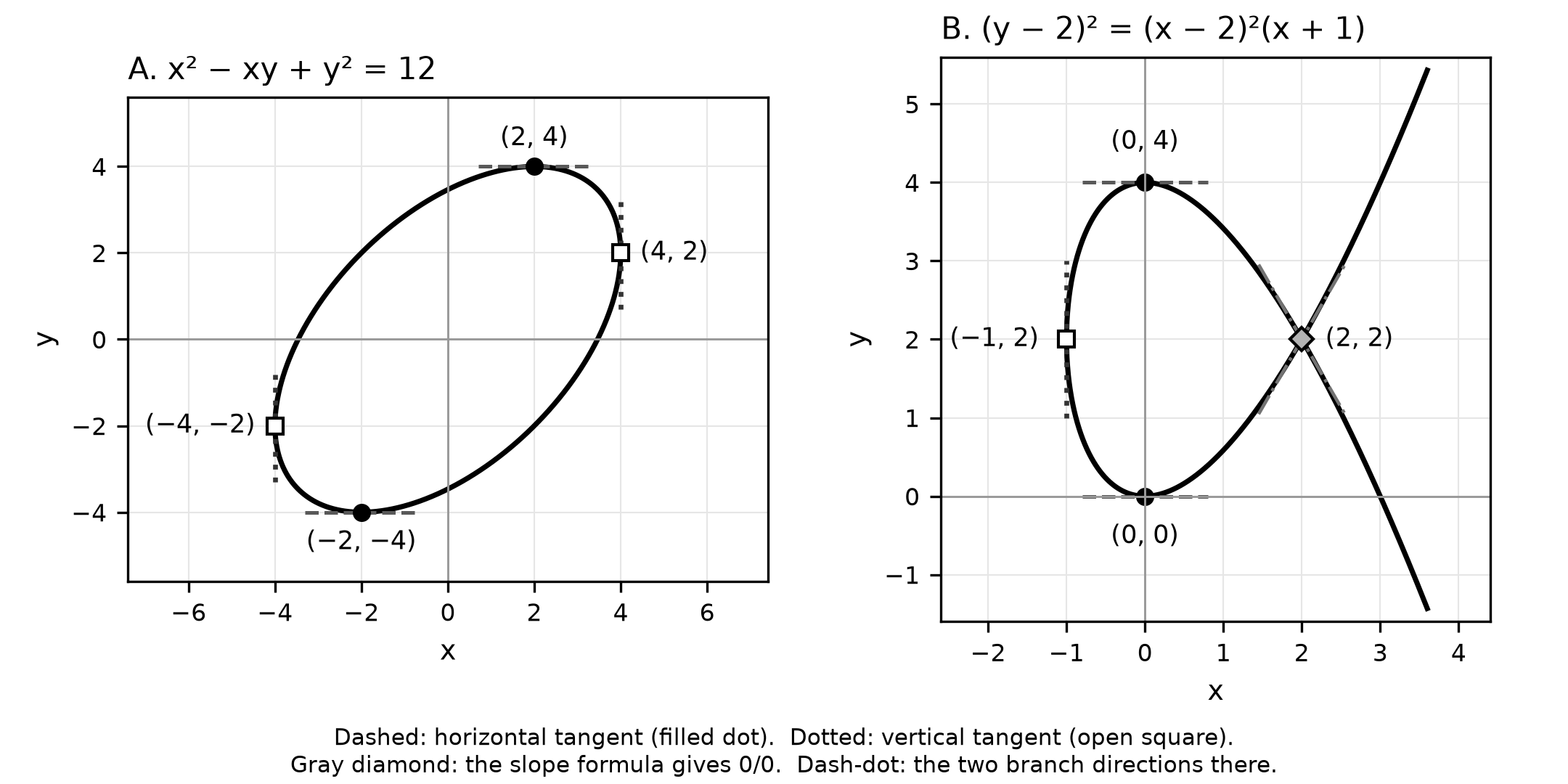
Figure 13.2. Horizontal and vertical tangents on two implicit curves. At the gray diamond the slope formula reads 0/0, and the curve has two directions.
Worked example 13.5: diagnose a tangent-point solution
A student analyzes and writes:
", so . Horizontal tangents occur where , at and . At , or ; at , . So the horizontal tangents are at , and ."
The derivative is correct, and and are correct: the denominator there is or . The error is , where the denominator is also 0. The formula gives , which fails the condition . Rewriting the curve shows what happens there. Adding 4 to both sides gives , so near the curve is two branches, . The branches cross at with slopes and , as the gray diamond in Figure 13.2B shows. Neither is horizontal.
Repair: "Horizontal tangents occur at and , where the numerator is 0 and the denominator is not. At both are 0, so the derivative gives no conclusion." The same check finds the vertical tangent. when , and then . At the numerator is , so the tangent there is vertical.
Decide local behavior with the second derivative
For an implicit curve, comes from differentiating implicitly again. The result contains , and . Substitute the point and the slope there before you simplify.
Worked example 13.6: a high point on the ellipse
Classify the point on . Apply the quotient rule to :
At , , so the numerator is and . The slope is 0 and the curve bends down, so near the curve, viewed as a function of , has a relative maximum. This is the Second Derivative Test from Chapter 12, applied to one branch of the curve.
A global claim needs more. The ellipse is bounded, so it has a highest point, and the slope there must be 0 because the tangent cannot be vertical. Its horizontal tangents are only at and , so is the greatest -value on the curve.
Try it
Try it 13.1. A rectangle has its base on the -axis and its upper corners on . Find the greatest possible area and justify that it is the absolute maximum.
Solution. With upper corners at , on . is 0 at , positive on and negative on . The absolute maximum is square units, from a rectangle 4 wide and 8 tall.
Try it 13.2. A pen is built against a barn wall 30 m long, using the wall for one side and 100 m of fence for the other three. Maximize the area.
Solution. With the side perpendicular to the wall, the side along the wall is , and . at , but then the wall side would be 50 m. The wall forces , so , and there . The maximum is square meters, using the whole wall.
Try it 13.3. For , find every point with a horizontal tangent.
Solution. , so . At , has no real solution. At , gives , where . The points are and .
Check your work
- Did you state the feasible domain before differentiating, and reject critical numbers outside it?
- Does the justification cover the whole domain: a Candidates Test on a closed interval, or a sign argument?
- For an implicit curve, does each claimed point satisfy the original equation, with the other part of the fraction nonzero?
- Did you answer the question asked: a location, a value or a distance, with units?
Practice
This chapter's bank items are APCAL-C13-M01 to APCAL-C13-M13, printed after the companion panel as Questions 169–181, and the nine-point written task APCAL-C13-F01, printed as Written task 18. Questions 169–177 and Written task 18 are no-calculator work. Questions 178–181 require a graphing calculator in radian mode; give decimals to the nearest thousandth. Answers, the error behind each wrong choice, the rubric and a complete response are in Answers, explanations and written responses, under Chapter 13: answers and explanations.
Review and retrieve
Wait two days. Then, without notes, write the five setup steps and redo Worked example 13.4 from its equation. About a week later, mix this chapter with Chapter 12: for , find the horizontal tangents and classify the upper one with the second derivative. Check: horizontal tangents at and , and at , a relative maximum.