What to practice
- Distinguish definite-integral values, antiderivative families and FTC reasoning
Chapter 14 built the definite integral as a limit of rate-times-width sums and showed that an accumulation function grows at the rate of its integrand. This chapter turns that connection into exact evaluation. Three objects look alike on the page, so name the one a question wants before you compute.
| Object | Example | What it is |
|---|---|---|
| Definite integral | One number: 8 | |
| Antiderivative | One function whose derivative is | |
| Indefinite integral | The whole family of antiderivatives |
A number never carries . A family always does. A single antiderivative needs one more fact, such as a known value.
Use the properties of definite integrals (topic 6.6)
For a continuous function on the intervals involved:
- Zero width: .
- Reversal: . Running the interval backward makes every width negative.
- Additivity: , whatever the order of , and .
- Constants and sums: .
- Geometry: when and the graph forms known shapes, the integral is signed area. Regions above the axis count as positive; regions below count as negative.
No property splits a product: is generally not the product of two integrals. A constant integrates to , its height times the width.
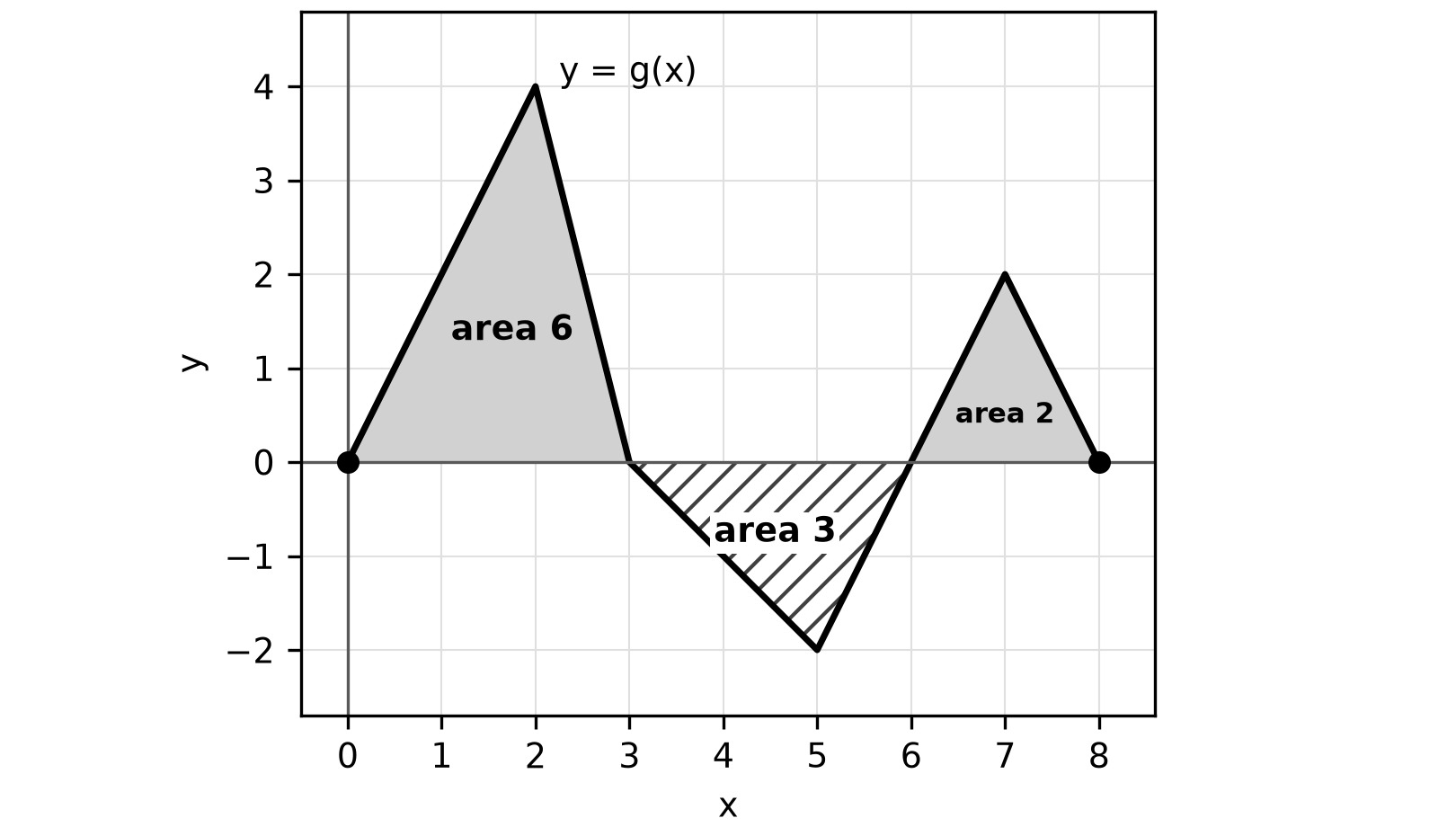
Figure 15.1. Signed regions between the graph of g and the x-axis.
Worked example 15.1: from a graph to numbers
Use Figure 15.1 to find (a) , (b) , (c) and (d) the total area between the graph and the axis on .
Solution. First translate each region into a signed number: , and . Every answer is then arithmetic.
(a) .
(b) Forward, . Reversing the bounds gives .
(c) . The constant 1 contributes its width, 6.
(d) Area ignores sign: . A definite integral and an area answer different questions.
Check. The interval from 3 to 8 holds more area below the axis than above it, so the forward integral must be negative and the reversed one positive, as found.
Worked example 15.2: properties from given values
Suppose , and . Find .
Solution. Additivity gives . Work on the forward interval: . Reverse once, at the end: .
Check. Applying the reversal as the final single step guarantees that both terms change sign, not just one.
Worked example 15.3: a jump discontinuity
Let for and for . Find .
Solution. The function jumps at , yet the integral exists: split where the formula changes. On the graph and the axis form a trapezoid with heights 1 and 3, area . On the rectangle has area 3. The total is 7. One value, , sits over zero width, so it cannot change an integral. Definite integrals extend in this way to functions with jump or removable discontinuities (CED topic 6.6).
Check. By antiderivatives, , matching the trapezoid.
Common errors. Counting area below the axis as positive; reversing the bounds on one term only; integrating a constant as itself instead of constant times width.
Try it 15.1. Use Figure 15.1. (a) Find . (b) Find . (c) Which is larger, or ? Explain.
Answers. (a) . (b) . (c) exceeds , because the region on lies above the axis and adds 2.
Evaluate with the Fundamental Theorem of Calculus (topic 6.7)
An antiderivative of is a function with . Chapter 14 showed that is one whenever is continuous. Comparing with any other antiderivative turns that fact into an evaluation rule.
Fundamental Theorem of Calculus (evaluation form). If is continuous on and is any antiderivative of on that interval, then
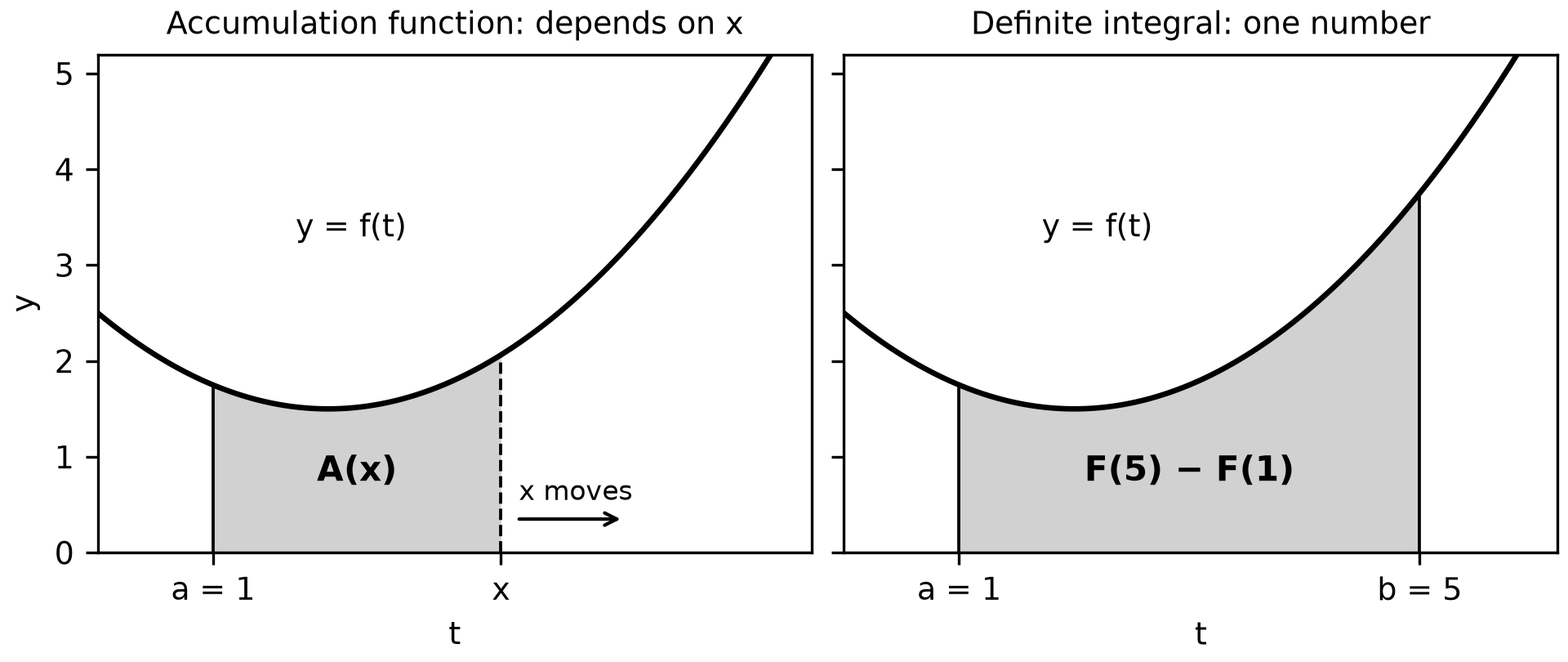
Figure 15.2. A moving upper limit gives a function; fixed limits give one number.
Why it works. and are both antiderivatives of on , so they differ by a constant: . Then , and because it covers zero width. What remains is , which is the integral.
Any antiderivative works, because an added constant cancels in the subtraction. Write for : upper value minus lower value. Swapping the order gives the negative, which matches the reversal property. The letter in Figure 15.2 is a dummy variable; the answer depends only on the limits. The theorem also has a hypothesis: must be continuous on the whole closed interval.
Worked example 15.4: rewrite, evaluate, check
Evaluate .
Solution. Rewrite as , whose antiderivative is . So , and .
Check. Differentiate: , the integrand. For size, the integrand rises from to across a width of 1, so 12 is plausible.
Worked example 15.5: choose the method
(a) . No basic antiderivative fits, but the graph is the upper half of a circle of radius 3. Geometry gives .
(b) . An antiderivative would need two formulas. Geometry is faster: triangles of area on and 2 on , total . FTC agrees only after splitting at 1: .
(c) has no antiderivative built from familiar functions. In a calculator section, evaluate it numerically: about 0.882.
The rule behind the choices. Use geometry when the graph is made of known shapes, an antiderivative when one is available, and a numerical integral when neither applies and a calculator is allowed.
Worked example 15.6: diagnose two incorrect solutions
A student writes . Since on , a negative answer is impossible. The error is the antiderivative: the derivative of is . With , the value is .
A second student writes . The antiderivative is right, but the hypothesis fails: is undefined at , inside the interval. A positive integrand cannot produce 0. The theorem does not apply. AB questions do not ask you to evaluate such integrals; your job is to notice that the theorem's condition is not met.
Worked example 15.7: starting value plus accumulated change
Rearranged, the theorem says . It also runs backward: .
Calculator active. A function has and . Find .
Solution. .
Check. for , so increases and must be less than 12.
Find antiderivatives and indefinite integrals (topic 6.8)
The notation means that and is any constant. On an interval, every antiderivative has this form, because two functions with equal derivatives differ by a constant (a consequence of the Mean Value Theorem, Chapter 11). Each derivative rule, read backward, is an antiderivative rule.
| Integrand | Antiderivative family | Condition |
|---|---|---|
| an interval without 0 | ||
| ; | ; | |
| ; | ; | |
Constants factor out and sums split. Products and quotients do not: rewrite them as sums of powers first, or use Chapter 16's methods. Some functions, such as , have no antiderivative that can be written with familiar functions, yet they still have antiderivatives: is one.
Worked example 15.8: choose one member of the family
Suppose and . Find .
Solution. Antidifferentiate: . Apply the condition: , so and .
Check. and . The same function is .
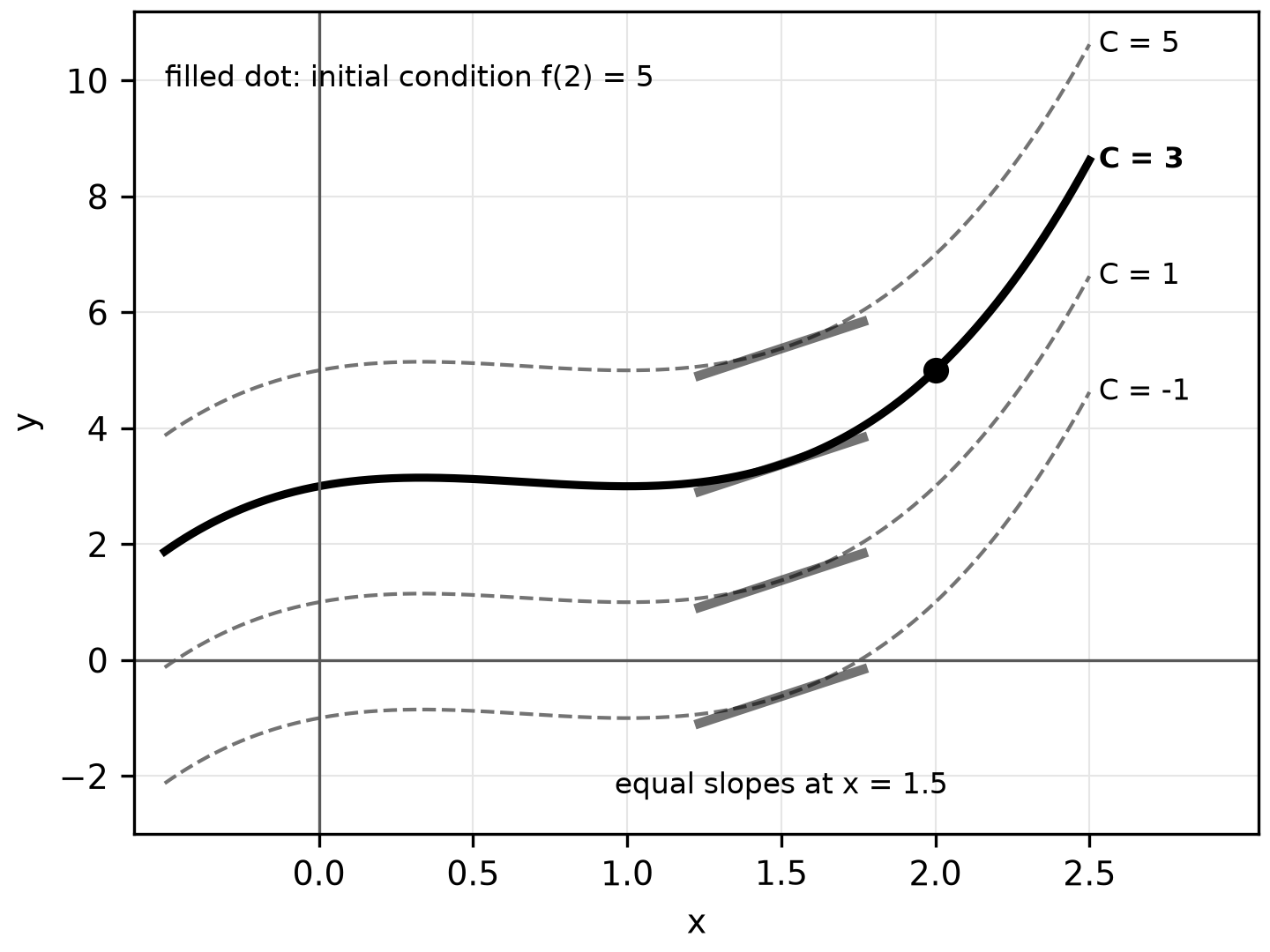
Figure 15.3. Antiderivatives differ by vertical shifts; one condition selects one curve.
Worked example 15.9: diagnose an antiderivative
A student writes . Differentiate the answer: , twice the integrand. Factor the constant first: , so the family is .
Another student writes , integrating the top and bottom separately. Divide first: , so the family is .
Try it 15.2. (a) Find . (b) Evaluate . (c) If and , find . (d) Is a correct evaluation?
Answers. (a) . (b) . (c) , so . (d) No: is not continuous on , so the theorem does not apply.
Choose and check: a routine
- Name the object: number, single function or family.
- Check the hypothesis: is the integrand continuous on the closed interval, and where does its formula change?
- Choose a route: geometry, a property, an antiderivative or, with a calculator, a numerical integral.
- Predict the sign and rough size, then compare.
- Differentiate any antiderivative you write.
Retrieval. Tomorrow, without notes, list the five properties and the basic table. In a week, redo Worked examples 15.6 and 15.9 from their statements alone and explain each error in one sentence.
Practice
Chapter 15's practice is items APCAL-C15-M01 to APCAL-C15-M14 and the written tasks APCAL-C15-F01 and APCAL-C15-F02, printed after this chapter's companion panel as Questions 198–211 and Written tasks 21–22. Questions 198–208 and Written task 22 are no-calculator work. Questions 209–211 and Written task 21 require a graphing calculator in radian mode; give decimals to the nearest thousandth. Answers, the error behind each wrong choice, rubrics and complete responses are in Answers, explanations and written responses, under Chapter 15: answers and explanations.